


Assuming your PHP is up to date, the biggest Canadian tech news this week was new details on the federal government’s $1.75-billion VCAP VCCI Venture and Growth Capital Plan.
Ignoring the feds’ confusing commitment to revising naming conventions, the plan consists of two main components: $1 billion for Growth VCCI, the fourth such federal fund-of-funds investing program, with earmarks for life sciences ($200 million) and emerging manager-led ($100 million) VC firms; and the new $750-million Early and Growth Stage Investment Strategy, with the majority going to support tech firms at the Series B-plus stage, and a nominal $75 million for pre-seed and seed startups. In total, the feds hope to attract at least $3.8 billion in additional private capital.
BetaKit has extensive coverage of the new plan details, as well as initial reactions to the feds’ “spread-the-peanut-butter strategy.” Response so far has been generally positive, with concerns mostly focused on limited early-stage support and speed of deployment.
I’ll focus today on speed. The $1-billion Growth VCCI commitment was initially announced in 2024, and based on historicals, it might take another 12 to 18 months for capital to reach fund managers (longer for it to reach Canadian startups). The additional $750 million commitment was announced in Budget 2025—one year later, the feds are still working out how the capital will be administered. This is not the speed Canada’s anemic VC ecosystem needs to get back to a healthy capital deployment weight.
Putting aside the federal government’s lack of celerity, some of the culpability likely falls to the plan’s administrator, BDC. Which is also responsible for deploying a $6-billion defence platform. In addition to already being Canada’s most-active direct and indirect venture capital investor. Responsibility for so much capital, across so many touchpoints, must be an incredible logistical burden.
It’s also likely a bottleneck. BetaKit exclusively revealed earlier this year that VCs have (privately) griped since 2023 about the difficulties in navigating an organization that is both your LP investor (or LP’s investor) and deal competitor. BDC’s role in Canadian tech has only grown since then.
Carney’s Liberals have made significant capital commitments to Canadian tech; more may come in Budget 2026. It’s worth asking how effectively the peanut butter can be spread if one Crown corporation is always holding the knife.
Douglas Soltys,
Editor-in-Chief

One place for every payment your business makes.
More than 10,000 Canadian businesses use Float to issue CAD and USD corporate cards, pay bills and send money in 21 currencies, with no bank portal or second login. EFT, ACH and SEPA payments are free, and eligible bills paid by Float card earn up to 1% cashback on card spend over $25K a month.
Float Intelligence reads the GST, HST, PST and QST split off every invoice, helping finance teams close their books up to 8x faster.
Top stories from BetaKit
Full-stack seniors’ home
Many seniors are eventually forced to confront the fact that their desire to remain independent and their advancing age are at odds. BetaKit visited Calgary-based Garden Loft, which is a full-stack alternative to assisted living facilities that allows seniors to live how they choose while receiving tech-enabled monitoring and care.
1Password’s road to $1 billion
Toronto-based cybersecurity software company 1Password announced that it crossed $500 million USD in annual recurring revenue this week amid rising demand for its AI security tools. CEO David Faugno told BetaKit that he sees an achievable path to hitting $1 billion USD in ARR over the next several years.
East-coast advantage
St. John’s may be an unlikely tech hub, but rapidly scaling startups like CoLab Software are building its reputation. BetaKit sat down with CoLab chief strategy officer Taylor Young to learn more about the business’ journey and the Newfoundland advantage.
Rocket plan
Longueuil, Que.-based rocket maker Reaction Dynamics revealed a five-year plan to raise $350 million CAD, dramatically increase its manufacturing footprint, and add nearly 300 employees. The rapid expansion is in service of developing and launching a new medium-lift rocket by 2031.
Legendary studio shuts down
Electronic Arts shut down BioWare this week after several years of turbulence for both companies. The Edmonton-based game development studio had defined the role-playing genre since 1995, creating titles like Baldur’s Gate, Mass Effect, and Dragon Age.
Sponsored stories
Cybersecurity has a builder problem and a buyer problem. Rogers Cybersecure Catalyst is working on both.
Rogers Cybersecure Catalyst launched two initiatives, the Cyber Challenge for startups and Cyber Integration for Businesses for SMEs, to bridge the gap between cybersecurity creators validating their products and smaller companies seeking tailored security guidance.
This program is pushing startups to plan for security sooner
Rogers Cybersecure Catalyst’s no-cost “Cyber for Startups” program provides early-stage Canadian tech startups with coaching, assessments, and roadmaps to integrate security directly into their products and business models from the start.

Scale your finance operations without increasing headcount.
Join BetaKit and Ramp on Tuesday, October 27th at 12:00 PM ET for an exclusive session with Dave Wieseneck, Expert in Residence at Ramp.
Discover how to:
- Identify key operational bottlenecks
- Safely test practical AI automation across expenses and reporting workflows
- Reduce manual friction while retaining essential human judgment.
Deals, dollars, drops
Who’s cashing in, or out, this week:
- Last-mile delivery company UniUni’s go-public deal fell through after the SPAC terminated the agreement. (Richmond/Toronto)
- Neo Financial closed a $185-million credit facility from ATB Financial and other credit unions to grow its credit card program. (Calgary)
- PataBid secured $2 million to commercialize its AI-powered construction estimating tool. (Calgary)
- Inspection platform ConeLabs was acquired by US-based engineering firm Consor. (Kitchener-Waterloo)
- Quantum computing firm Xanadu was approved for up to $10 million more in DARPA funding. (Toronto)
- Mecka AI acquired popular social mobile app Thirdspace to scale its home data capture efforts. (Toronto/Ottawa)
- Shopify co-led a $200-million Series D investment in US-based online commerce competitor Whop. (Ottawa)
- Inovia Capital secured a $200-million USD first close for its sixth early-stage VC fund. (Montréal)
- Anthropic signed on to build its first Canadian data centre with EverWind’s $10-billion project. (Point Tupper)
- The Canadian military signed a $20-million contract for access to NordSpace’s Atlantic Spaceport Complex. (Markham/St. John’s)
Data point
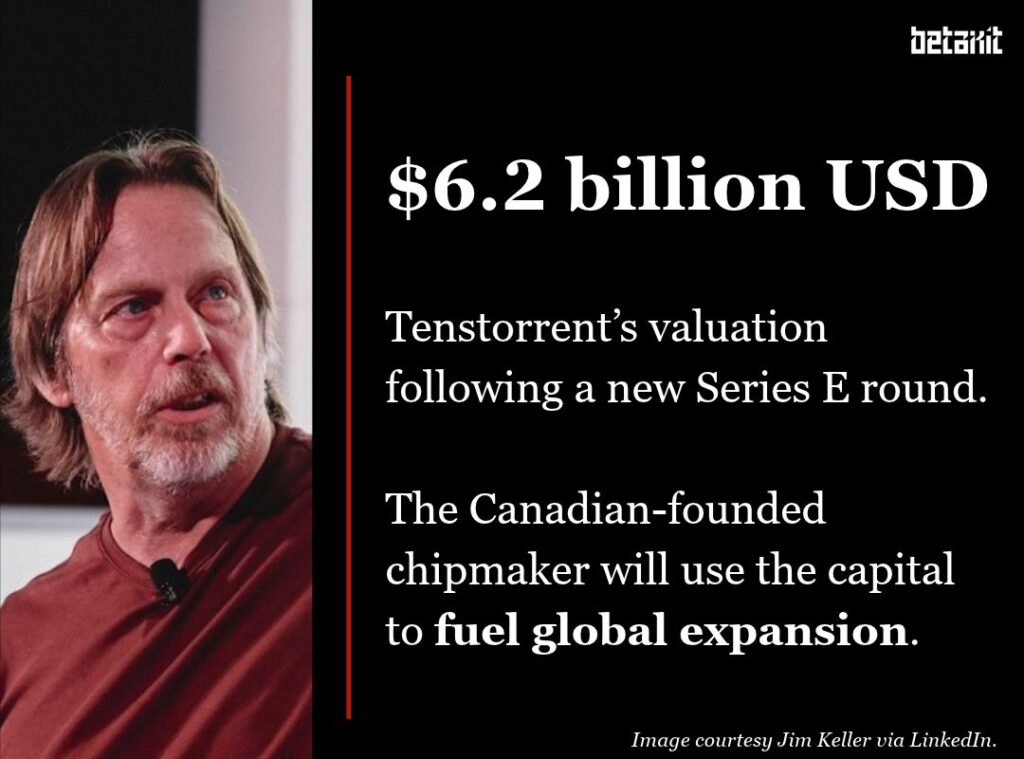
Read more on BetaKit.
The refresh

Some final words on Foursquare
One month after location data firm Foursquare’s acquisition, co-founder Dennis Crowley wrote a thoughtful Substack post reflecting on his role in the company’s 17-year journey, how the exit resulted in a zero-dollar return for equity holders, and his final advice to founders.

BetaKit Podcast · Oct 19
“The United States economy definitely has a cold right now. And when the US sneezes, the whole world catches a cold.”
Economic commentator and New York Times bestselling author Kyla Scanlon joins to discuss the concerning connection between debt and the AI data centre buildout, how AI companies drive the US economy with impunity, and the impacts of AI adoption on the labour market. Watch and listen now ›
Contributors: Alex Riehl (Ottawa staff writer), Trevor Nichols (web editor), Sarah Rieger (managing editor), Douglas Soltys (editor in chief).
Feature image courtesy Mélanie Joly via LinkedIn.