

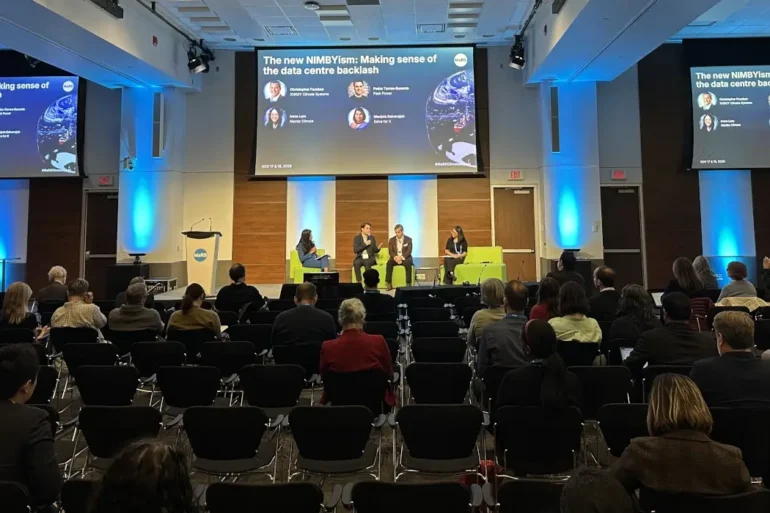
Communities should ensure innovation is baked into the data centre development process from the get-go, argues Christopher Fazekas, vice-chair of Xnrgy Climate Systems’ board.
“Data centres aren’t going anywhere, but they can be better, so we should make them better, together,” Fazekas said on stage Tuesday morning in Toronto at the MaRS Climate Impact conference. Fazekas spoke during a panel focused on the ongoing public backlash toward data centres, which was reflected in the results of the recent US midterm elections that saw voters broadly reject measures that would have supported development.
“Data centres aren’t going anywhere, but they can be better, so we should make them better, together.”
Christopher Fazekas, Xnrgy Climate Systems
Angus Reid Institute polling shows more than two-thirds of Canadians would oppose having a large AI data centre built near their homes, as many communities have become increasingly concerned about the environmental impact of these facilities, from the water and electricity they consume to the air and noise pollution they create, and where the economic benefits flow. The industry is already feeling the effects: a lack of local support reportedly just drove Telus to pull out of two planned projects in Vancouver.
Arizona-based Xnrgy builds custom air handling solutions designed to help make data centres more sustainable. While Fazekas views the construction of these facilities as inevitable, he acknowledged that the broader data centre industry has thus far “done a terrible job of representing itself” and the value these types of sites could bring to communities. Fazekas and his colleagues believe that the path forward entails more than just building parks and schools.
Fellow panellist Irene Lam, director of client services at Toronto’s Mantle Climate, thinks there is a happy medium between opposing all data centre construction and simply accepting the AI infrastructure buildout on industry’s terms. Her employer is a strategy and risk management consultancy that has engaged the ecosystem on this exact topic.
“We don’t have to unconditionally accept [data centres], but we do need to consider some of the trade-offs that need to be made,” Lam said.
Lam argued that successful projects will require carefully planning these sites around energy system capacity, as well as ensuring communities have input in this process and any decisions that might impact their future.
RELATED: Telus pulls out of two government-backed AI data centres in Vancouver
“We are going to need some of this infrastructure built, regardless,” said Lam. “But the question really is, how do we do this in a Canadian way? How do we build more innovatively, sustainably, and responsibly?”
Lam has already seen a few ways that cities and towns can achieve this, including by ensuring that data centre developers engage with communities early on, establishing clear expectations, and holding these firms accountable through reporting requirements, deadlines, and penalties for non-compliance.
Fazekas echoed this sentiment, arguing that municipalities ought to set a few key ground rules for prospective new builds up front, including eliminating the use of water and evaporative cooling altogether, tackling noise pollution, and requiring sites to generate lasting local employment, such as by setting up corporate campuses nearby, rather than simply exporting processing power.
At the moment, Fazekas said “the only force for innovation … is coming from the industry itself” as it seeks to increase capacity to meet surging AI demand. He thinks greater pressure from communities could accelerate the pace of data centre innovation because more of these facilities are likely to be built, either way.
“The middle ground is an open conversation that demands innovation and demands progress, but also accepts the fact that this is part of industrialization and the new revolution of technology,” Fazekas said.
Feature image courtesy Josh Scott for BetaKit.