

Canadian-founded, United States (US)-based AI infrastructure company Tenstorrent announced today that it has closed $1.5 billion USD ($2.1 billion CAD) in Series E funding to fuel its global expansion plans.
The equity round, which was led by new US investors Trace Capital and Innovation X, gives Tenstorrent a post-money valuation of $6.2 billion USD (almost $8.8 billion CAD), more than twice the $2.6 billion USD mark that Tenstorrent was valued at when the company closed its nearly $700-million USD Series D in late 2024. Since then, Tenstorrent has begun shipping its Galaxy servers commercially.
“The future of compute is open, scalable, and owned by the people building on it.”
Jim Keller, Tenstorrent
Tenstorrent plans to use this capital to fund volume manufacturing of those Galaxy servers, the development of next-generation hardware and intellectual property (IP), and hiring, as it looks to compete with Nvidia and other established AI chipmakers and challenge traditional graphics processing unit (GPU) dominance in AI with an open-source approach it claims is cheaper, more scalable, and easier to customize.
“We built one architecture and sell it at every size,” Tenstorrent CEO Jim Keller said in a statement. “The future of compute is open, scalable, and owned by the people building on it.”
A Tenstorrent spokesperson told BetaKit over email that Canadian investors also participated in the round, but declined to share specific names. Tenstorrent’s existing Canadian backers include Export Development Canada, Georgian, the Healthcare of Ontario Pension Plan, and Real Ventures.
The Tenstorrent spokesperson also declined to share any more details regarding the structure of its Series E, including whether it involved any secondary capital, or disclose Tenstorrent’s total funding to date.
RELATED: US chip giant AMD to acquire Taalas
Founded in 2016 in Toronto by former AMD employees Ljubisa Bajic (who went on to build Taalas, which AMD recently agreed to acquire), Ivan Hamer, and Milos Trajkovic, Tenstorrent is developing what the company describes as “a general-purpose AI platform” for running large language models, video models, and image models.
The firm builds and sells AI compute “at every level,” from single cards and workstations to racks and superclusters, providing the hardware necessary for AI training and inference. Tenstorrent’s customers include chip designers, sovereign infrastructure providers, and inference platforms. The company also licenses its AI and RISC-V IP to clients who want to own and customize their silicon, including LG and Samsung.
Tenstorrent is betting that the future of AI inference is open-source, and views its software as a differentiator compared to competitors. “We built a scalable, open-source software stack because we believe customers want flexibility and control,” the Tenstorrent spokesperson said, adding that, “AI models keep changing, so hardware has to run whatever comes next.”
Tenstorrent’s clients and partners include FinTech firm Virtu Financial, data centre provider Equinix, and AI companies like ai& and Smallest.ai.
Keller, a renowned chip designer who also previously worked at AMD as well as Apple, Intel, and Tesla, took over for Bajic as Tenstorrent CEO in 2021. Tenstorrent quietly relocated from Canada to the US in 2023, moving its headquarters from Toronto to Santa Clara, California, to raise more money from American investors and prepare for an eventual initial public offering (IPO) on the Nasdaq or New York Stock Exchange.
RELATED: AI chipmaker Tenstorrent closes nearly $700-million USD Series D at $2.6-billion valuation
Despite this, Tenstorrent has retained a strong presence in Canada; Toronto remains its largest office, housing 200 of its 1,000 employees. The company also still makes a number of its parts at Vexos Canada’s Markham site.
This summer, The Information and Bloomberg reported that Tenstorrent has drawn takeover interest from larger US chipmakers Intel (Keller’s previous employer) and Qualcomm. While Keller told EE Times that he has met with the CEOs of both firms to pitch them on Tenstorrent’s hardware IP, he said an IPO remained the company’s target at that time.
The Tenstorrent spokesperson declined to comment on those reports, the status of those discussions, or the company’s IPO ambitions.
Last year, Tenstorrent made an acquisition of its own, snapping up Blue Cheetah Analog Design to bolster its in-house chip design capabilities, reportedly explored another fundraise, and shed 7.5 percent of its workforce amid a shift from enterprise to developer sales.
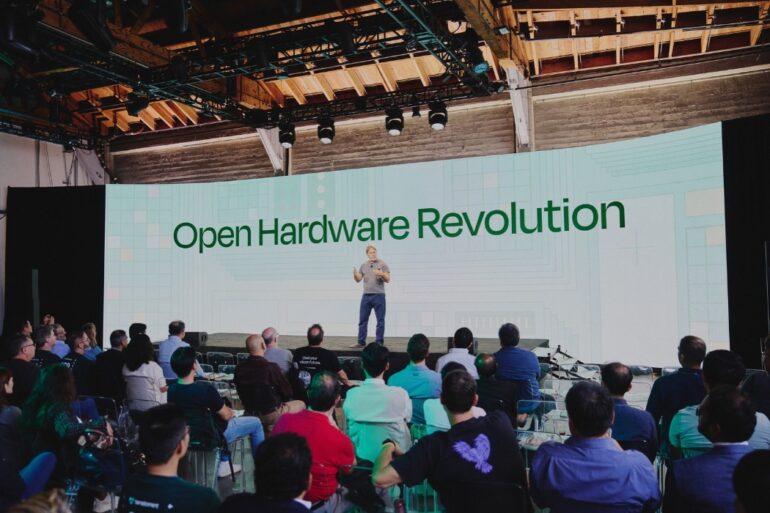
Feature image courtesy Tenstorrent.