

My grandmother was a commanding woman. In her 92 years, she raised three children and a grandchild, mostly by herself. She helped manage a series of successful restaurants and nightclubs; in her little spare time, she hiked and skied. She was decidedly capable.
But when I unexpectedly knocked on her door one autumn when I was 19, something was different: she asked me the same questions, different only in sentence structure, again and again.
What brought me to town?
Where was I going to school?
What was I doing in town?
What college was I enrolled in?
Over the years, she lost more of her faculties. Eventually, she left the stovetop on for so long that a steel pot melted into molten coagulant. That was the boiling point: a week later she moved in with my parents.
My grandmother’s experience was not abnormal. Like many seniors, she was caught between her desire to remain independent and the limitations of her advancing age; she didn’t want to leave her home, but could also no longer live safely on her own. With little money to afford in-home care, those years put untold pressure on my parents and left my grandmother in a sort of purgatory: she wasn’t independent, but she also didn’t have round-the-clock care.
If Calgary’s Garden Loft had been around back then, might things have been different?
“The world’s first full-stack house”
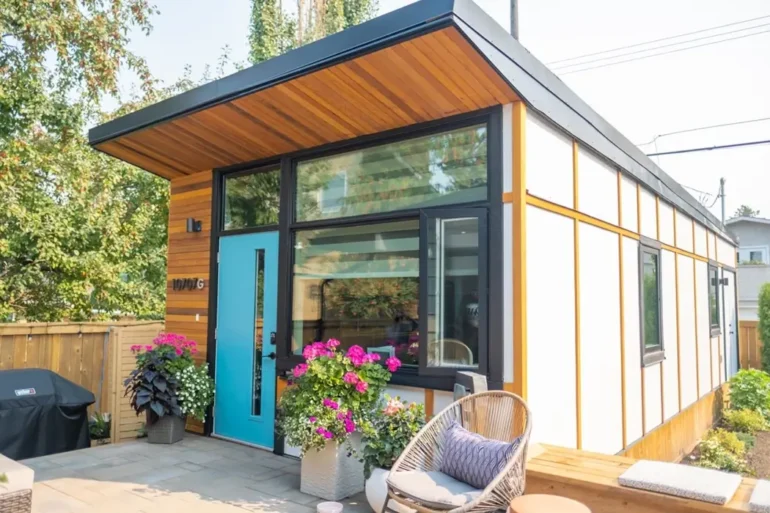
The small, loft-styled suites Garden Loft builds look like the type of in-fills you might see in a trendy Calgary neighbourhood: angular, with glassy entranceways and teak-wood finish. But inside, they’re full of cutting-edge tech masquerading as modern decor.
Garden Loft was founded in 2022 by University of Calgary dean of architecture John Brown, his wife and fellow co-founder Carina van Olm Brown, and third co-founder, Matthew North. The company builds modular, prefabricated housing for older people and others with differing abilities. Its tech is imbued with “gerontechnology,” more commonly called age-tech. Age-tech is digital technology used to improve or manage the health, well-being, and independence of seniors.
“This is more than a smart home. It’s a new model of care.”
Garden Loft evolved out of the trio’s previous business, a boutique design and construction firm called Housebrand. In its capacity as a custom builder, Housebrand had been receiving customer commissions asking for housing that could adapt to their needs as they aged.
“The costs of [renovating] all of that makes sense for a person that needs it, but it doesn’t make sense for the larger housing market,” Brown told me last July when I visited the industrial Calgary workshop where he and his partners are building Garden Loft’s homes. “We started to think about a separate solution: What if we had a house that already had everything in it?” he said.
That notion led to a research partnership in 2014 between Brown, in his capacity as dean of the U of C’s School of Architecture, Planning, and Landscape, and the Cumming School of Medicine. Its purpose was to explore the potential of integrating medical technology into backyard suite housing that could be leased, installed, and removed as a person’s health needs change.
Fast forward a decade and Garden Loft now describes itself as the Tesla of housing: a full-stack alternative to expensive in-home care and assisted living facilities that are often underfunded.
“Tesla, notwithstanding Elon Musk being crazy, was the first full-stack car. Deeply integrated technology on all kinds of levels,” Brown said, claiming that Garden Lofts is the “world’s first full-stack house.”
A mix of built-in tech and digital infrastructure, Garden Loft attempts to set itself apart from its peers in the seniors-housing space by the breadth of the technology it integrates into its products. Think injury-resistant flooring that Brown says can dampen fall impacts by as much as 43 percent, digital sensor technology to monitor activity levels, and a digital community platform with curated service delivery for users.
For its efforts, the company was awarded the City of Calgary’s 2023 accessibility award.
But where Garden Loft really makes its stand is in its use of software. Building on a proprietary digital platform, a Garden Loft suite can continuously measure 37 different data streams, looking for deviations in metrics like sleep quality, hydration, stability, gait speed, toilet use, activity levels, and more. That data runs through an algorithm that identifies potential early warning signals of declining health and compiles them along a gradient: green for good, yellow when three or four indicators emerge, and so on. All of this can be accessed by residents via Garden Loft’s digital platform.
If all of that data collection sounds a little Big Brother, Brown maintains that Garden Loft’s clients, most of whom are in their mid-80s or older, retain agency over how their data is used and shared.
RELATED: Canada’s housing supply is in crisis. Can robots help?
“You have control over your data. You can cede it; give access to your family or your healthcare provider,” Brown told me, adding that residents must choose what data, if any, they want to share with healthcare providers or supports like friends or family.
While Brown was clear that the data measured by Garden Loft’s systems is technically behavioural, not medical, information he recognized that it would still be sensitive. He said the company is working on ways to protect that data, though he didn’t explain exactly what those protections would look like.
“We generate the data, and we have control over it, and we’re just working right now around data privacy,” he said last August.
After our initial conversation, I reached out to Brown to follow up on the issue of data privacy. He told me that Garden Loft would house the data it generates on private, domestically located servers and that user data “will not be sold or otherwise shared.”
It takes a village
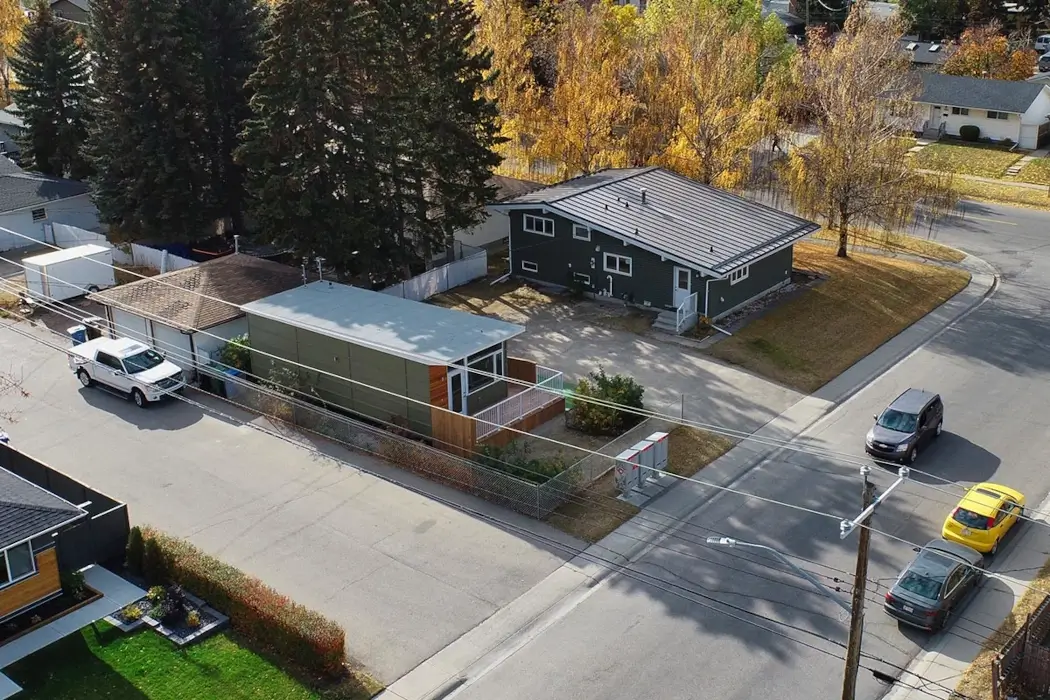
Garden Loft has spent the last few years incubating with the support of Calgary funding catalyst and growth studio Thin Air Labs (James Lochrie, a Thin Air managing partner, now sits on the company’s board). In that time, the company has deployed several prototype properties: three in Calgary, three in Edmonton, one in Airdrie, Alta., and one in Ottawa.
Currently, Garden Loft is working on several projects to build 10-to-30-unit “village” style housing that Brown thinks has the potential to upend the assisted-living model in Canada.
“You get 80 percent of what’s delivered in a supported living environment or long-term care facility at 50 percent of the cost, and you stay in the housing market rather than entering the care industry,” Brown claimed.

Image courtesy Garden Loft.
A 10-unit prototype village is under construction in Bassano, Alta., with four additional village projects in development, including in an as-of-yet-undisclosed Northern Alberta Indigenous community. The village design concept can include a different care model than the standalone homes the company currently has in the market. In the village scenario, Garden Loft is leaning into a telehealth model of care, integrating clinical and pharmaceutical support services that residents can contact on an as-needed basis. Those resident healthcare providers can in turn access residents’ real-time biometrics if they choose to make that data available.
The Bassano village project, which Brown says will open next year, is partnering with the Dr. Barrie Strafford Centre for Learning, Innovation, and Quality (CLIQ) on an Alberta Innovates-funded research project that will evaluate health outcomes over two years to fine-tune the company’s wellness monitoring platform.
A new kind of care
Much like Garden Loft’s village project aims to change what congregated supportive living looks like, age-tech is changing what supportive care looks like broadly at a moment when healthcare for older people in Canada is buckling.
Laura Tamblyn Watts is the CEO of CanAge, Canada’s national seniors’ advocacy organization. She’s also a board member of AgeWell, a national centre of excellence that studies aging and technology. Tamblyn Watts said that in the current senior-care environment, technology is playing a growing role in expanding the continuum of what care looks like as people get older.
“When you read statistics that say things like 90 percent of people want to remain in their own home—well, of course they do because the questions being asked are: ‘Do you want to move into long-term care or do you want to live in your home as long as you want?’ Those aren’t very good questions. They set up this false dichotomy [between long-term care and living alone].
“You get 80 percent of what’s delivered in a supported living environment or long-term care facility at 50 percent of the cost, and you stay in the housing market rather than entering the care industry.”
“There’s a continuum in between,” Tamblyn Watts said. “That idea of integrated age technology is so critically important; it’s part of a broader trend to look at prefabricated housing supports where they are both integrated, as well as accessible, affordable, and inclusive.”
That matters because regardless of where a person lives on that continuum of care, prices are steep. Retirement home costs average just over $3,000 per month, and can spike into the tens of thousands. In-home care isn’t much better, according to Tamblyn Watts, who said hiring a caregiver with only six weeks of formal education—far less than a registered nurse requires—can cost in the hundreds of thousands per year.
Put the soaring prices aside for a moment, and there is another chokepoint: capacity. According to the Canadian Institute for Health Information (CIHI), Canada has just shy of 200,000 long-term care beds. Meanwhile, Canadians 85 and older are among the country’s fastest-growing demographics, with researchers projecting that capacity in long-term care will need to double in the next decade to meet demand.
As I walked through Garden Loft’s warehouse last summer, its dual bays littered with halfway finished homes, my mind kept returning to my grandmother and the ways that as her cognition declined, the space she inhabited, and the life she had built for herself, diminished, too. Could such futuristic housing have slowed the pace at which her world shrunk? Might it have eased the burden of care as she transitioned from capable to dependent?
RELATED: AlayaCare raises $51 million CAD to scale homecare provider platform
Against that backdrop, Brown believes new caregiving models like the one he and his partners are building now will come to serve as a necessary release valve for the long-term care industry, the governments funding it, and the people whose health and dignity rely on these systems of care.
“Governments in North America realize they can’t provide the level of healthcare [needed], that we can’t keep everyone in a facility or hospital. There has to be home care,” Brown said, adding that what Garden Loft is building constitutes a new kind of supportive living.
“This is more than a smart home. It’s a new model of care,” he said. “We have to try to age people in place, and what we’re doing is providing a technical, digital, and physical framework to enable that to happen to a higher degree.”
BetaKit’s Prairies reporting is funded in part by YEGAF, a not-for-profit dedicated to amplifying business stories in Alberta.
Feature image courtesy Garden Loft.