

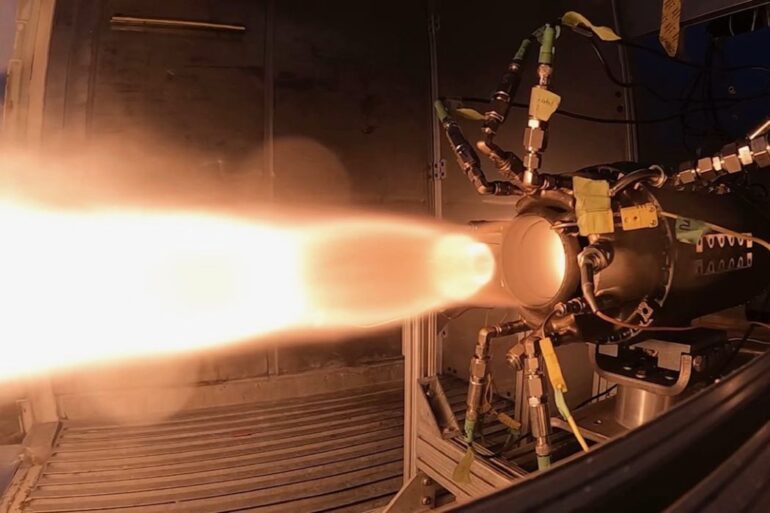
Reaction Dynamics is looking to raise hundreds of millions in funding and add nearly 300 employees over the next five years to send a new, more powerful rocket toward the stars.
At the SpaceBound Conference in Ottawa on Tuesday morning, the Longueuil, Que.-based rocket maker revealed its plans to develop and send a new medium-lift rocket to space by 2031. Dubbed Borealis, the medium-lift rocket is the larger sibling of Reaction Dynamics’ light-lift Aurora rocket. While Aurora is meant for payloads below half a tonne, Borealis is designed to haul a six-tonne payload to low Earth orbit for larger spacecraft deployments, satellite constellation launches, and other large space missions, similar to SpaceX’s Falcon 9 rocket.
“We founded Reaction Dynamics because we believe Canada should be able to reach orbit on its own terms.”
SpaceX’s rocket is so popular for shipping satellites to space that it’s started turning away customers past 2028. This has opened the door for Canada’s burgeoning space industry, including Reaction Dynamics. The company said it’s already signed 10 agreements and letters of intent with undisclosed prospective launch customers across Canada, the United States, and Europe.
“We see an opportunity to serve Canadian demand while providing additional dedicated launch capacity for customers in the United States, Europe, and allied countries,” Jesse Mikelberg, Reaction Dynamics’ director of business, tech, and strategy, said in an email to BetaKit. “As a result, customers would have greater control over their launch schedule and destination orbit.”
To give those prospective customers a ride to space, Reaction Dynamics has set some big-time goals. First, the company wants to launch Aurora into orbit from Canadian soil by 2028. The company will then build on that base of manufacturing investments, equipment, processes, and expertise to get Borealis into space by 2031, Mikelberg explained.
“Aurora will give us flight experience and practical knowledge of manufacturing, transporting, integrating, and launching an orbital vehicle,” Mikelberg said. “It will also help us establish customer relationships, spaceport operations, and credibility through execution.”
While Mikelberg makes it sound simple, it is literally rocket science. This requires a lot of manpower and capital. Reaction Dynamics is planning for a large influx of both.
Over the next five years, the company aims to increase its headcount from 68 employees to 350. To accommodate all the new staff, Reaction Dynamics is also looking to increase its manufacturing and testing footprint from 60,000 square feet to 375,000 square feet. The company sees a “strong foundation” for this expansion in Québec, Mikelberg said, but it’s also eyeing land in Ontario or Nova Scotia.
RELATED: First Canada, then the world: nation’s rocket builders see a bigger opening in space
Expanding a business like this, let alone one that builds rockets, isn’t cheap. Reaction Dynamics is planning to raise around $350 million CAD in new private investment across two rounds over the next five years: a Series B targeting between $70 million and 100 million CAD to support Aurora’s first orbital launch in 2028, and then a Series C, or a similar funding instrument, targeting between $200 million and 250 million CAD to aid development for Borealis’ first launch in 2031.
This funding would come in addition to the $50 million Reaction Dynamics has already raised to date from private investors and non-dilutive government funding sources.
“Our approach is to broaden the investor base as we demonstrate propulsion performance, establish manufacturing capacity, secure customers, and gain flight experience,” Mikelberg said.
Founded in 2017, Reaction Dynamics has been building rocket propulsion systems since long before space became one of the “key sovereign capabilities” in the federal government’s Defence Industrial Strategy. Under the DIS, the 2025 federal budget committed $182.6 million over three years to the Department of National Defence (DND) to establish a sovereign space launch capability.
Reaction Dynamics benefitted from Canada’s renewed focus on space earlier this year when the company was awarded an $8.3 million grant under the first round of the DND’s Innovation for Defence Excellence and Security (IDEaS) Launch the North contest to build out its rocket launch capabilities. Reaction’s younger Canadian rocket-building peers, Canada Rocket Company and NordSpace, also received that funding.
The IDEaS funding was announced alongside the federal government signing a $200 million lease with Maritime Launch Services to establish a government spaceport in Nova Scotia. Reaction Dynamics has also invested in MLS, and its spaceport just outside Canso, NS, is the planned location for Aurora’s first orbital launch.
“We founded Reaction Dynamics because we believe Canada should be able to reach orbit on its own terms,” Reaction Dynamics founder and CEO Bachar Elzein said in a statement. “Aurora is how we get there in 2028. Borealis is how we build on that foundation to deliver medium lift by 2031. Nearly a decade of propulsion development and engineering, right here in Quebec, has brought us to this point.”
Feature image courtesy Reaction Dynamics.