

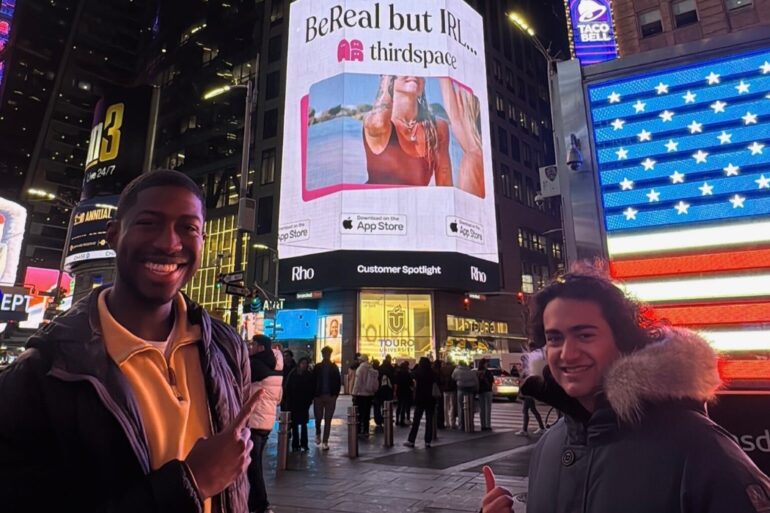
Toronto- and New York City-based Mecka AI, which aims to supply the training data necessary to deploy robots in the real world, has completed its second acquisition to date.
The buzzy AI startup announced today that it bought Ottawa’s Thirdspace, a popular social mobile app that Mecka described as a mix between BeReal, Instagram, and Snapchat. Thirdspace bills itself as a venue for “[in real life] side quests with friends.” The news comes shortly after Mecka revealed it had closed $60 million USD ($86 million CAD) in Series B funding from Sequoia Capital, Nvidia, Microsoft, Qualcomm, and Samsung, among others.
“They’ve captured this lightning in the bottle of what it takes to get viral.”
Launched last year by former Carleton University students Cedric Osagie and Eshan Betrabet, Thirdspace allows users to take and post photos of themselves doing fun things and invites friends to join. The images are only briefly viewable—once others have accepted the invite, they’ll get a location to join in and capture a pic together.
In an exclusive interview with BetaKit, Osagie said the goal was to build a fun, spontaneous way to encourage lonely university students to connect more in person. The idea has taken off: in less than two years, Thirdspace has amassed upwards of 20,000 downloads, 60 million views, and has been tripling its monthly active users on the back of $100,000 CAD in angel funding.
In an interview with BetaKit, Mecka special projects lead Mark Grinev said Thirdspace’s “small but mighty team” was “the most important piece,” noting that Mecka was drawn to the playbook that Osagie and Betrabet deployed to grow Thirdspace.
Both firms declined to disclose the acquisition price. The cash-and-stock deal, which closed a few weeks ago around the same time as Mecka’s recent $60-million USD Series B round, is effectively an acquihire, similar in nature to Mecka’s purchase of Vancouver-based Docula earlier this year.
While Thirdspace will remain operational going forward, Osagie and Betrabet have ceased working on it and have joined Mecka as heads of mobile capture and to expand the reach of its home capture app and lead its efforts “across all things mobile.”
“They’re exceptional growth hackers and thinkers, and they’ve captured this lightning in the bottle of what it takes to get viral,” Grinev said. “That is crucial because scaling the mobile app is imperative to hit these big goals of ours.”
RELATED: Mecka AI reveals $60-million USD Series B round backed by Sequoia, Nvidia
Mecka is betting that egocentric, or first-person video will help robots learn faster and scale more efficiently. Demand for this type of data—which, unlike the text, images, and video required to train large language models, cannot be scraped from the internet—is booming. The approximately 80-person startup has built hardware with sensors to capture video and the computer vision and multimodal models to turn it into usable robot training fodder for multiple frontier robotics labs and Big Tech firms.
While Mecka has already collected millions of hours worth of egocentric video from hundreds of thousands of individuals, that is still far from enough to train real-world robots, Grinev said. Given this, Mecka has set an ambitious video target for the end of 2027: 100 million hours of footage. Getting there will require millions of people to download its app, strap their phones to their heads, and collect and submit footage of themselves completing various tasks, he said.
Mecka is betting that Osagie and Betrabet can deploy some of the same strategies they used at Thirdspace to help the company get there, including their ability to leverage user-generated content and find and run with the right viral formats to fuel organic growth.
“This is actually the first team I’ve seen in the robotics realm that is growth-hacking their app like a traditional consumer product, which I think gives incredible advantages,” Osagie said.
RELATED: Mecka AI acquires Docula as it builds the data layer for robotics
While TechCrunch first reported last month that Mecka was raising a new round at a valuation of about $500 million, Grinev declined to share how Mecka’s all-equity, all-primary capital Series B financing valued the two-year-old startup, which has now raised $120 million USD.
Grinev said that Mecka, which claimed to have surpassed a $100-million USD run-rate in June and expects to hit $300 million by the end of this year, raised so much in close succession because it sees a big opportunity and requires a lot of capital to sustain its pace.
Mecka intends to use its Series B capital to grow its teams across Toronto and New York and expand to San Francisco. It also plans to use the funds to finance its compute and storage costs, fund payouts for the folks capturing data, and support its tech development plans.
Grinev acknowledged that the AI talent wars have become “quite intense.” While Mecka does not have any other acquihires planned at the moment, he said he would not be surprised to see the company pursue more such deals in the future.
Feature image courtesy Mecka AI.