


What does a federal budget “about entrepreneurs” look like? Today, Canadian tech received the answer.
While Prime Minister Mark Carney’s first budget set an ambitious vision (with massive spending commitments—or investment, depending on who you ask), Budget 2026 gets into the gritty implementation details. Twenty months into office, Carney’s government has evolved its plan to spur investment, support economic growth, and enhance Canada’s sovereignty and resilience.
“We’re gonna be very competitive [for] people who want to grow companies, reinvest in Canadian companies.”
Finance Minister François-Philippe Champagne
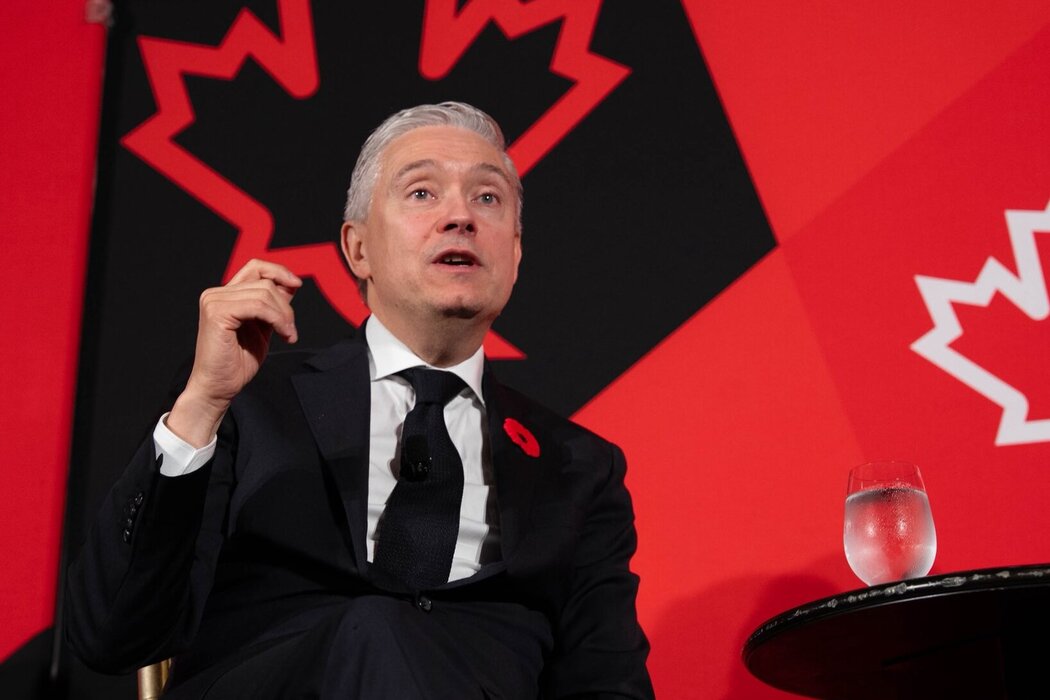
“We’re gonna be very competitive [for] people who want to grow companies, reinvest in Canadian companies,” Finance Minister François-Philippe Champagne said at a press conference on Thursday.
Refinements to Canada’s defence and dual-use strategy—including aerospace, quantum, and drones—and globally competitive tax incentives all appeared as expected. Continuing on recent sovereign AI investments, the feds also committed to supplying 500 MW worth of compute for Canadian tech companies.
That’s not to say Budget 2026 is without surprises. It introduced a massive reorganization of the nation’s Crown corporations, including the planned merger of the two most familiar to Canadian tech: BDC and EDC. While the decision has been publicly welcomed, BetaKit was told that BDC employees attending SAAS NORTH collectively gasped upon learning the news.
Budget 2026 also featured a few high-profile omissions and controversial decisions. An effective replacement for the failed Start-up Visa program is still MIA, and CFIB president and CEO Dan Kelly did not mince words about the feds’ ongoing approach to the trade war. “I find it appalling that, a year and a half into the trade war, the government hasn’t even bothered to fix the failing tariff relief measures,” he tweeted.
Still, buoyed by higher tax revenues from restated economic growth figures and higher oil prices, the federal government was able to announce $151.1 billion in new investments, while largely keeping the deficit track unchanged from the Spring Economic Update.
But, as always, the devil is in the details. Here’s a look at what Canadian tech expected, what it got, and how it’s reacting.
Crown Corps
Taxes & IP
AI
Defence & Dual-Use
Financial Innovation
Energy & Cleantech
Executive Summary
Crown Corp. Changes
- BDC & EDC to consolidate under a single federal development bank
- Canadian Commercial Corporation to become a subsidiary of Export Development Canada (EDC)
- Minister of Finance now responsible for Canada Infrastructure Bank (CIB)
- Canada Strong Fund to become Crown corp.
- Canada Growth Fund mandate to be expanded
- $3.5 million over two years to the Department of Finance to oversee new Crown corp. functions & support consolidation
Taxes & IP
- A new Canada Growth Incentive tax exemption on up to $15 million in capital gains earnings, starting in 2027-28
- $930 million over five years for SR&ED expansion to cover commercialization expenses ($235 million ongoing)
- Clean Technology and Clean Electricity investment tax credits extended to end of 2040
- Patent Act amendments for greater visibility on Canadian patent ownership
- Additional IP modernization measures to be announced spring 2027
- Simplified business tax rules, including dividend exemptions and increasing dividend allowance to $1.5M
AI
- Access to 500 MW of sovereign AI compute through new financial tools
- Exploring creation of a Technology Stability Board to assess whether advanced AI models are safe and remain under human control
- $6.2 million over four years to ISED for Canada’s continued participation in the Global Partnership on Artificial Intelligence
- $100 million over three years towards Federation of Canadian Municipalities partnership to support AI adoption & e-permitting
Defence & Dual-use (Quantum & Aerospace)
- $2.7 billion (previously committed) from the Defence Industrial Strategy to:
- Canadian Quantum Champions Program Phase 2
- Expand Launch the North initiative to establish sovereign medium-launch space capability
- Further develop space technology through CSA’s Space Technology Development Program
- Extend BOREALIS, Defence Industry Assist, and the Regional Defence Investment Initiative
- Recapitalize the Canadian Defence Industry Resilience Program
- Defence production and artillery manufacturing capacity funding
- Fully operationalize the National Research Council’s drone innovation hubs
- Provide $2.3 billion over five years (a portion from existing funding) to the Department of National Defence for the Defence Drone Initiative
Financial Innovation
- Real-Time Rail Phase 1 launch Nov.9
- Public consultation on payments modernization in early 2027
- Amendments to the RPAA to strengthen Bank of Canada’s oversight of payment service providers
- Require regulated financial institutions to issue stablecoins through non-financial institution subsidiaries regulated under the Stablecoin Act
- Extend Stablecoin Act to foreign financial institutions not prudentially regulated in Canada
- Introduce a Multi-Sector Anti-Fraud Framework as cornerstone of National Anti-Fraud Strategy
- Establish new Financial Crimes Agency (operations beginning fall 2027)
- Competition objective to instruct OSFI regulations
- One-year timeline on application decisions for prospective regulated financial institutions
- Greater flexibility on foreign ownership structures to encourage entry of mid-sized challenger banks
Energy & Clean Technologies
- $50 billion through the National Electricity Strategy to double electricity supply by 2050
- A $6.5-billion nuclear strategy
- $298 million to renew NRC IRAP Clean Technology Program
- Clean Technology and Clean Electricity investment tax credits extended to end of 2040
- $587 million over five years to renew the Zero-Emission Vehicle Infrastructure Program, supporting the installation of 55,000 additional EV chargers
- $45 million to Natural Resources Canada over five years for charging infrastructure R&D
Other Priorities
Tariffs
- $500 million financing stream under BDC’s Pivot to Grow program
- Minimum revenue requirement to access BDC’s tariff programs lowered to $1 million
Competition
- Competition Bureau formally recognized as an investigative body under privacy regulations
- Competition objective to instruct OSFI regulations
Natural Resources
- $6.5-billion Forest Sector Transformation Strategy to reduce costs through innovative forest management and technology adoption
- Renewed $2.3-billion critical minerals strategy
Investment
- Another $1 billion over six years to the Strategic Response Fund, starting in 2028-29
- $181.4 million over four years to expand Invest in Canada to deliver future Canada Investment Summits
Digital Transformation
- $1 billion over five years to establish a Government Transformation Fund for “transformative IT projects”
- $176.3 million over five years to establish a new, arm’s-length Digital Safety and Data Protection Commission of Canada
- Intention to introduce the Digital Transformation Canada Act
More on Budget 2026
• What’s in Budget 2026 for Canadian tech?
• Ottawa earmarks $176 million to establish online super regulator
• Canada’s long-awaited Real-Time Rail payments system launches without Big Six banks
• Canada to implement QSBS-style tax incentive and “level playing field” with US
• The feds plan to merge BDC and EDC. What might that mean for Canada’s largest VC investor?
• Canadian tech sees promise in federal government’s 500-MW sovereign AI compute pledge
The breakdown
Crown Corp. changes
The two Crown corporations most familiar to Canadian tech will become one.
The dollars: $3.5 million
The ask: When the Canada Strong Fund was initially announced in the spring, some critics had questions about how the sovereign wealth fund would work and urged the government to put a greater emphasis on the digital economy.
When laying out plans for the fund, the Spring Economic Update also contained a note that proved to be consequential on budget day: to avoid duplication, the government would be undertaking “comprehensive mandate reviews” of each Crown corporation in the federal financing ecosystem. But there weren’t specific asks from the innovation sector about significant changes to the main Crown corporations that invest in Canadian tech made in Budget 2026.
What the feds did: Surprise! Following said review, Budget 2026 revealed that the feds would launch a transition process to combine the Business Development Bank of Canada (BDC) and Export Development Canada (EDC), effectively putting two of the most important financing bodies for Canadian businesses under one roof.
The major restructuring notice came alongside a number of other Crown corporation changes. The Canadian Commercial Corporation will become a subsidiary of EDC, and the Minister of Finance will take over responsibility for the Canada Infrastructure Bank. The Canada Growth Fund’s mandate will expand, too, though Budget 2026 was unclear on how. The Department of Finance will get $3.5 million over two years to support and oversee these structural changes.
The budget also confirmed the $25-billion Canada Strong Fund will operate as a Crown corporation that will invest in Canadian companies on behalf of Canadians on a “fully commercial basis” with the private sector. Launching in early 2027, the fund will have an associated retail investment product called Canada Strong Notes, which Canadians will be able to purchase through participating financial institutions.
The changes come as the federal government seems to be broadly reimagining its relationship with Crown corporations, having recently introduced a bill to turn the Defence Investment Agency into one to make it “more fleet-footed.” Budget 2026 says the federal government now “expects financing Crown corporations to have a greater risk tolerance than private sector peers.” It also stresses that government-backed financing should complement, rather than replicate, private investments.
The reaction: In a LinkedIn post, the BDC stated that it welcomed the merger. “Our two organizations have complementary mandates and a shared ambition: to simplify and accelerate access to the support and financing entrepreneurs need to grow their businesses,” BDC stated.
“Between them, BDC and EDC have historically large scopes and impact many stakeholders across Canadian markets, so their merger will have lasting implications for not only those stakeholders but for the new players that Budget 2026 is seeking to activate,” TJ Misra, interim executive director of the Canadian Startup Capital Association, told BetaKit. She said she looks forward to further details as to how the merger will impact the deployment of Growth VCCI and the Early and Growth Stage Investment Strategy.
Gideon Hayden, co-founder and managing partner of Leaders Fund, told BetaKit that he’s always in favour of simplifying organizational structures. “In the past six years we’ve seen the tech industry try to unwind the overhiring and layers of management they’ve implemented … I’d like to see the same effort be applied in government, because I assume these organizations can function better for Canadians if they were streamlined,” he said.
Taxes & IP
Budget 2026 is “about entrepreneurs,” which means tax breaks for entrepreneurs.
The dollars: ~$1.6 billion
The ask: Business and tech groups wanted tax changes to make Canada a more compelling place to invest. CCI, CVCA, NACO, and other investor groups launched a campaign asking the feds to create a tax incentive similar to the US Qualified Small Business Stock (QSBS) regime, and a capital gains tax deferral when proceeds are reinvested in another Canadian company. Build Canada went a step further, suggesting a corporate tax change that only taxed profits, not reinvested earnings. CFIB asked to cut the small-business rate from nine to six percent and to extend the preferred tax rate for small businesses to a company’s first $700,000 of income, rather than $500,000.
What the feds did: Canada’s answer to QSBS is here. The budget outlines a new Canada Growth Incentive tax exemption on up to $15 million in capital gains earnings, providing $715 million in tax relief over four years, starting in 2027-28. The feds say a founder with a $15-million capital gain would now retain nearly 96 percent of the value when they exit, compared with 71 percent before Budget 2026.
Read our breakdown on the Canada Growth Incentive here.
The feds are also giving the Scientific Research and Experimental Development (SR&ED) tax credit a $930-million expansion, setting it up to cover certain commercialization expenses, like obtaining regulatory approvals and intellectual property protection. Budget 2026 says the CRA will work to provide sector-specific guidance on SR&ED eligibility for commercialization expenses.
The government has also extended the Clean Technology and Clean Electricity investment tax credits to the end of 2040 and simplified business tax rules, including dividend exemptions and increased dividend allowance to $1.5 million. The Patent Act is also set to be amended to allow for greater visibility on Canadian patent ownership and establish minimum requirements for written patent demand letters, with additional IP modernization measures to be announced in Spring 2027.
The reaction: Investors and investor advocacy groups welcomed the QSBS-style incentive. “Credit to Minister Champagne and this government definitely is deserved for listening and acting on what the innovation and entrepreneurship community really needs,” CCI CEO Patrick Searle told BetaKit. Eva Lau, co-founder and general partner of Two Small Fish Ventures, said the tax break “will encourage more investors to invest in early-stage startups.”
NACO CEO Claudio Rojas said that capital will come with “mentorship, access to networks, and the expertise needed to scale.” Joe Canavan, principal at Canavan Capital, said that the government’s move to put investors and entrepreneurs first will unlock a “powerful period” of growth for the country. John Ruffolo, founder and managing partner of Maverix Private Equity, also told BetaKit he was pleased to see the incentive.
However, Dan Kelly, president of the Canadian Federation of Independent Business (CFIB), said in a statement that while the capital gains exemption is helpful, the government has a “blind spot” when it comes specifically to small business. For those facing rising costs and tariffs, “the budget will provide you with no help whatsoever,” he argued.
AI
The feds follow their AI for All strategy with more compute, cash for digital transformation, and the concepts of a plan to keep advanced AI models safe.
The dollars: $1.1 billion
The ask: The tech sector wanted AI infrastructure built in Canada. CCI recommended that the feds build a “sovereign industrial base” of Canadian firms by providing domestic compute capacity, better access to high-quality data, and procurement rules that prioritize buying Canadian. Similarly, the Canadian Shield Institute called for a “strategic sovereign compute entity” that Canadian companies can tap for computing power.
Meanwhile, other groups were focused on adoption. Accountant group CPA Canada asked for more responsible AI adoption and stronger governance, while Sage Canada suggested an AI and digital investment tax credit to encourage small businesses to integrate the technology. Academics, including Canadian AI godfathers Geoffrey Hinton and Yoshua Bengio, have called for the creation of an international AI regulator, an idea AI Minister Evan Solomon has already floated.
What the feds did: Crank the juice. The government said it will enable Canadian AI companies to access 500 MW of sovereign AI compute through financial tools like backstops and offtake agreements, giving domestic firms a chance to secure space in Canadian data centres at a time when hyperscalers like Anthropic and Meta take that capacity, and more, for themselves. The government will also supply $100 million over three years towards a partnership with the Federation of Canadian Municipalities to support AI adoption and e-permitting.
Building on the launch of Digital Transformation Canada, which looks to improve how the feds develop, buy, and use AI and other tech, the budget has committed $1 billion over five years to establish a Government Transformation Fund for such “transformative IT projects.”
At the international level, the budget committed $6.2 million over four years to support Canada’s continued participation in the Global Partnership on Artificial Intelligence. The feds will also work with international partners to explore the creation of a new “Technology Stability Board,” which would assess whether advanced AI models are safe and remain under human control.
The reaction: Ali Asaria, co-founder of AI research firm Transformer Lab, told BetaKit that “right now, getting GPUs in Canada is close to impossible,” adding that the lengthy and unpredictable waits for startups to access hardware are not feasible. “Ottawa helping data centres finance those purchases might sound crazy, but it might be crazy enough to work. Demand is so high that the government’s risk is close to zero,” he said.
Defence & Dual-use
The dollars: $5 billion (over $2.7 billion previously committed)
Space is the place for the next phase of Canada’s revitalized defence and dual-use strategy.
The ask: Canadian defence tech firms wanted clearer and faster-moving procurement rules. Aspiring neoprime Dominion Dynamics asked the feds to lower the threshold for contracts awarded through the Defence Investment Agency to $25 million and to create “agile procurement models” for software and other advanced defence tech. The Canadian Strategic Mission Corporation advocated for funding toward its own nuclear micro-reactors and asked for increased investment in dual-use technologies.
Similar procurement asks came from the spacetech sector. Satellite company Kepler Communications wanted the government to apply the defence Build-Partner-Buy framework to the space sector, and more clarity on how to be selected as a strategic partner. A coalition of space companies, including Maritime Launch Services and Reaction Dynamics, called for a new national space industrial strategy and for the feds to commit to being the first customers for domestic space companies.
What the feds did: There was nothing new on procurement and relatively little new funding committed for defence tech in Budget 2026. Instead, this year’s budget established where some of last year’s $81.8-billion commitment to reinvest in the Canadian Armed Forces is going.
This includes $2.7 billion from the Defence Industrial Strategy being divvied up to a smorgasbord of dual-use initiatives, such as Phase 2 of the Canadian Quantum Champions Program, expanding the Launch the North initiative to establish sovereign medium-launch space capability (to support Canadian firms no longer able to hitch a ride on SpaceX), further developing space technology through the Canada Space Agency’s Space Technology Development Program, and extending other initiatives like BOREALIS, Defence Industry Assist, export promotion, and the Regional Defence Investment Initiative.
Some of that funding will also be used to recapitalize the Canadian Defence Industry Resilience Program, fund munitions production facilities in Québec and Ontario, and to “fully operationalize” the National Research Council’s drone innovation hubs.
Some net new funding will be applied within the $2.3-billion commitment to the Department of National Defence over five years for the Defence Drone Initiative (DDI), starting in 2027-28. The DDI was established earlier this year to create a pool of drone suppliers for Canada and its allies.
The reaction: Matthew Lombardi, co-founder of defence innovation network The Icebreaker, told BetaKit the funding for the DDI is a “positive signal,” but suggested it’s one that will need to be followed by ongoing, timely procurement. He said that if Ottawa can back that funding with ongoing orders, it will support Canadian companies to build factories here, but “otherwise, they’ll keep selling prototypes while our allies buy the full production runs.”
Meanwhile, Xanadu founder and CEO Christian Weedbrook celebrated the government’s commitment to quantum funding, adding that it helps his company resist pressures to move to the US to access capital.

Financial Innovation
A tech sector tired of waiting sees incremental progress and a few new fig leaves to financial competition.
The dollars: N/A
The ask: Canada’s financial disruptors continued to bang the drum for long-awaited competition-boosting measures to finally come into effect.
Industry group Fintechs Canada, FinTech startup Neo Financial, and EQ Bank asked for the feds to follow through on (and, in some cases, speed up delivery of) an open banking system. Fintechs Canada and EQ Bank also asked for an accelerated rollout of Real-Time Rail (RTR); Payments Canada, the organization responsible for delivering it, wanted the government’s continued support for the launch.
Wealthsimple wanted the feds to implement a ban on investment and registered account transfer fees that was announced last year. On crypto, the Canadian Web3 Council and Shakepay recommended the government loosen its language around a ban on stablecoin interest and yields.
What the feds did: The wait is almost over: the first phase of Canada’s Real-Time Rail payment system launches Monday, Nov. 9 (likely without any banks initially participating). The government said the next phase will be guided by a public consultation it expects to hold in early 2027. There was no meaningful mention of open banking outside of the government’s intention to expand data portability beyond banking. In a press conference prior to tabling the budget, Finance Minister François-Philippe Champagne said “there’s regulation, which is going to be published soon.”
Read more about the upcoming Real-Time Rail payments system launch here.
Budget 2026 does forward a number of other measures to boost FinTech competition. This includes streamlining the process for becoming a federally regulated financial institution by establishing a one-year timeline for application decisions, and encouraging challenger banks to enter the country by loosening ownership structure requirements. This means foreign bank subsidiaries with less than $8 billion in equity will be exempted from a requirement to have public holdings, so long as their foreign parent is listed on a recognized foreign stock exchange. Canada will also raise the threshold at which banks must transition to widely held ownership (meaning they must have no single major shareholder) from $12 billion to $25 billion in equity.
The government is also looking to introduce a secondary competition objective for OSFI, introduce a Multi-Sector Anti-Fraud Framework to increase protections across the financial sector and digital platforms, establish a new Financial Crimes Agency to investigate serious financial crime by fall 2027, and strengthen the Bank of Canada’s oversight of payment service providers.
On stablecoins, the government intends to require federally regulated financial institutions to issue stablecoins through non-financial institution subsidiaries regulated under the Stablecoin Act, as well as extend the Stablecoin Act to foreign financial institutions that are not prudentially regulated in Canada.
The reaction: Abraham Tachjian, managing director of payments and open banking for Accenture, said in a post on LinkedIn that he’s left with an open question—”how stablecoins will fit alongside Real-Time Rail and the broader payments modernization agenda.”
With files from Josh Scott and Sarah Rieger.
Feature image courtesy François-Philippe Champagne via LinkedIn.