

This article appears in The BetaKit Guide to Alberta’s Silicon City. Learn more about Edmonton semiconductor innovation here.
Nanotechnology first became a hot commodity in the early aughts. Heralded as the next revolution, it was common to see pop-culture visions of a future where nanobots would scour our bloodstreams for cancer cells and skyscrapers would self-assemble. The tech attracted billions in federal and VC dollars, with both US Presidents Bill Clinton and George Bush making hefty investments in the field.
Nanotech’s high profile has dissipated since then, but the technology hasn’t. Today, nanotech is more prevalent than ever, underpinning everything from the semiconductor chips powering AI to vaccines and even sunscreen.
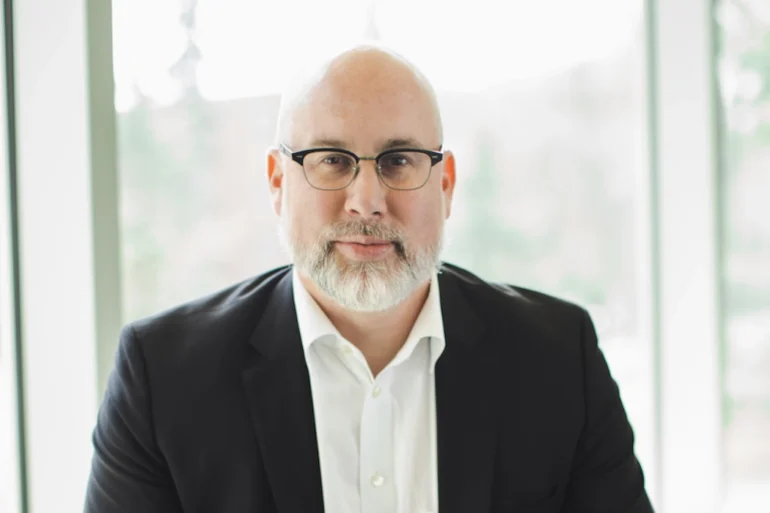
The sector also continues to garner interest from government, business, and academia. To find out what that renewed interest means for the future of nanotech, and Canada’s place as a potential leader, BetaKit sat down with Dr. Andrew Myles, the director of research and development at the Quantum and Nanotechnology Research Centre (NANO) in Edmonton.
The following interview has been edited for both clarity and length.
Many people might not really know what nanotechnology means. Can you define it for our readers?
Nanotechnology is any technology that exploits features on the nano scale; between one and 100 nanometres is usually the common definition. The way I like to explain it is: one nanometer compared to one millimetre is the same as one millimetre compared to one kilometre. So that gives you an idea of perspective.
Once you get down to these small particles, you have unique features, like an extremely high surface area of any material that is reduced to a nanoparticle, and you can exploit that kind of feature in any technology that would benefit from high surface area. It’s very applicable to biology and medicine because our bodies have DNA, proteins, and all of these enzymes that have little nooks and crannies in them at the nano scale. So for the medical side, for solar cells, for batteries, these types of technologies can all benefit from nanotechnology.
What’s the coolest thing being researched at NANO right now?
One thing that really motivates us here now is remote environmental sensing. We work a lot in the North and with Indigenous communities doing environmental sensing research and looking at detecting toxins in water, for instance, but also networking that information. So we have different sensors networking through and collecting that data and looking at those advances of not only the technology but also that digital technology component.
Seeing the technology and what it can do for these communities, I think that’s probably one of the most exciting things we’ve seen in the last little while.
What’s one thing you think people should know about nanotech today?
Nanotech can be applied across industry sectors and is often incorporated in more conventional applications than you may imagine. When you talk about nanotechnology being in things like tennis rackets or lubricants or bandages, people are kind of surprised. But it’s already deployed to a large extent, and there are a lot of benefits already. So it’s not as out of reach as some people may think. It’s a fantastic area to explore because it has a lot of interesting science still going on, but a lot of excellent applications already in place.
Biomedicine is extremely active in this space. I would remind you of the COVID-19 vaccine that was based on lipid nanoparticle technology developed in Canada. This is the beginning. Now this is being explored for all kinds of different biomedicines.
Why do you think Alberta has become an institutional home for nanotech and R&D in Canada? What makes the province so appealing to the industry?
It’s a combination of a couple of things. One is that Alberta’s always had this entrepreneurial, get-‘er-done spirit. I would also say that our universities are fantastic. There are a lot of universities in Alberta; they’re all strong; they all interact; there’s connections and engagement; people graduating with high-tech degrees, getting jobs, and bringing that expertise into companies.
What does Canada need to do to become a leader in nanotech, or to maintain its edge?
We like to look at demonstrating technologies to industry and really trying to move industry and our academic base closer together. I think you’re seeing that across the country in many universities. Places like the University of Alberta’s NanoFAB have many companies every single day, side by side with people at the university working on actual new products. It’s extremely exciting.
I feel like Canada’s move towards really funding and sponsoring technology development and science is very promising. Now it’s up to us as scientists to make sure that we deliver that value to our industries.
If Canada becomes a leader in nanotechnology, how does that benefit the country?
I think it’s all part of moving to a knowledge-based economy and having high-tech as a major pillar. It bolsters all of our industries. The concept of nanotechnology applied across sectors can be beneficial all over the place. It also just gets more conventional, maybe risk-averse companies to sort of step out and look at some options for how they could improve.
And, certainly, global competitiveness is a driver. But it also just strengthens industry locally. It strengthens our position, our major sectors. If we have more of these technologies introduced into our major resource sectors, it strengthens them and bolsters them even more than we already do.
What do you think the future of nanotech looks like, both here in Alberta and more broadly?
I see a lot of more conventional industries adopting nanotechnologies, and in the future you’re going to start seeing nano elements within lots of different technologies. Also, more specifically, connected sensing. So being connected through the Internet of Things and the use of AI to get real-time, remote, and complex data analyzed for us through sensing systems. I mentioned nanomedicine earlier, and with the success of lipid nanoparticle technology, I do expect to see more of that in the future as well.
Feature image courtesy Andrew Myles.