

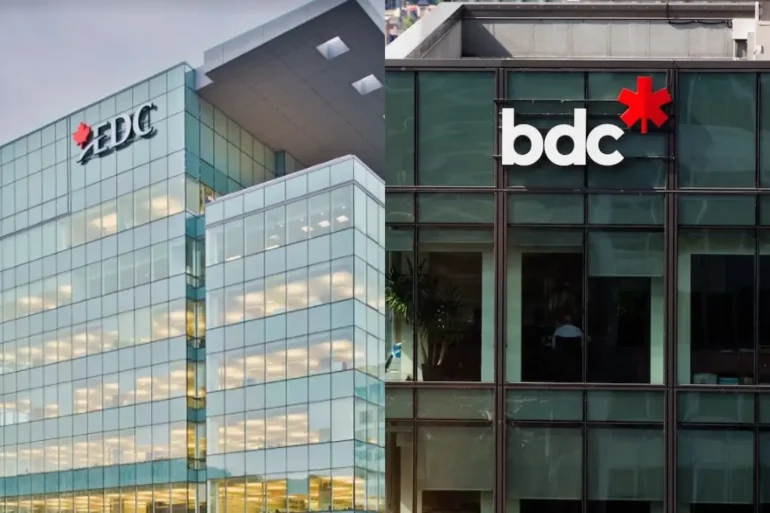
Canada is combining the two Crown corporations most directly involved in financing Canadian startups and promoting trade, a complex process that raises questions about downstream impacts on the innovation economy.
The consequential announcement was buried at the back of Thursday’s federal budget document. Following a review of the effectiveness of financing Crown corporations, the feds are launching a transition process to merge the Business Development Bank of Canada (BDC) and Export Development Canada (EDC) into a single federal development bank.
If combined today, the Crown corporations would total approximately 5,000 employees and more than $120 billion in assets
The budget document said the new institution would “build on the strengths, expertise, and strong teams” of BDC and EDC to provide a “more integrated suite of financing solutions” for Canadian businesses.
The decision was part of an effort, originally referenced in the Spring Economic Update, to review the effectiveness of Canada’s financing Crown corporations, which also include Canada Infrastructure Bank, the Canada Growth Fund, and a forthcoming sovereign wealth fund called the Canada Strong Fund.
With little detail out so far, questions abound about how the merger process could change financing options for entrepreneurs, or whether it might address some of the historical gripes about BDC’s role in the market.
EDC is Canada’s export credit agency, which generally serves larger Canadian businesses selling internationally. BDC is a development bank for Canadian entrepreneurs, typically serving smaller businesses. Separate from BDC’s large loan and financing business, BDC Capital is Canada’s most active venture capital investor, acting as both a limited partner (LP) in many funds and a direct investor across major sectors. If combined today, the Crown corporations would total approximately 5,000 employees and more than $120 billion in assets.
Merging these organizations won’t be a light task and will certainly take years, said Sean Mullin, a senior fellow at the University of Toronto Munk School of Global Affairs & Public Policy and a former special advisor to the prime minister. A “specially constituted” board of directors will be formed to oversee the transition, and the government will have to figure out a plan before amending two pieces of legislation: the BDC Act and the Export Canada Act.
There will also be leadership questions about who will lead the combined entity and how it could impact staff with overlapping roles.
More on #Budget2026
• What’s in Budget 2026 for Canadian tech?
• Ottawa earmarks $176 million to establish online super regulator
• Real-Time Rail payments system to launch Monday, feds say
• Canada to implement QSBS-style tax incentive and “level playing field” with US
• The feds plan to merge BDC and EDC. What might that mean for Canada’s largest VC investor?
“You have to be very careful to make sure you’re not interrupting the delivery of services while this is happening,” Mullin said in an interview. According to the feds, “existing products and services will be fully maintained throughout the transition.”
In response to questions from BetaKit about potential staff cuts, possible program interruptions, and government guidance, both BDC and EDC pointed to official statements on the planned merger. BDC’s statement said the organization “welcome[d] this decision with openness” and that its priorities for supporting entrepreneurs remained unchanged.
“We don’t have all the answers today, but what I do know is that both organizations bring complementary strengths, deep expertise, talented people, and a strong commitment to helping Canadian businesses succeed,” EDC president and CEO Alison Nankivell wrote in a LinkedIn post on Friday.
A spokesperson for the Department of Finance told BetaKit in an email that this proposed merger was “subject to budget secrecy” until the budget was tabled. Since Thursday, the government has been working with both organizations on the transition, and both will continue to operate under their existing mandates, the spokesperson said.
A new future for BDC?
The feds framed the proposed merger as a way to reduce overlap and improve the efficiency of federal financing bodies.
“In the economy of 2026, their distinct roles—one focused on export markets, one focused on growing businesses at home—probably don’t make sense anymore to have as two separate organizations,” Mullin said, as a key growth driver for most companies now is selling abroad.
Notably, the budget document said it expects these Crown corporations to “have a greater risk tolerance than private sector peers” and to complement, instead of replicate, investments that could come from the private sector.
BDC has previously been told via legislative review to refine its risk appetite. Canadian VCs have suggested that the Crown corporation should play less of a role in the direct investing market and skew its activity toward investing in funds. Current CEO Isabelle Hudon told BetaKit earlier this year that the bank is increasingly taking that approach.
RELATED: Canada’s early-stage investment gap “now a sovereignty issue,” BDC says
John Edgar, a Montréal-based partner at cross-border fund Maple VC, told BetaKit that combining the two Crown corporations and changing their focus could be a boon for Canadian venture if they focus less on direct investing and prioritize coinvesting with fund managers. “If they could do that, that would be great for Canada,” Edgar said in an interview.
“Those types of organizations should focus on market making instead of direct investing in the market,” Edgar said.
Chris Arsenault, co-founder and partner at Inovia Capital—one of Canada’s largest venture firms, with BDC in its LP pool—called it a “courageous move” given the size and activity of both organizations.
“I think it makes sense to become more efficient and offer Canadians a single access for all things capital, equity, debt, and global export support,” Arsenault said in a text message. However, he added, some entrepreneurs and GPs could see the combined organization as one less LP to potentially fundraise from.
Some founders were optimistic about the planned consolidation. “In my recent experience with both, it’s blurry trying to understand their separation of roles,” Rivercity Innovations CEO John Shirley wrote in an X post. “All great services and people, but having them under one banner makes sense from my user perspective.”
Feature image courtesy BDC and EDC.