


Prime Minister Mark Carney’s second federal budget makes clear the PM remains solely focused on driving “ambitious” economic growth, with a whole lot of levers his government plans to pull to deliver. BetaKit published a nearly 3,500-word budget overview for Canadian tech, as well as features on some of the biggest line items (all of our Budget 2026 coverage can be found here).
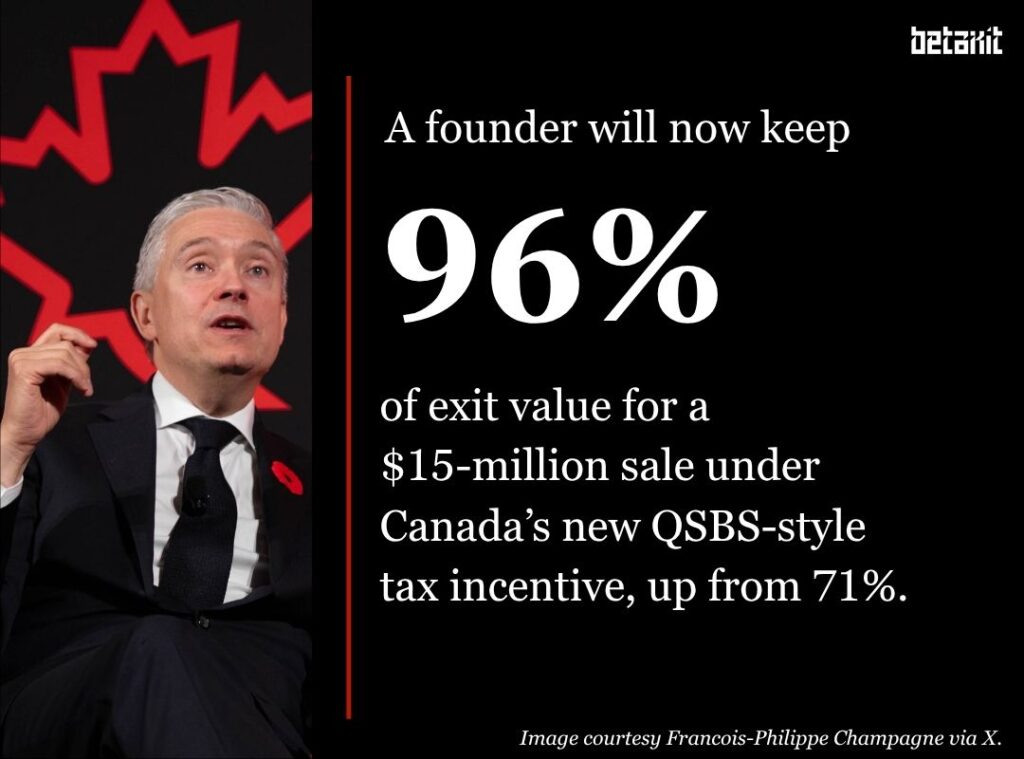
While some of these levers are net new, like the Canada Growth Initiative and US QSBS-style capital gains tax cut, others detail how previously committed capital will be spent, or continue past pledges. There are plans to anchor quantum companies in Canada, develop dual-use tech, forge sovereign space launch capability, provide AI compute, expand cleantech tax credits, and support homegrown IP. As Munk School senior fellow Jaxson Khan said on The BetaKit Podcast, “it’s pretty clear the government has gone down a lot of the laundry lists from businesses and entrepreneurs and just said, ‘OK, well, what if we do all of the above?’”
It’s a lot of new and past commitments to execute on, especially since this government’s record on execution has a few black marks.
Take one pullout: open banking. Since the government first announced it would be studied in 2018, BetaKit has tracked a series of missed launch dates and a narrowed scope of delivery (recently introduced regulations include read-only access, not write access, one of the key asks from FinTechs). Budget 2026 featured no open banking movement beyond teasing an expanded scope for consumer data portability to telecom and transportation—despite the feds not yet enabling it in the financial industry. Canada’s Start-up Visa program is another example: applications remain indefinitely paused, with no replacement, despite promises an update would come before the end of this year.
Some changes will need to be executed smoothly to avoid gumming up the works. Take the proposed BDC-EDC merger. The combined Crown corporations will need to bring together more than 5,000 employees and $120 billion in assets, with very different cultures and structures, all while ensuring that committed capital (including $4 billion for defence and $1.75 billion in the government’s Venture and Growth Capital Plan) starts flowing. BDC is already a capital bottleneck for Canadian tech; more delays could be disastrous.
The real test of this budget’s ability to kickstart growth won’t be found in the size and breadth of its commitments, but in how fast (and well) Ottawa can execute. The government is pulling many levers—BetaKit will be watching to see what they’re connected to.
Sarah Rieger,
Managing Editor
One place for every payment your business makes.
More than 10,000 Canadian businesses use Float to issue CAD and USD corporate cards, pay bills and send money in 21 currencies, with no bank portal or second login. EFT, ACH and SEPA payments are free, and eligible bills paid by Float card earn up to 1% cashback on card spend over $25K a month.
Float Intelligence reads the GST, HST, PST and QST split off every invoice, helping finance teams close their books up to 8x faster.
Top stories from BetaKit
Transit’s journey
Public transit riders are likely very familiar with the little green app that helps them catch their bus on time every day. BetaKit explored the Montréal company’s 14-year journey from a simple consumer app into a complex data layer for transit agencies.
Wealthsimple’s AI assistant
Toronto FinTech company Wealthsimple announced a dozen new banking, investing, and AI products and features at its latest product showcase this past week. At the forefront was Penny, its upcoming AI assistant meant to help any user better understand their financial situation, move money around, and place trades more easily.
Tech stock rout hits Shopify and Lightspeed
Tech stocks have been experiencing a massive AI-driven rout; $2.5 trillion USD was lost from the Nasdaq on Thursday alone. Canadian retail tech companies Shopify and Lightspeed felt the effects this week despite their earnings reports only narrowly missing and meeting expectations, respectively.

A faux protest
Halifax-founded, Toronto-based Floqer is much smaller than fellow CRM platform Clay, which recently minted a $7-billion USD valuation. To take on its biggest competitor without spending millions, Floqer busted out signs, slogans, and memes for a picket line outside of Clay’s marquee event.
How Europe’s fridges got hacked
European grocery stores lost hundreds of millions of euros worth of product in recent weeks as hackers turned up the heat in their fridges and freezers. BetaKit sat down with Jeff Shirley, founder and CEO of Saskatoon-based fridgetech company Rivercity Innovations, to learn more about what happened and whether Canadian devices are at risk.
On big tech
While technology is supposed to get faster and cheaper over time, Tailscale CEO Avery Pennarun writes for BetaKit that big players building bundled systems risk AI becoming a walled garden where buyers never see the benefits.
Meanwhile, as the federal government says it’s making domestic procurement a priority, the Canadian Shield Institute argues that Canada needs a new definition of “Buy Canadian” that doesn’t include foreign branch plants.
Sponsored stories
How Canada can build tech careers worth staying for
To retain Canada’s top engineering talent, Capital One Canada is future-proofing tech careers by operating entirely in the cloud, giving local teams end-to-end ownership over high-impact products, and actively investing in transferable skills through company-wide mentorship and learning programs.
How TD is building the intelligent front door to modern banking for clients
Ranked #1 for customer satisfaction by JD Power, TD is leveraging cloud modernization and thoughtful AI integration to simplify everyday mobile banking through intuitive, proactive features like in-app payroll switching and real-time guidance while maintaining human support when clients need it most.
Canada’s drone ambitions put domestic manufacturers to the test
As Ottawa ramps up military drone procurement, AVSS is expanding its workforce and production to deliver over 1,000 domestically engineered drones, proving true defence sovereignty requires owning the underlying IP rather than just assembling foreign designs.

Build A Cleaner Economy
MaRS Climate Impact delves into the most promising ideas and innovations that could help prevent the most disastrous consequences of climate change and build a cleaner economy.
Join us at the MaRS Centre in downtown Toronto or online on November 17 & 18, 2026 for two days of interactive panel discussions, thought-provoking debates, company demos and more.
Connect with innovators and global cleantech leaders working on the platforms, partnerships and strategies needed to scale the most impactful solutions.
Deals and dollars
Who cashed in, or out, this week:
- Canada is creating more startups than it was last year, but fewer are raising pre-seed capital, according to a new report from Panache Ventures.
- Navigation tech company OSI Maritime Systems was acquired by a consortium of largely domestic investors led by PE firm Novacap, the Globe reports. (Burnaby)
- Customer service tech firm Ada is set to merge with US-based Dialpad in a deal reportedly valuing the firm at $600 million. (Toronto)
- CPPIB took a $50-million USD stake in AI holding firm Beacon Software. (Toronto)
- Snaplii raised $15 million to give AI agents a pre-paid wallet, Axios reported. (Toronto)
- Employee benefits brokerage Sterling Brokers says it has acquired AI platform Lucite to help other brokers analyze data and automate workflows. (Toronto)
- Three Black-led startups took home a combined $170,000 from DMZ’s Black Innovation Summit pitch competition. (Toronto)
Data point
Read more on BetaKit.

BetaKit Podcast · Oct 19
“The United States economy definitely has a cold right now. And when the US sneezes, the whole world catches a cold.”
Economic commentator and New York Times bestselling author Kyla Scanlon joins to discuss the concerning connection between debt and the AI data centre buildout, how AI companies drive the US economy with impunity, and the impacts of AI adoption on the labour market. Watch and listen now ›
Contributors: Alex Riehl (Ottawa staff writer), Douglas Soltys (editor-in-chief), Sarah Rieger (managing editor), Trevor Nichols (web editor).
Feature image courtesy Mark Carney via X.