

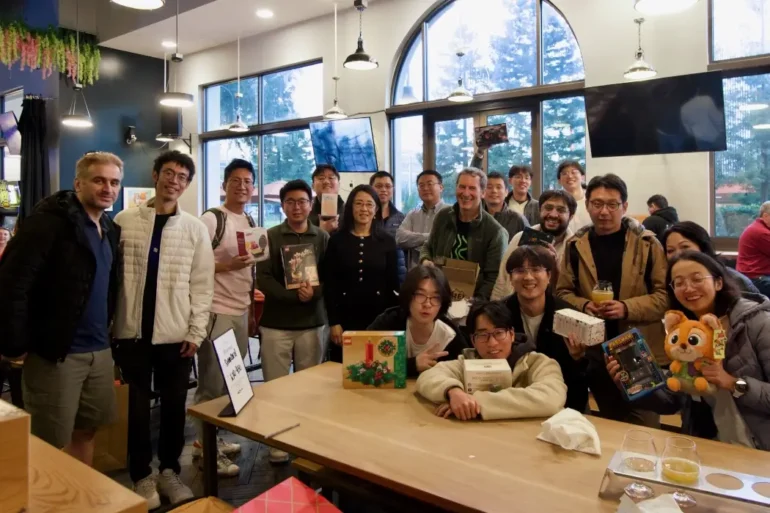
Silicon Valley-based Boson AI has been quietly building a presence in Canada since late 2023.
Over the past couple of years, the well-funded AI research lab has opened an office in Toronto that now houses approximately 20 of its 40 staff, established a relationship with the Master of Science in Applied Computing Program at the University of Toronto (U of T), and begun purchasing most of its computing power from eStruxture’s Barrie, Ontario data centre.
Boson chose to set up shop in Toronto because it offered access to the compute, talent, and the predictability the startup needed to advance its plans to build foundation models to power voice agents, Boson co-founder and CEO Alex Smola told BetaKit in an interview.
Alex Smola argues that US actions to curb immigration present a “massive” opportunity for Canada that “will not last forever.”
Ahead of the last federal election in the United States, Smola said Boson thought it prudent to develop a “Plan B” in case the US began acting erratically and making conducting business in the country more difficult. That has since happened after US President Donald Trump implemented steep tariffs and drastically restricted immigration.
Boson’s decision to build a presence in Toronto “has turned out to be a really good thing because, so far, Canada has been a lot more predictable,” and provided the compute and talent the company requires, Smola said.
The German-born AI leader, who previously served as a vice-president and distinguished scientist at Amazon Web Services, co-launched Boson in 2023, and the company has since closed $70 million USD ($98 million CAD) to take on OpenAI and Meta in the voice AI model race.
During Boson’s early days, the CEO said he ran the numbers and quickly realized that renting computing capacity from a big cloud provider or neocloud was simply “not sustainable.”
RELATED: Superwhisper partners with Cohere for all-Canadian voice-to-text AI
When Boson shopped around for alternative options, Smola said the startup got connected with Montréal-based eStruxture and initially considered setting up in that city, which also possesses a deep AI talent pool thanks to the strength of its local research institutions.
Boson ultimately landed in Toronto after it found suitable power and a compelling offer from eStruxture’s Barrie facility. While the startup had a competing offer from a US provider at the time, Smola said eStruxture was “just a lot nicer” to work with compared to the other company, which he claimed tried to walk back their initial quote and tack on extra fees.
While Boson’s Canadian operations have allowed the firm to bypass tariffs and access equipment and products it needs for cheaper, some of which are not currently available in the US, Smola said access to talent has been the bigger boon thus far.

courtesy Boson AI.
Today, Boson’s Toronto office offers staff a lower cost of living compared to Silicon Valley. The hub is a short walk down the street from U of T’s downtown campus, from which the startup regularly sources interns. It also houses, among others, two Iranians who Smola said are “excellent” staff members but who are unable to travel to the US at the moment.
Right now, Smola said Boson is growing faster in Toronto than Santa Clara because it remains easier to access the work permits and navigate the associated requirements, timelines, and fees necessary to hire AI talent from abroad in Canada.
“This is starting to become a real issue in the US,” Smola said, adding that in many cases it has become “very difficult” for the firm to bring prospective staff to California.
Smola said he didn’t even open a current machine learning engineer position in the US, citing work permitting challenges, as well as the higher cost of living and turnover characteristic of Silicon Valley compared to Toronto.
The Boson CEO believes the actions the Trump administration has taken to steeply curb US immigration present a “massive” opportunity for Canada to recruit talented folks who might have otherwise moved to the US, and argued that this opening “will not last forever.”
But Smola also highlighted that securing the work permits it needs could soon become an issue for the company in Canada.
“We’ve been told that the requirements have gone up by our immigration advisers and we’re about to find out for a candidate we’re bringing in from Europe,” Smola said. “We have high hopes that it will work out, but ultimately this is in the hands of the appropriate authorities. Overall, I hope that Canada can be (and remain) a place that will continue to attract and retain talent from all around the world.”
Feature image courtesy Boson AI.