

Canada’s productivity challenges have put a renewed focus on how companies spend, hire, and invest in technology to support growth.
At BetaKit Talks: The Québec Productivity Engine, the spotlight was on a province showing signs of bucking the national trend.
“We plant the seed, we water the plant, we grow the plant, and someone else harvests it. That has to stop”
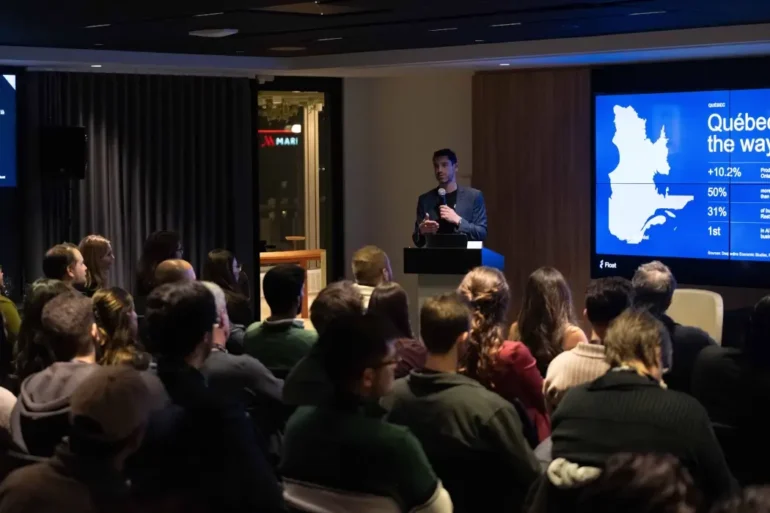
Presented by Float in Montréal’s Place Ville Marie, the event brought together Float Co-founder and CEO Rob Khazzam, Shakepay Co-founder and CEO Jean Amiouny, and Deck Co-founder and CEO Yves-Gabriel Leboeuf for a panel discussion moderated by BetaKit Editor-In-Chief Douglas Soltys.
The evening began with a French-language introduction to Float’s story, followed by a video address from Evan Solomon, Minister of AI and Digital Innovation, who highlighted new budget measures intended to improve access to investment capital and computing infrastructure.
“We plant the seed, we water the plant, we grow the plant, and someone else harvests it,” Solomon said to the audience of Québec founders. “That has to stop, and it is stopping now. Canadian companies must be able to grow here and stay here and compete with the world.”
Build where others see barriers
The three panellists have each helped build homegrown technology companies by identifying opportunities that established players had long overlooked. Amiouny launched Shakepay in 2015 when cryptocurrency was unfamiliar to investors, few banks were willing to work with FinTech startups, and Canadian consumers had limited access to Canadian-built financial products.
“Our view was there has to be something for Canadians, and I think this is the opportunity that most Canadian entrepreneurs see,” Amiouny said. “The barrier to entry can be high. I think FinTech generally is a little bit higher in Canada than in most countries, but beyond that, there’s not much competition.”
Shakepay, which allows Canadians to buy, sell, and hold Bitcoin, now serves just under two million Canadians. Its early years, however, were marked by difficult fundraising conditions. The company raised $20,000 in its first round, at a valuation below $1 million, when many investors were unwilling to back cryptocurrency companies.
Amiouny cautioned the next generation of founders against interpreting a difficult funding environment as a verdict on their ideas.
“VCs, the funding environment—these are all lagging indicators,” he said, adding that a founder’s conviction is a leading indicator. “The world may orient or adapt towards your idea in a year, two years, three years, or so on.” Amiouny added.
Make capital work harder
Khazzam also saw an opportunity to address inefficiencies in Canada’s business banking market. Float was founded to simplify corporate spending and expense management, and has since raised approximately $300 million CAD.
Float is now committing $5 million to expand its presence in Québec, where more than 1,000 businesses already use its platform. The investment includes plans to open the company’s first office outside Toronto in Montréal in 2027, recruit a General Manager, and build a local team dedicated to serving businesses in the province.
Khazzam pointed to Float’s customer data, which shows Québec businesses using the platform are more active in international transactions and AI adoption than their counterparts elsewhere in Canada.

“The productivity growth rate in Québec has been double that of Ontario and the rest of the country for the last 10 years,” Khazzam said. “I don’t know fully how it’s happening, but I want to learn, and I want to be a part of it, and I want to help amplify it because I think the rest of the country can learn a lot from Québec.”
Float’s growth has required a sustained focus on productivity. In the year or so after raising $30 million USD ($37 million CAD) at a $150-million USD ($215-million CAD) valuation in 2021, the broader tech funding market began to sour.
“We knew this valuation could kill the company if we didn’t grow into it,” Khazzam said. So, the company embarked on an 18-month push to improve revenue per employee ahead of its next funding round.
“We kept our headcount flat for 18 months,” he added. “We quadrupled our revenue. We didn’t spend another dollar.”
It was an exercise in capital efficiency born out of necessity, and one that Khazzam said made the company stronger.
Protect the freedom to make decisions
Leboeuf, who sold his first startup, Flinks, to National Bank of Canada in 2021, said having an exit behind him made raising capital for his next venture considerably easier.
“You raise more, faster, [on] better terms,” Leboeuf said.
“You can solve a revenue problem, you can solve a market problem, you can solve a product problem, all those things can be solved. What cannot be solved is you quitting.”
Leboeuf’s current venture, Deck, which develops infrastructure for accessing and interacting with websites, has raised approximately $25 million USD to date, and he acknowledged that investors tend to place greater confidence in founders who have completed a successful exit, even when their new ventures are still in their earliest stages.
When it comes to financing those ventures, Leboeuf strongly favours equity over debt. He argued that startups are inherently risky, and personally guaranteed loans can leave founders weighing their own financial security against the needs of their businesses.
“I would treat debt as almost poison when you’re early stage,” he added.
Turn AI into a productivity advantage
Advances in AI are also changing how much companies can accomplish with limited resources. Float encourages employees to experiment with AI, which has allowed them to create functional prototypes without weeks of back-and-forth between design and engineering teams.
“You can take an idea from a customer and have something ship within 24 hours,” Khazzam said. “I think right now we’re doing 70 percent more output per engineer at Float than six months ago. Over a one-year period, a three-year period, a five-year period, if we all have that mindset, how far are we going to get relative to the rest of the market? That’s what output and GDP per capita is all about.”

Deck has taken a more radical approach in the AI era. “We actually decided to scrap everything we had built and start a full replatforming earlier this year,” Leboeuf said.
The question of how to build—or rebuild—with limited resources was familiar to Leboeuf long before AI entered the picture. He recalled a period in 2017 when Flinks had just two weeks of cash remaining and no revenue, and what eventually got the company through.
“Just sign some deals and get revenues in your company,” he said to the audience. “That’s the only thing you have to do to survive.”
Amiouny argued that the need for perseverance doesn’t change as a company matures.
“Your idea dies when you quit,” Amiouny said. “I firmly believe this to be true. You can solve any problem: you can solve a revenue problem, you can solve a market problem, you can solve a product problem, all those things can be solved. What cannot be solved is you quitting.”
PRESENTED BY

Float helps Canadian businesses streamline spending, simplify financial operations, and do more with less. Learn more.
Feature image courtesy Float.