

Earlier this year, AI Minister Evan Solomon revealed Canada’s refreshed AI strategy, promising the Canadian tech ecosystem a path to capital, compute, and customers, and that the government would shift from a startup supporter to a stakeholder. Over the past month, those promises have begun to move forward.
The Government of Canada revealed a QSBS-style tax incentive and sovereign compute commitments in the federal budget, and it took a hefty, $1.6-billion stake in Toronto-based frontier AI developer Cohere. Solomon has been busy.
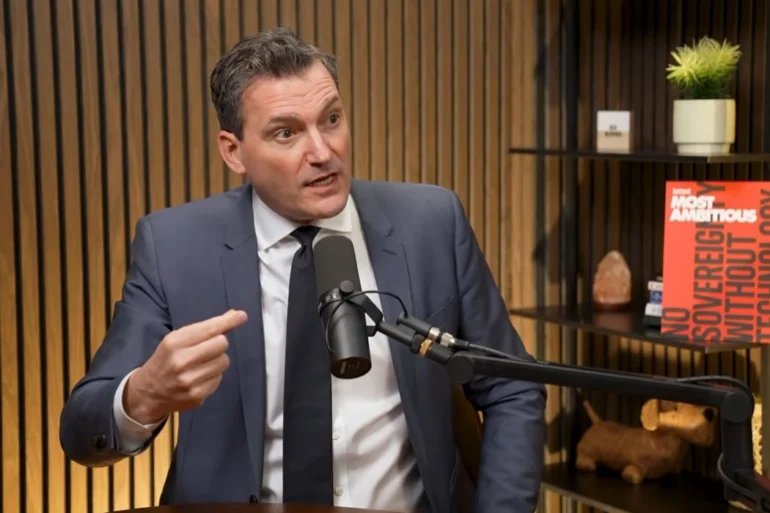
It’s one thing to read a line item; it’s another to hear it from the man himself. Solomon joined The BetaKit Podcast to debrief on Budget 2026, pitch his plan to keep more technology companies in Canada, and explain why Canadian taxpayers shouldn’t expect to learn more details about that big Cohere investment.
The following interview has been edited for clarity and length.
Building sovereign capabilities has been a large part of your portfolio. Since we last sat down, Taalas got acquired by US chip giant AMD, and Canadian-founded, US-based Tenstorrent has reportedly lobbied Canada for sovereign AI contracts. Are you comfortable with that dynamic?
Strategically, we’ve made a very big effort to make sure that talent stays here.
If a company is still invested in Canada, and they’re hiring in Canada, and they do business in Canada, that’s great. But the problem that we’ve talked about is that we plant the seed here, we fertilize it, we grow the plant, and someone else harvests it and we lose the IP and the company headquarters. We’re trying to stop that; this is part of the budget.
We’ve got to make this the best place to invest because we want capital to come here. The Productivity Mega Deduction means that the marginal effective tax rate that a business pays here is 6.4 percent. This is by far the most effective and the lowest marginal effective tax rate. The Canada Growth Incentive is also very important. If you’ve invested in a company that’s become successful and you have an exit, you reinvest up to $15 million back into another Canadian company, then you don’t pay capital gains tax because you’ve reinvested it. This is really the engine to spin the flywheel of investment.
What I’m hearing from you is, directionally, you’re okay with Tenstorrent being on both sides of the border, but you don’t want Canadian companies having to make that choice to begin with.
Tenstorrent made that decision a couple of years ago.
When the next company is looking at the environment and, for whatever reason, they decide to redomicile, my job is to make that decision significantly more difficult because they should be able to say now, “Why? We don’t need to redomicile for access to capital. This is the best place we can get the capital. This is the best place to build a business, and we can grow around the world and stay here in Canada,” and this is the environment that I think we’ve created.
The budget also pledged 500 megawatts of sovereign AI compute to Canadian companies through “backstops and offtake agreements.” Can you explain how that will work?
So here’s the problem: Compute is essentially the fuel of innovation, and it’s expensive. For small-to-medium-sized companies that are trying to buy compute, it’s really hard to get, partly because big companies buy up all the compute in these big projects and there’s not a lot left over.
Through an offtake, we can become the customer, and then we can sort of say, “Oh, you can sell the compute to us.”
You resell it to Canadian companies.
Yes. Or we can do the backstop that we actually, through financial instruments, backstop the building of compute capacity. We haven’t decided on the exact instruments. What we’re making sure of is that if there’s this race to get compute, it’s not just the big hyperscalers that can take the compute and grab it.
Let’s talk about the federal government’s $1.6-billion investment in Cohere. Why is the government choosing this approach?
Simply put, Canada’s not going to wait for others to build the AI. Maybe they would be people we don’t know or don’t trust. We’re going to build it now. Plan A is to build; that’s what every element of our strategy is.
Canada decided to take an equity stake in a strategically important company, Cohere, for three reasons. One, because we want to make sure this company stays Canadian, it’s headquartered in Canada, and its intellectual property stays in Canada. Two, Canadians should have a chance to benefit from this technology, so Canadians get an opportunity to share in the upside of this technology. And three, this gives us a seat at the table. Cohere, after it merged with Aleph Alpha, is now the largest AI language company outside the US and China. This is absolutely critical; this allows us to build in Canada according to our values and our rules.
This is a unique moment where the Canadian public now has skin in the game with a private company. How much should Canadians expect to know about the terms of this deal?
It’s an absolutely vital question. Look, we’re trying to get the best possible terms for Canadians. Our job is to make sure that Canadians benefit from this, Canadians see the upside in this, that our sovereignty and security is protected, and that we’re investing responsibly. We invest through the Canada Development Investment Corporation; they do these kinds of investments, so there’s a due diligence process.
One of the reasons why the details on the commercial terms are not released is that they’re commercially sensitive, but we are making other investments, and it is strategically important not to give away our positions because we’re trying to always negotiate the best terms for Canadians in this deal and in other deals. So again, I think Canadians will appreciate that there’s a diligence process that goes on, but we also can’t weaken our negotiating position on this and other potential investments. We’re following pretty normal investor confidence terms.
Watch and listen to the full conversation here:
Feature image courtesy The BetaKit Podcast.