

Last month, storied Edmonton-based game developer BioWare announced it was being shuttered by parent company Electronic Arts (EA). The closure has left a hole in Alberta’s gaming industry and sparked backlash from fans of the studio’s iconic games. Hundreds of thousands have signed petitions like #SaveMassEffect, while others have advocated for the studio’s sale rather than closure.
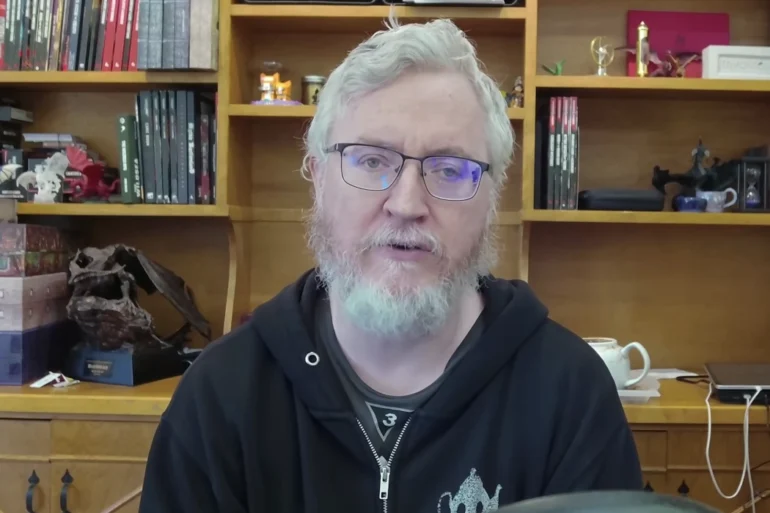
Mark Darrah helped build a lot of that fanbase. The former BioWare developer and current video game consultant and YouTuber left the company in 2021 after nearly 25 years of helping produce some of the firm’s biggest titles. In the wake of his former alma mater’s demise, BetaKit caught up with Darrah to talk about why the studio was shut down, his thoughts on EA, and why he thinks ballooning budgets for AAA games could lead to the end of many more gaming studios.
The following interview has been edited for clarity and length.
BioWare was an anchor for gaming in Edmonton, Alberta, and Western Canada. Without it, what gaps are left? Does its loss create an opportunity for other studios?
BioWare was this gravitational force that kind of swept off everything else. There wasn’t really anything else. Now, it feels like there is a more vibrant mid-tier community in Edmonton than before. The thing that BioWare provided that’s now gone is a backstop. If I interview and I decide to relocate to Edmonton and things go belly up and the studio loses its funding, then I could go to BioWare. With that gone, if I move to Edmonton, I’m taking a risk because if my job goes away, I have to try to land at one of the other indie studios that are never hiring many people.
So there’s less stability in the game development market here without BioWare?
Yeah, exactly.
You were with BioWare almost from its beginning. Why did you finally step away in 2021?
Some of it was that my relationship with EA changed in 2017 and we never really came out the other side of that. So, by late 2020, it was just time to go.
I had been treating [EA] as if it was this caring entity, but, of course, it’s not. It’s a corporation, and it’s behaving like a corporation.
How do you navigate between a game publisher doing what’s in its best interest, and seeing those decisions lead to indirectly sabotaging a studio’s creative process?
The fundamental incompatibility between EA and BioWare was that on pretty much all of its projects BioWare grew its way to success. In the early days, when we were struggling to make Baldur’s Gate, we hired 40 more people. After we were acquired by EA, we weren’t allowed to hire people anymore. So what do we do? Well, Dragon Age and Mass Effect need more people to ship. We’ll just eat all the other things we’ve been doing. They’re all gone. After a point, we’ve kind of eaten all the fat off of our studio, and so now, even though our processes still kind of demand this little surge at the end, we weren’t allowed to do it anymore.
I don’t blame EA for that. That’s just EA; that’s just how they are. Ultimately, that friction was building up in BioWare’s machinery; the studio probably should have been 100 more people than it was, or it should have dropped an entire franchise line, but it did neither, and so that friction was building up until it ultimately kind of resulted in the machinery not really operating properly anymore.
You mean just focusing on a single game exclusively? What might that have looked like?
When you look at a studio like Maxis, which is also a studio with a culture very different to EA’s, what they did was they effectively became one project, and so the envelope is very much sized to that one project. I wouldn’t have wanted BioWare to do this, but I believe that if it had, it would have slotted into the culture of EA better.
Since the closure, there have been some grassroots efforts to save some of BioWare’s intellectual property. The #SaveMassEffect campaign has hundreds of thousands of signatures. Do you think realistically that EA would ever be open to selling that IP?
If EA was still fully independent, I would say no. A lot of EA’s culture is built around avoiding blame. You can’t think of EA as a single entity, you have to remember it’s built out of a lot of people. What they’re trying to do isn’t make the most money for EA: they’re not trying to make the best decision, they’re not trying to make the best art, they’re trying to avoid someone yelling at them.
If you think about the scenario of taking that IP and selling it for, let’s say, $10 million. EA gets $10 million. Everyone’s happy, right? The thing that the person making that decision is worried about is, if they sell Dragon Age for $10 million, and then the people who buy it make a game that wins Game of the Year, well then someone comes and yells at them, and is like, “why couldn’t we do that?”
EA has been bought out by a Saudi investment company, and EA now has $20 billion USD of debt from that leveraged deal. They’ve got about a billion dollars in profit in a given year. So now the calculus is maybe changed.
In Canada, we’ve seen many recent layoffs and other game studio closures, most notably at Ubisoft. What does the end of BioWare signal about the state of the video-game industry right now?
The fidelity of games has gone up and up, especially in AAA games. You can see the peak of that in Grand Theft Auto VI. Its budget is probably north of a billion dollars. Nobody else can spend that. What I think is starting to happen is you’re starting to see that traditional AAA games are almost moving up into AAAA. The rest of us are going to go the other way, and our budgets have to come down. What we are starting to see signs of is separation. The games right where BioWare sat are starting to go away. The high-budget, but lower-tier AAA games may disappear. Those studios are going to have to drive their budgets down.
I do think that there is a path forward, but I think a bunch of AAA studios are going to essentially not make the cut. They will not be able to pivot. They won’t be able to either become Skyrim or Grand Theft Auto, or figure out how to make their games for less money. There will be a hole, and AA studios will move into that hole.
What impact do you think those higher costs have on the Canadian market?
The problem in Canada is that it’s harder to get $75 million than in San Francisco or New York. If this is what’s happening, if we’re going to turn over the entire industry, then we’re going to lose a bunch of studios, and new studios will rise into the hole in places where they can get funding. That likely leads to studios from the edges of the tree falling away, and more studios rising closer to the trunk.
BetaKit’s Prairies reporting is funded in part by YEGAF, a not-for-profit dedicated to amplifying business stories in Alberta.
Feature image courtsey Mark Darrah on YouTube.