

Since retiring from figure skating in 2010, Craig Buntin has not lost his edge or stopped to catch his breath. Entrepreneurship was an obvious next step for the three-time Canadian national champion and former Olympic pairs skater, who is not one to rest on his laurels.
Buntin’s first foray into business was a coffee-tea fusion company named Teabean that he managed to get into 100 cafes across Montréal before eventually selling out to his distributor.
Craig Buntin’s mom taught him how to chase his dreams. His latest one involves helping Canada build homes faster with robots.
His second, a Montréal-based AI-powered hockey analytics software startup called Sportlogiq, raised the stakes and stoked his interest in technology. He co-built Sportlogiq into a platform that helped nearly every NHL team track, analyze, and optimize on-ice performance, culminating in an exit to larger US peer Teamworks earlier this year.
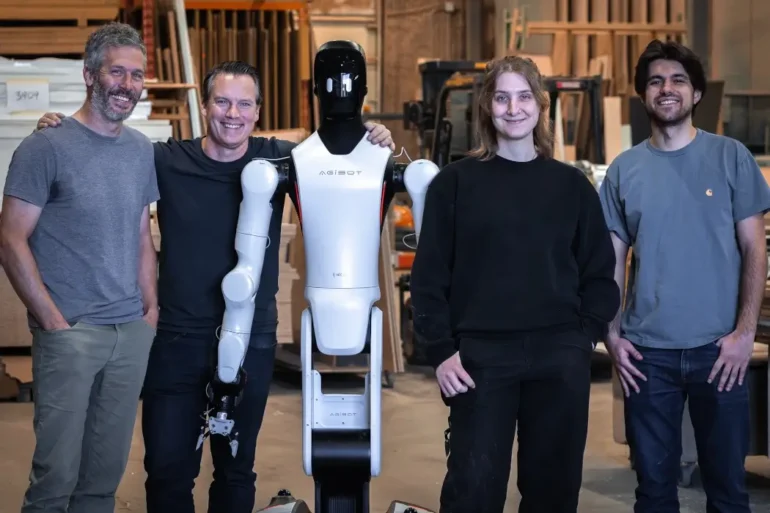
After that, Buntin immediately began working on another AI startup, Rise Automation, to tackle what might be his biggest challenge yet: putting a dent in Canada’s housing crisis by helping custom millwork, cabinetry, and precast concrete factories deploy robots.
The Montréal-based Mila spinout closed $2.4 million CAD in previously unannounced pre-seed funding in July—from BDC Capital’s Industrial Innovation Venture Fund, Developer Capital, and Cycle Capital—to build the AI-powered software “coordination layer” that small shops need to automate parts of the homebuilding process. That simple agreement for future equity financing, Rise’s first round to date, was supported by undisclosed angels and clients.
In an exclusive interview with BetaKit, Buntin unpacked his journey from figure skating to repeat entrepreneurship, and talked about where he plans to go from here as co-founder and CEO of Rise.
Finding his edge
Buntin, a Kelowna native, began figure skating when he was 10 because he wanted to learn how to play hockey. Despite being late to the party—most of his peers had started at six or seven—he quickly demonstrated a knack for the sport. After successfully landing his first jump on one foot in hockey skates as a small crowd of coaches, peers, and parents cheered, he was hooked.
Buntin and his older brother Jamie were raised by a single mother with limited means. A week into his figure-skating career, his mom, Jan, who worked as an office manager, sat him down after receiving her first bill to gauge his passion. According to Buntin, she said, “‘Look, if you really love this, I’ll support you. We’ll pay the bill, we’ll keep going. If not, there’s 100 other sports that are way less expensive that we could manage.’”
“I told her right there that I wanted to go to the Olympics, and that was it for me,” he said. “I never had a Plan B … That’s what I was in love with, and that’s what I was immediately dedicated to doing.”

Buntin struck a deal with his mom that, for as long as he worked hard and loved the sport, their family would make the necessary sacrifices to support his ambitions. Over the next 20 years, that’s exactly what they did. He put everything he had into achieving that goal; to help finance his efforts, his mom sold her house and his brother took on three jobs. During high school, Buntin spent his spare time working as a bus boy, washing trucks, and serving as the mascot of the local major junior hockey team, the Kelowna Rockets.
“We pushed so that I could do it, and I think she taught me how to chase my dreams and to focus on that massive north star,” Buntin said. He is grateful to have had the chance to travel the globe and represent Canada at seven World Championships and the 2006 Winter Olympics, and is glad that he retired feeling like he left nothing on the table.
Buntin sees many parallels between competitive sports and entrepreneurship. Both require setting a mission and relentlessly pursuing it “no matter how many times you fall down.”
RELATED: Teamworks, the “operating system for sports,” buys hockey analytics platform Sportlogiq
“When you go to the Olympics, you’re standing at center ice and you’re either going to win and become a hero or lose and nobody’s going to remember you,” Buntin said. “[The] idea of entrepreneurship is you’re going to work hard, make good decisions, and win, or you’re going to lose it all. It always felt really natural.”
During the final months of his figure-skating career, Buntin began toying with the idea of building a company. He began working on Teabean full-time a day after hanging up his skates. Despite lacking an undergraduate degree, he simultaneously managed to gain entry into and complete McGill University’s MBA program, which led to him focusing on Sportlogiq, which was officially founded in 2015.
From sports to sports tech
Sportlogiq’s first investor was local venture studio TandemLaunch. An old YouTube video of one of Buntin’s 2008 figure-skating performances helped convince TandemLaunch founder, managing partner, and CEO Helge Seetzen that he was a good bet.
That video showed a Paris competition where his partner Meagan Duhamel’s skate accidentally sliced the back of Buntin’s hand mid-routine. He returned minutes later, bandaged but still visibly bloodied, and the duo finished their dance to a standing ovation, ultimately securing bronze. “He’s like, ‘Yeah, this is the guy that I’m backing … Regardless of what tech, I know that this founder will bleed and keep going,’” Buntin said.
“Clearly he was not somebody who would give up easily,” Seetzen told BetaKit over email, adding that “his level of drive can go a long way.”
RELATED: TandemLaunch closes $37-million Fund IV to create and back deep tech startups
Sportlogiq uses a patented combination of AI and computer vision to pull player movement and activity data directly from standard video feeds, make it easy to parse, and derive deeper insights that coaches can use to scout, strategize, and improve performance, and broadcasters can leverage for storytelling. The startup’s tech, which has become ubiquitous in professional hockey, is also used at the college and amateur levels, and in football and soccer.
The company, which raised approximately $28 million to fuel its efforts, had a near-death experience during the early days of COVID-19, when the pandemic temporarily shut down the sports world and its sales cratered. “This is where I earned my grey hairs,” Buntin said. That stretch came post-Series B, shortly after Sportlogiq had made some big investments in expanding beyond professional hockey, forcing the firm to kill those initiatives in an effort to conserve cash. Buntin credits Sportlogiq’s team for pulling together and quickly adjusting during this period.
RELATED: AI investment firm DevCap closes $5 million as it eyes public listing
Sportlogiq was able to weather this storm and find its footing once again as a profitable, 80-person firm with more than $10 million in annual recurring revenue and a particularly attractive data-capture engine.
While the financial terms of Sportlogiq’s January 2026 acquisition by Teamworks were not disclosed, Buntin claimed it was a “sizeable” win for the firm’s founders, staff, and investors by Montréal ecosystem standards.
Tackling the housing crisis with robots
During Sportlogiq’s final days as an independent company, Buntin started working on Rise. He noted that building homes in Canada, let alone buying them, is an expensive and time-consuming process. “It’s a massive societal crisis right now,” Buntin said, and it’s one he’s particularly passionate about.
His mom selling her house to support his dream is certainly a factor. “I’ll never forget her pride in knowing it was hers, a home that would appreciate over time,” Buntin said. “You can’t underestimate how empowering that is after decades of living paycheque to paycheque.”
Buntin is also motivated by the chance to make homeownership more affordable for the next generation of Canadians, and thinks Rise offers his best chance yet “to make the most meaningful impact.”
He initially set out to help by developing sustainable building materials like carbon-negative drywall and robots to install them, but while those components can be expensive, he said that price pales in comparison to the cost of labour; Canada’s residential construction sector currently faces a severe shortage of workers.
“Homes are a manufacturing problem: the cabinets, millwork, and concrete that go into them are made in factories, and in the shops we work with, the machines sit idle about 90 percent of the week,” Buntin said. “Running them three shifts would take triple the workforce, but [there] are only about 40,000 open manufacturing jobs today. Intelligent robots close that gap.”
This led the startup to refocus on retrofitting existing shops. He co-founded Rise with chief scientific officer Liam Paull and chief innovation officer Charlie Gauthier, two researchers connected to local AI research institute Mila (Paull is an associate professor at the University of Montréal, while Gauthier is a student at Mila under him). Gauthier is developing Rise’s core tech as her PhD thesis. Buntin described it as an AI memory and mapping software system that enables robotic orchestration.
Craig Buntin, Rise
“[The] idea of entrepreneurship is you’re going to work hard, make good decisions, and win, or you’re going to lose it all. It always felt really natural.”
Mila’s managing director of AI ventures, Stéphane Marceau, said Buntin was the AI research institute’s first founder-in-residence. “What stood out early was his empirical and humble approach to building the business,” he told BetaKit over email. “He spent significant time with manufacturers, observing their operations and understanding their problems in detail before jumping to solutions.”
Most of the factories that Rise has set its sights on are not currently using robots. They have lots of unused capacity and could also stand to gain by automating some of their core daily tasks, Buntin said. But after spending a few months embedded inside some of these sites, he quickly realized that industry was “nowhere near ready for automation.”
Buntin said many factories contain “the same type of chaos as hockey,” with operations that are heavily reliant upon the institutional know-how of longstanding staff. By either setting up video cameras of its own or leveraging existing feeds inside these facilities and deriving insight from them using its tech, Rise sees room to help floor managers better understand what’s happening in their shops and the potential return on investment of automation.
“I think of it a little bit like Sportlogiq for your factory,” Buntin said. That pitch has begun resonating, as the now six-person startup is set to install its tech at its fifth factory by the end of November. That marks the first step in Rise’s game plan. The next step is connecting these factories with partner third-party robotics firms like Laval, QC-based Omnirobotic and providing the “human-robot interface” or “coordination layer” necessary to retrofit their sites for these robots. While it has begun doing the latter, its progress on this front remains early.
A scarcity of egocentric data remains a key barrier to more widespread deployment of robots capable of consistently executing real-world tasks. Buntin is betting another firm will win that race, and positioning Rise as not only an infrastructure player that other manufacturing robotics firms can plug into but a potential sales channel for them.
For the shops Rise is selling to, the pitch is simple: the chance to boost their capacity and reduce their costs. With Rise, Buntin hopes to help Canada tackle some huge challenges, from housing costs to construction timelines, while also trying its best to bring workers along for the ride, rather than displacing them.
“We’ve got a mountain in front of us,” Buntin said. He’s excited to embark on another climb.
Feature image courtesy Rise Automation.