

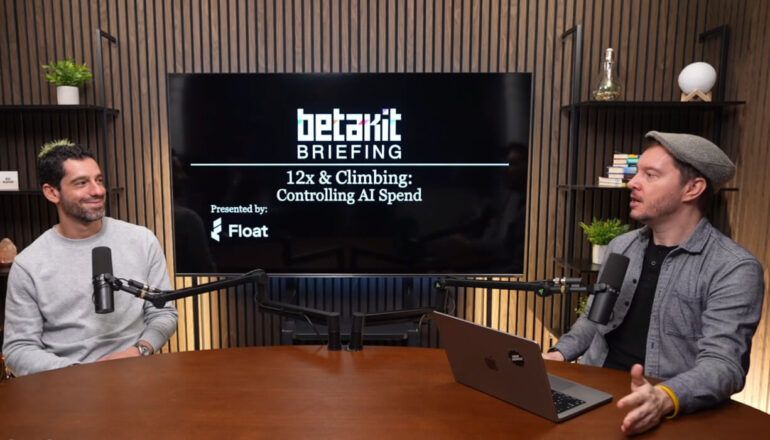
Rob Khazzam has a funny story about keeping business AI costs under control. A few months ago, he discovered his own usage was costing $2,364 a day. He’d selected an expensive model without realizing it would remain the default for new conversations, so even routine prompts were running up the bill.
For the co-founder and CEO of Float, the Toronto-based startup building Canada’s intelligent financial operating system, it was a lesson in a challenge facing many of its nearly 10,000 customers.
“We’re seeing an explosion of spending, an explosion of adoption.”
Rob Khazzam
Float CEO
When looking at the data across Canadian businesses using Float, “We’re seeing an explosion of spending, an explosion of adoption,” Khazzam told BetaKit in a recent interview.
AI spending on Float grew twelve-fold over two years and more than four-fold in the past year alone, he said. In the past year, seventy percent of customers had experienced a month when their AI bill jumped 50 percent.
But bringing those bills down isn’t always the right response. Khazzam says that leaders need to understand how AI spending helps their teams accomplish more, while being able to catch costly habits like his own.
Drawing on Float’s experiments and expensive lessons, Khazzam shared what’s changing his thinking about spending, hiring, and helping employees get more out of AI. Here are five of his hottest takes.
1. Treat AI spending as an investment in your team
A rising AI bill doesn’t necessarily mean the company is becoming more expensive to run. If the tools help employees accomplish more without adding as many new hires, that spending could support a more productive business.
It’s why Khazzam has moved away from treating AI as a software expense to cut whenever it climbs too high. Instead, he said, “The right frame to me is to look at your payroll and your token spend together, and look at that combined number as your human capital investment.”
At Float, token spend rose from the equivalent of 0.1 percent of payroll a year earlier to about five to six percent in October. Khazzam now looks at the two costs together as a percentage of revenue, with the understanding that the business will grow alongside the combined expense.
The test extends beyond efficiency: “Do you solve customer problems faster? Do you build better product experiences faster? Does your organization learn faster?”
2. As part of the hiring process, consider what role AI can play
Before adding someone new to a team, Khazzam asks managers to consider how AI could help existing employees handle the work.
“Anytime someone wants to post a role, send us an email and explain why you need to fill this role and how AI can support the work,” he said, describing Float’s approach.

Hiring may still go ahead; Float is hiring now more than ever, but the exercise is designed to create a pause to help managers reconsider the responsibilities and resources required and how their team builds with AI first.
AI can also change what a company needs from a role. Float’s designers now build working prototypes using an internal tool called Surf. Khazzam said that’s changed what he looks for in a design team compared with a year earlier.
3. Match the model to the work
More powerful AI models can cost more to use, but their additional capabilities are not necessary for every job. Editing an email, for example, doesn’t need the same resources as solving a difficult data science problem.
“In most use cases, the marginal benefit of a frontier model is not needed,” he said.
Managing that difference requires more than instructions telling employees which model to select. Khazzam favours permissions that give people tackling complex technical problems, such as data scientists and principal engineers, more discretion over access.
Companies also need to catch spending increases as they happen. He recommended setting thresholds and assigning someone responsibility for flagging when usage crosses them, investigating the causes, and recommending adjustments.
4. Let employees explore, then choose shared tools
Letting employees try different AI tools has helped Float discover useful applications. But as adoption grew, people were sometimes solving the same problem with different products, making collaboration harder.
“We had, for example, 20 people trying to solve the same problem using five different tools,” said Khazzam.
Monthly adoption reports showed who was using which products and consuming the most tokens. Float eventually consolidated its tools. Khazzam noted that standardizing made it easier for Float to manage permissions, protect sensitive information, and give employees access to shared business context.
“Because the power of AI is not just editing an email. It’s being able to have it understand your business, the problem you’re trying to solve, and perpetually get smarter.”
5. Give learning time to pay off
A higher AI bill may arrive before the benefits show up in financial results. Khazzam cautioned against concluding an investment has failed simply because revenue per employee has not immediately risen in proportion to spending.
“It takes time,” he said.
At Float, company-wide hackathons have provided a useful way to assess progress. Watching employees build and ship something useful in a day or two gave leadership the confidence to keep supporting experimentation.
The events extend beyond engineering and product to include marketing, sales, and other non-technical teams who take part to ship new workflows and customer solutions both in and out of the product. Employees then show colleagues what they’ve built, helping practical knowledge spread across the business.
Khazzam sees that kind of learning as an investment that can compound: employees using AI now have more time to develop their capabilities than those who wait.
“I’m completely fine overspending for the next six to nine months, and culling it back if it means that the sum total of hours our team has spent learning is as high as humanly possible.”
PRESENTED BY

Click here to read Canada’s AI Spending Snapshot from Float for the latest data and insights to take back control of your company’s AI spending.