

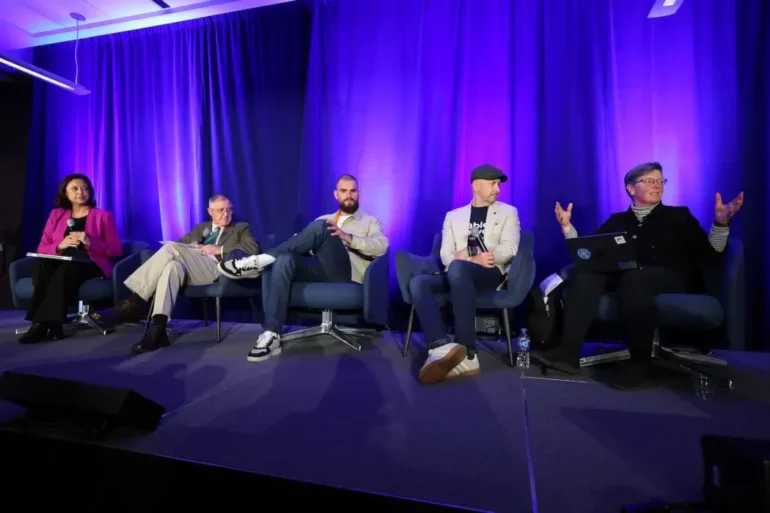
In many ways, AI has made things better for people living with disabilities. In others, the technology has exacerbated existing problems.
Speakers at Access to Success’ inaugural Canadian Disability Tech Summit in Toronto on Wednesday afternoon unpacked some of the most interesting ways that AI is improving accessibility, how its underlying nature is deepening existing divides, and how we ought to leverage this tech to build a more inclusive world.
“Disability has always been a driver of innovation.”
Pete Horsley, Remarkable
Panellist Max Lemmens, general manager of Canada at the UK-founded, US-based voice AI firm ElevenLabs, noted that AI has made it easier to not only create but restore things. Some of ElevenLabs’ work has focused on giving a voice to people living with permanent voice loss.
“Historically, people who’ve lost their voice have been stuck with what I’ll call the Stephen Hawking effect, where it’s a very robotic voice that’s not really theirs,” Lemmens said. “For many people, their voice is their identity.”
To help address this problem, Lemmens claimed that, to date, ElevenLabs has helped more than 11,000 people regain access to their voice by applying AI to old recordings.
Fellow panellist Pete Horsley, founder of Australian disability tech accelerator Remarkable, highlighted some of the capabilities that Calgary-based brain-computer interface startup Possibility Neurotechnologies has demonstrated in his country as another helpful use-case. Possibility aims to allow users to control devices using their thoughts.
RELATED: Accessibility isn’t “a niche problem,” says organizer of inaugural assistive tech conference
“For one child that we tested the technology [on] within Australia, they only [previously] had a signal for yes … [Possibility was] able to give this child the ability to say no, and they actually said no a whole lot more after that,” Horsley said to audience laughter.
Tom Butcher is a senior advisor and ambassador at Austrian disability research organization Zero Project. He said the World Institute on Disability’s work using AI to compile resources on where to find wheelchairs, interpreters, and accessible shelters during times of crisis is an example of how AI can break down barriers.
However, as panellist Jutta Treviranus pointed out, one of the biggest underlying challenges is that AI is “statistically representative.” Modern AI and large language models rely on statistical pattern recognition, often amplifying the biases and trends present in their training data.
Treviranus, professor at OCAD University and director of the Inclusive Design Research Centre, said that since AI chooses “the average, the middle, the majority, [of] the most popular … many of [its] determinations regarding people with disabilities are wrong right from the get-go.”
“What we’re creating is this almost digital eugenics.”
Jutta Treviranus,
OCAD and IDRC
“Disability is a universal condition,” Treviranus added. “We will all experience it, and we all know that within this room. But, for whatever reason, we haven’t considered that. What we’re creating is this almost digital eugenics where we’re removing difference, we’re removing comfort with difference, and we’re not addressing that diversity that is the key to our human survival.”
Treviranus is particularly frustrated that “we are now going into what is the disruption of our lifetime, or this generation, but we’re not disrupting; we are basically automating, accelerating, and amplifying past patterns.”
People in the disability community are often told to just use these AI tools. But in practice, they can “work the worst for people [who] need them the most” due to their algorithms and often limited data on users with disabilities, Treviranus said.
Treviranus believes the solution involves re-engineering those algorithms and enabling on-device AI that can make use of individual data to better serve members of the disability community. Lemmens thinks that AI trained on synthetic data based on disability-focused datasets like the one Treviranus has spent years collecting could also help fill this need.
RELATED: Toronto gets a new hub for accessibility innovation
Lemmens does not see avoiding AI as an option. He believes the best approach involves pushing things forward, recognizing the tech’s shortcomings, and addressing them “head on.”
Horsley stressed that “disability is not about some of us; it’s about all of us,” and encouraged people living with disabilities to play an active role in building the world they’d like to inhabit. “Disability has always been a driver of innovation,” he said. “When you don’t have a world that’s creative for your needs, you’re always thinking about, what is the solution for that?”
Given where we now sit in the AI era, Horsley sees a unique chance to build better systems “from the bottom up,” rather than retrofit for accessibility, which is typically costlier. Horsley said Remarkable has seen “a massive, massive uptick” in the number of founders with disabilities launching businesses using AI tools, and urged attendees to follow suit. “There are huge opportunities here to create your future in [this] space, so go ahead and do it.”
Feature image courtesy Access to Success. Photo by Tim Fraser of KITE Studio.