

Anthropic is preparing for the world’s largest IPO, and it’s citing Canadian copyright battles as one of the many risks facing investors who want to participate.
The news: Nearly a third of the frontier AI giant’s IPO filing on Monday was dedicated to “Risk Factors,” such as reputational harm from misaligned AI, the need to secure more capital for compute, and litigation related to AI model harms.
A detailed list of Anthropic’s legal matters from the filing includes four copyright actions in Canada, which allege that the work of authors and news publishers was illegally copied to train the company’s AI models. It’s facing multiple similar copyright suits in the US from music publishers, plus individual suits from authors who opted out of a class-action lawsuit that Anthropic settled for $1.5 billion.
Anthropic “disputes the allegations of wrongdoing and intends to defend itself vigorously in these matters,” the prospectus says.
From the source: “Much of Anthropic’s pitch is that a company with a single product—one it admits is dangerously uncontrollable and unpopular—can justify a $1.5-trillion (or so) price tag,” Semafor’s business reporters wrote.
The context: While the filing shows a massively capitalized company with a valuation that could eclipse the $1.5-trillion figure, it also shows one massively in debt. Anthropic owes $400 billion in future obligations for compute purchases and data centre leases and, despite 1,368-percent revenue growth, saw a net loss of $80 billion in the first half of 2026.
The business is using that debt load to rapidly accelerate its plans. This includes expansion into Canada with recent hiring sprees and data centre projects (its first is planned for Nova Scotia), all while it contends with the copyright lawsuits and an uncertain regulatory future in the country. Anthropic may be chasing a huge reward in its public offering, but its mounting legal fights only add to the sheer scale of all that risk.
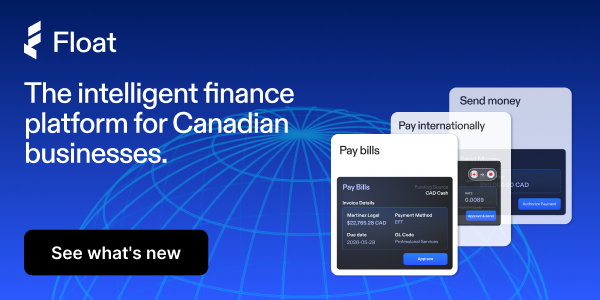
One place for every payment your business makes.
More than 10,000 Canadian businesses use Float to issue CAD and USD corporate cards, pay bills and send money in 21 currencies, with no bank portal or second login. EFT, ACH and SEPA payments are free, and eligible bills paid by Float card earn up to 1% cashback on card spend over $25K a month.
Float Intelligence reads the GST, HST, PST and QST split off every invoice, helping finance teams close their books up to 8x faster.
Latest news across tech
RBC blocks AI agents
The Royal Bank of Canada has become the first Canadian bank to block customers’ third-party AI agents from directly accessing online banking, saying in an internal memo that the practice “can create unacceptable customer risk.” RBC is following the lead of multiple major US banks, including Morgan Stanley, JPMorgan, Bank of America, and Citi, after some detected agents that appeared to be active in customer accounts without user instruction.
Another open banking delay
Last Friday, Canada’s Competition Bureau submitted its endorsement of the country’s proposed open banking regulations, citing their “alignment with a pro-competitive regulatory framework.” However, The Logic reported this week that the long-awaited financial data-sharing system is once again held up as the feds weigh whether to adopt a US-based technical standard-setter.
China’s AI stock selloff
A glance at China’s stock market could fill any AI bubble doomer with a sense of vindication. Mainland China’s AI-dominated STAR50 index has dropped by 40 percent in less than four months, erasing around $480 billion in market value, according to Reuters. Don’t assume this crash is a warning signal for Western markets, however, as China’s market operates under stricter government control and features outsized retail investor participation, meaning it’s more prone to drastic sentiment- or policy-driven swings.
Coldcard class action
Toronto-based Coinkite is facing a class action lawsuit after more than $140 million USD in Bitcoin was stolen from users of its offline crypto wallet storage device, Coldcard, over the summer. The lawsuit, which has not yet been certified, alleges Coinkite failed to inform users of a security vulnerability and that its negligence allowed the breach to happen.
A BDC influencer fund?
YouTube is calling on Canada to recognize social media influencers as a distinct professional category. It hopes to improve data collection on an economic sector the video-sharing platform claims will “be worth billions of dollars in the coming years.” The company also suggested a dedicated lending stream for digital media entrepreneurs under BDC to help “scale up” through hiring or studio space, YouTube Canada head Nicole Bell told The Globe and Mail.
Sponsored stories
Cybersecurity has a builder problem and a buyer problem. Rogers Cybersecure Catalyst is working on both.
Rogers Cybersecure Catalyst launched two initiatives, the Cyber Challenge for startups and Cyber Integration for Businesses for SMEs, to bridge the gap between cybersecurity creators validating their products and smaller companies seeking tailored security guidance.
This program is pushing startups to plan for security sooner
Rogers Cybersecure Catalyst’s no-cost “Cyber for Startups” program provides early-stage Canadian tech startups with coaching, assessments, and roadmaps to integrate security directly into their products and business models from the start.
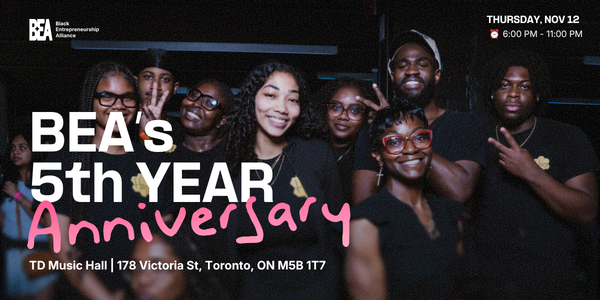
BEA Celebrates 5 Years of Building Loud!
The Black Entrepreneurship Alliance (BEA) is celebrating five years of breaking barriers, creating opportunities, and championing Black entrepreneurship!
Join us on November 12, 2026, at TD Music Hall in Toronto for an unforgettable evening of music, storytelling, networking, and community celebration.
Together, we’ll reflect on five years of impact, recognize the entrepreneurs, partners, and changemakers who have shaped our journey, and celebrate what’s next.
Expect bold energy, meaningful connections, and a night to remember. Come dressed to impress and celebrate this milestone with us!
November 12, 2026 | Doors Open at 6 PM | TD Music Hall, Toronto
On the move
This week’s hires, fires, and exec shakeups:
- Former SXSW president Hugh Forrest joined Toronto-based comparative intelligence company Erisian as a strategic partner and founding shareholder.
- CIFAR AI chair Pat Pilarski told the TechSurge podcast he will soon join Richard Sutton at SF-based ExperienceFlow as head of edge superintelligence.
- Toronto-based savings unicorn Super.com appointed former Match Group CEO Bernard Kim and former Braze CFO Isabelle Winkles to its board.
- Vancouver-based PE firm Vistara Growth promoted John O’Donoghue and Neil Kenley to partner, and hired Jyotin Handa as CFO as it launches a new fund.
- Calgary-based defence tech company North Vector Dynamics expects to double staff to roughly 50 employees over the next six to eight months following a new funding round.
- Amazon used an AI tool to assess the likelihood of workers unionizing in its Canadian warehouses, complete with a “labour risk” score, according to The Globe and Mail.
- Microsoft is offering voluntary buyouts to about 60,000 employees, roughly a quarter of its workforce, including in Canada, to cut costs.
- Nearly half of Canadian CEOs are eyeing AI-driven growth with smaller staff, according to an EY survey of 50 business leaders.
- White-collar workers are pre-emptively changing careers, or would like to, as they fear AI disruption, reports The Globe and Mail.
Want to feature a hiring announcement in our list? Email partnerships@betakit.com with the subject line JOBS.

#1. Which internet meme of yesteryear appeared in an ad for Mozilla Firefox pushing back against online tracking and AI features?
Your score:
Quiz answer: e) all of the above. The surprisingly charming ad, titled “The Internet you loved is still here,” gathered 10 meme icons from the 2000s and 2010s to “remind people of what made the internet so wonderful in the first place,” Mozilla’s CMO told Mashable. Will it be enough for users to Leeroy Jenkins their way back to the browser?
Quiz answer: e) all of the above. The surprisingly charming ad, titled “The Internet you loved is still here,” gathered 10 meme icons from the 2000s and 2010s to “remind people of what made the internet so wonderful in the first place,” Mozilla’s CMO told Mashable. Will it be enough for users to Leeroy Jenkins their way back to the browser?
Contributors: Alex Riehl (Ottawa staff writer), Madison McLauchlan, Montréal reporter, Douglas Soltys (editor-in-chief), Sarah Rieger (managing editor), Trevor Nichols (web editor).
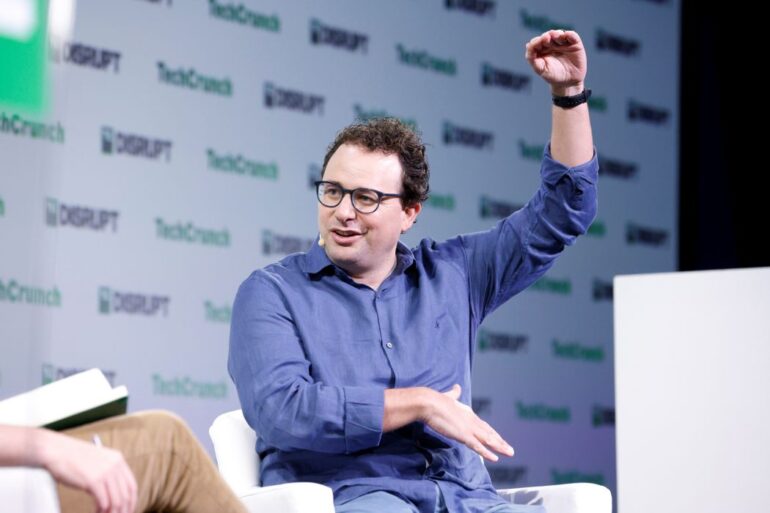
Feature image courtesy TechCrunch via Flickr, licensed under CC BY 2.0.