

This article appears in The BetaKit Guide to Alberta’s Silicon City. Learn more about Edmonton semiconductor innovation here.
Less dependent on the boom-and-bust cycle of oil and gas than Calgary or its rural counterparts, Alberta’s capital city has traditionally featured a more diverse economic makeup than its peers. It’s home to skilled tradespeople and industrial manufacturing, a robust arts and culture sector, and, perhaps most notably, a world-class academic ecosystem that boasts eight postsecondary institutes and the Alberta Machine Intelligence Institute (Amii).
“I’m a firm believer in the importance and the value of government in a lot of spaces”
In recent years, the city’s tech and startup community has come together to undertake the difficult work of commercializing that world-class research, endeavouring to turn decades of knowledge into an economic engine. The result is a growing deep tech sector that’s quickly gained prominence within Alberta.
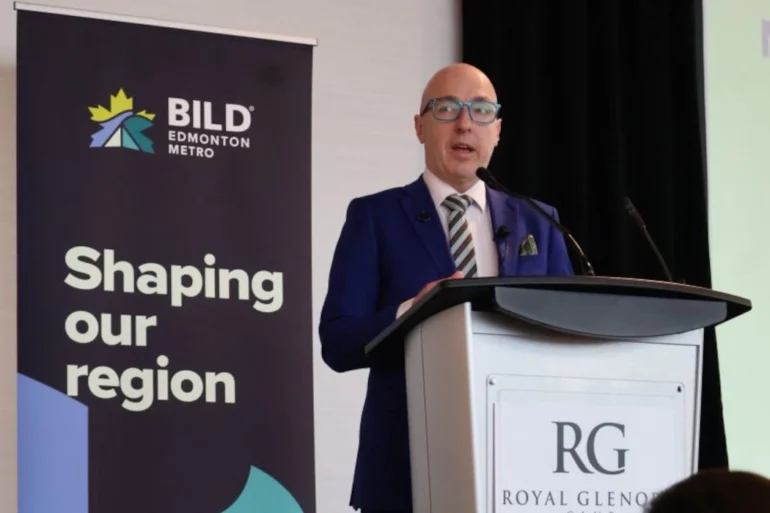
BetaKit wanted to find out why so much deep tech is deciding to call Edmonton home, and what the sector’s interest in the city means for Edmonton and Alberta’s economic future. We sat down with Edmonton Mayor Andrew Knack to find out, and discuss what the city can do to make sure deep tech succeeds.
The following interview has been edited for both length and clarity.
How and why has Edmonton, and Alberta, become a hub for deep tech?
A few things have contributed to this. One is the strength of our postsecondary system and the talent that gets created here. We have eight postsecondaries, with anywhere from about 110,000 to 130,000 students, and they complement one another. That means you get different types of talent coming out of each group. That coalition has produced a lot of incredible talent. It’s also helped to create groups like Amii, which has attracted immense talent as well. These world-leading talents are able to say, “Hey, I come to Edmonton and I have this pipeline coming out of post-secondary.”
The other piece, which might not sound connected, is that Edmonton is also the most affordable major city in Canada. If you are somebody who is starting out in your career, you can maybe take on that job or research position that might not make a tonne of money at the start, but because of our cost of living, it gives you the opportunity to get started, build that foundation that allows you to grow into something bigger. If you’re taking a risk—and risk is significant in this space—this is the best place to take that risk.
How important is Edmonton’s tech sector to the city’s economy?
Really important. Alberta is known for being an oil and gas economy, and certainly Edmonton has been a part of that. But if you look at the last 10 or 20 years, the proportion of Edmonton’s economy that is tied to the natural resource sector is much lower than many other cities in Alberta. For us, that means we’re not as reliant on the boom-and-bust cycle, and so we can branch out into other sectors. There’s more we can do to support growth in that tech and deep tech space, but I think there’s a really strong foundation.
You mention there are things you think Edmonton can be doing better. What are they?
The one thing that Edmonton has been lacking is making sure we’re also putting in financial resources as a city. A lot of cities say they care about these sectors, and then might not invest the resources—the financial resources—to further expand on that, and I would say Edmonton’s been guilty of that.
In the City’s upcoming draft budget, there is a service package that is recommended to be funded called the Edmonton Advantage, which looks to start investing more resources into the overall economy and actually trying to encourage more businesses to start up here, higher job creation, and business growth in a way that we really haven’t done in my 13 years on council.

We don’t want to be the only ones doing this. We know this space, this deep tech space, needs support from many other investors, and it needs a strong ecosystem. I don’t think we’re looking to replace the ecosystem; it is growing, but we want to make sure we’re supplementing that work.
Amii has been an anchor for the deep tech community here. Now it’s been tapped to lead a national AI literacy program. What opportunities does that open up for Alberta in the global conversation? Does it elevate the City and province’s profile on the broader tech landscape?
I would say yes. It helps with that, being able to say, “Hey, the federal government has acknowledged the need to support this work, and has said the best group to do that in the country is right here in Edmonton,” will hold a lot of weight. When you have Amii going across the world to share that message, people will see that, hear that, and understand that, and see the opportunity that comes with that, as well.
One of the things we hear within the deep tech community is the challenge that comes with trying to commercialize a lot of this research. Is there anything Edmonton could do better to connect these post-secondary institutes with the startup community?
I’m a firm believer in the importance and the value of government in a lot of spaces, but this is an area that moves so quickly, and it is hard for us to take the lead in any of this work.
I do think our role is creating an environment where more investors see this as a viable solution. That can mean something as simple as the city being maybe the first customer for some of these projects as a proof of concept to allow that commercialization to become more defined or to more easily attract investors. This doesn’t just need to be city governance. I’m talking about the broader city, the business community, the post-secondary community—all of these spaces can benefit from the work of deep tech. Have they set themselves up in a way that allows us to test out the talents that these folks have to help improve the work that we’re doing?
Can you leave us with one thing you think we could all do a better job of cheerleading when it comes to deep tech in Alberta?
The broader question is, does the average person know about this? And I don’t think they do. I’ll be the first to acknowledge that I still feel like I don’t even fully appreciate just how good we are in this space. I hear it more and more: “Oh wow, this is bigger than we give it credit for.” We have a lot of Edmontonians who I don’t even think know what that means, let alone how we succeed in this space. This community is one that can sometimes still feel a little daunting. So, how do we simplify that?
Feature image courtesy Andrew Knack.