

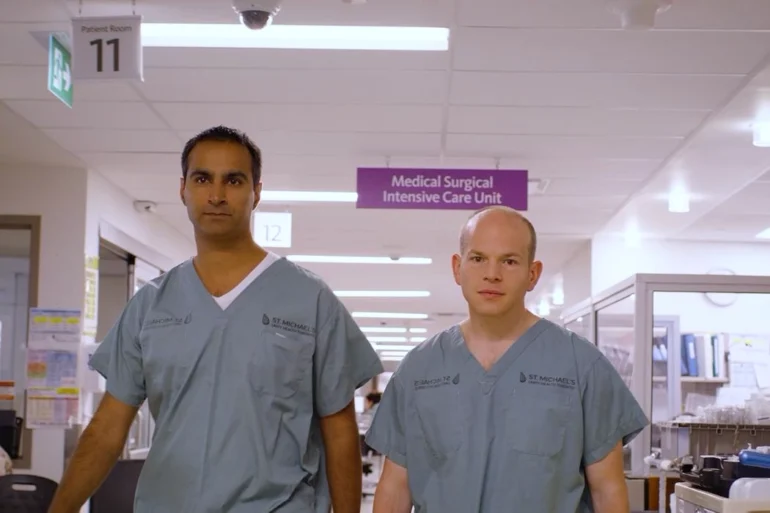
There’s a patient who’s stuck in Dr. Bijan Teja’s head. He calls him “Bob.”
Last year, Bob was sitting in his hospital bed talking with his family and joking with his nurse as he recovered from surgery. Sure, his heart rate rose, and his blood pressure fell a bit throughout the day, but nothing dramatic happened. Everything seemed to be going well. But by midnight, Bob was back on a breathing machine and rushed into surgery. By morning, he was dead.
Dr. Bijan Teja,
“The worst feeling as an intensivist is when the alarms only ring when it’s too late and you lose a patient.”
AI Compass
“The worst feeling as an intensivist is when the alarms only ring when it’s too late and you lose a patient,” Teja, an ICU doctor at St. Michael’s Hospital in Toronto, said.
Teja has been working with Dr. Michael Sklar, his best friend at the hospital, on a new tool that might have been able to save Bob’s life: AI Compass. It will be fed data on tens of thousands of ICU patients to identify imperceptible patterns that emerge in patients’ health before they take a turn for the worse, potentially giving doctors more time to save a life.
“Bijan and I, as ICU doctors, think we know the patterns that exist when someone may deteriorate, and alternatively, when someone may be improving,” Sklar said. “Is it possible that there are signs in the data that we’re collecting that we just don’t know yet … that could signify deterioration?”
AI Compass isn’t in any ICUs yet, and it may sound theoretical right now, but Teja and Sklar have a reason to believe it will work. St. Michael’s Hospital already uses a similar tool called ChartWatch, which monitors patients in wards and provides an early warning if they need to head to the ICU. A hospital study found the tool led to a 26-percent reduction in unanticipated deaths in the general medicine ward, where there is much less data to work with than in the ICU. While wards collect a set of vital signs every four hours, and maybe labs once a day, Teja explained that the ICU collects data every minute, giving AI Compass even more to find patterns in.
“The volume of data is enormous, and on many more things too, including ventilator settings and life support, … many more parameters, and it’s predicting something different,” Teja said. “ChartWatch predicts who needs to go to the ICU; AI Compass predicts who in the ICU is at risk for deterioration and death.”
RELATED: Getting old is hard. This age-tech housing aims to make it easier.
AI Compass has a multidisciplinary team within St. Michael’s of 30 people, including Dr. Amol Verma, who led ChartWatch’s development. Teja and Sklar, who say they bring complementary skill sets to the project, have been working on AI Compass since roughly 2024. However, they didn’t feel like they were actually “getting it off the ground” until earlier this year, Teja said, when they started preparing to pitch for the St. Michael’s Hospital Foundation’s Angel’s Den competition. Angel’s Den claims to be Canada’s biggest medical research competition; earlier this month, it had $700,000 up for grabs, of which AI Compass secured $200,000 under the Mitchell Award for Health System Innovation.
The award is just a start for AI Compass. It buys the team time to train its AI model and get it ready for testing, but Teja stressed he’s “fighting hard” to secure even more because he knows they’ll need it. His ultimate dream is that this St. Michael’s-led project ends up in hundreds of ICUs across Canada and beyond.
“We want to see, looking retrospectively at St. Mike’s patients, would [AI Compass] have caught those patients like Bob earlier and given us more time?” Teja said. “We’ll need more support, but to get it at least to that proof-of-concept stage, already this $200,000 starts to move us toward [it].”
Feature image courtesy St. Michael’s Hospital Foundation.