

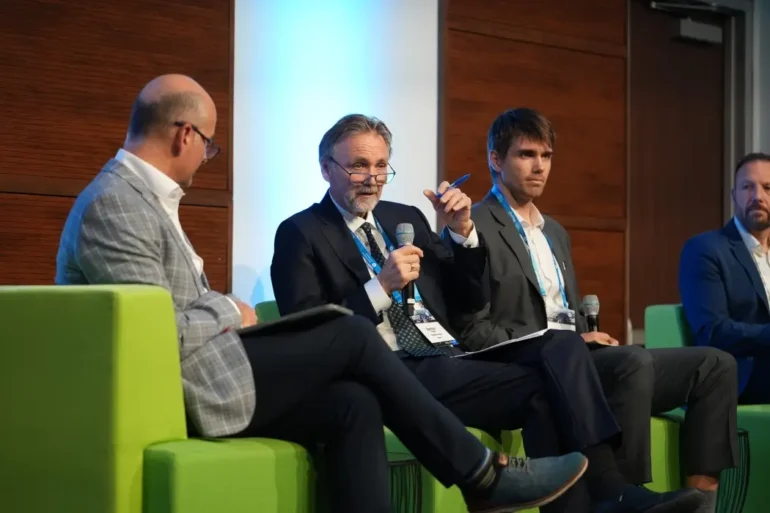
As the global race to develop commercially viable nuclear fusion power intensifies, a trio of the field’s leading Canadians entrepreneurs says it is time for the country to prioritize investment in the industry.
Daedal Systems founder and CEO Henry Gould, General Fusion CEO Greg Twinney, and Stellarex Energy co-founder and CEO Spencer Pitcher made the argument on stage yesterday at the MaRS Climate Impact conference in Toronto during a panel on commercial fusion.
Many global players are competing to harness fusion, the same physical process that powers the sun, to generate abundant, carbon-free energy. Pitcher, who leads the fusion-focused and Toronto-based Princeton University laboratory spinoff Stellarex, argued that Canada now needs to follow the same path it took when it began investing heavily in nuclear energy after World War II.
“If we don’t make this decision now, we’ll buy our devices from other countries for a very long time.”
Spencer Pitcher, Stellarex
“Seventy-five years ago, our grandparents—in some cases, your great-grandparents—made a decision that Canada would have a clean source of nuclear energy based on heavy water, moderated reactors, and unenriched uranium,” Pitcher said. “This was a really bold decision made by politicians, engineers, bankers, and investors … It [has been] the foundation of energy supply in [Ontario] for two generations, and will probably continue for another few generations.”
Pitcher thinks Canada would benefit from adopting the same “can-do attitude” today. “Fusion is the ultimate source of energy,” he added. “It’s the primary source of energy in the universe. Nothing comes after it; it’s the end game. If we don’t make this decision now, we’ll buy our devices from other countries for a very long time.”
Twinney and Gould agreed. “We need Canada to acknowledge this opportunity in a real way,” Twinney said.
Gould noted that the last two decades of fusion and plasma development in Canada “have been lacklustre, basically non-existent, with the exception of General Fusion,” his previous employer.
He thinks the path forward entails focusing on tritium systems, where he said Canada has a competitive advantage. Canada is a global leader in the production, processing, and handling of tritium, a radioactive isotope of hydrogen and a key ingredient in the fuel for nuclear fusion, which could soon become a key strategic resource.
“Do we only sell fuel-handling systems to this emerging industry for value to be captured elsewhere, or do we leverage that competitive advantage, do more with it, bolster reactor developers and other parts of the supply chain?” Gould asked.
RELATED: Ex-General Fusion employee raises $4 million USD for fusion diagnostics startup Daedal
Gould believes a three-pronged approach is in order: doubling down on tritium systems, supporting fusion developers, and filling tech gaps in the industry, such as in measurement instruments like the ones Daedal is building.
Twinney said Canada lags the United States and United Kingdom on a regulatory framework for fusion, and ought to follow in those countries’ footsteps.
Though Canada recently launched a national nuclear energy strategy that listed fusion as one of the innovative forms of power the federal government intends to support, Twinney thinks the country could use a dedicated national fusion strategy, something General Fusion advocated for but did not receive in the federal government’s latest budget.
“We have some of the best fusion companies—even though there’s a small group of us—in the world … These companies are going to be successful one way or the other, and we should keep them in Canada,” he added.
An open approach to combat “Theranos-type risk”
Moderator Zoltan Tompa, partner and team lead of BDC Capital’s Climate Tech Fund, noted that establishing credibility is “critical” when it comes to fusion development. Tompa asked the panellists whether they see potential “Theranos-type risk” in the sector, highlighting that some unnamed firms have been making “extraordinary claims” lately that they may not be able to support and could ultimately chill market interest in fusion.
“In the scientific community, we’ve been worried about this for several years,” Pitcher said.
Gould also sees potential for fraud to create a chill in fusion. “It’s deep tech,” he said. “There’s long development cycles. There [are] these thorny physics and science problems that are difficult for the investment community to understand … It’s a long path to revenue.”
RELATED: General Fusion “pleased” with public-market debut after redemption-heavy SPAC deal
With capital providers investing in fusion based on tech development milestones rather than actual sales, assessing true value creation can be more difficult, especially for the less technically savvy.
To build trust, Pitcher argued that companies could disclose two key performance metrics, their “fusion triple product” and their recirculating power requirement, without threatening their intellectual property or “special sauce.”
Twinney agreed with the sentiment. “Sharing the science basis of your approach and what you’ve achieved, and allowing peers and industry [to evaluate it], this is common practice and a great way to establish your own credibility, to get feedback from [third parties], and also make sure that you are bringing the people along that you need to bring along.”
“We believe an open approach is the best approach,” he said.
Feature image courtesy MaRS.