

Richmond, BC’s General Fusion wants to become the first company to develop commercially viable fusion power, and thinks going public could help provide the capital it needs to win.
Pending regulatory and shareholder approval, General Fusion is expected to debut on the Nasdaq by mid-2026, after striking a deal to merge with Dallas-based special purpose acquisition company (SPAC) Spring Valley Acquisition Corp. III (Spring Valley) at a projected future equity value of $1 billion USD ($1.4 million CAD).
CEO Greg Twinney joined General Fusion in part for the chance “to leave the world in a much, much better place” for his children
During a presentation for analysts on Wednesday, General Fusion CEO Greg Twinney said he joined the company for two reasons: the chance “to leave the world in a much, much better place” for his children, and because the business that commercializes fusion first and owns this market will generate “huge financial returns.”
“The opportunity is massive,” he said.
General Fusion’s SPAC transaction, which would make it the first publicly traded firm focused exclusively on fusion power, is set to provide the business with $105 million in guaranteed funding from institutional backers, as well as up to $230 million in additional cash from Spring Valley’s trust capital, subject to redemptions, to fuel its quest.
Commercializing fusion power
At the analyst event, which was held in New York City at the Nasdaq MarketSite, Twinney and other members of General Fusion’s leadership team unpacked the firm’s technological progress and how it plans to unlock the promise of fusion power at a commercial scale over the coming years as a public company.
General Fusion senior vice-president of finance Robert Crystal said that even if the SPAC’s public investors redeem all of their shares, this transaction still leaves General Fusion with enough capital to achieve key milestones over the next three years as part of its current Lawson Machine 26 (LM26) program.
But given Spring Valley’s track record of success with other first-movers, history of relatively low redemptions, and General Fusion’s attractive valuation compared to public and private peers, Crystal said the BC firm is confident that a meaningful portion will remain invested.
“Across the private fusion industry, there are other companies valued around a billion [dollars], and some in the multiples, but they don’t have short-term liquidity,” Crystal said.
This matters because getting to this point has already taken General Fusion nearly 25 years and $400 million—though the company claims this is much less capital than some of its peers—and it remains years away from bringing its tech to market.
“This isn’t a ‘raise a massive amount of money up front, hold your breath for five years, and hope that it works [situation].”
Twinney noted during the event that other companies with a clear list of achievable, incremental milestones have been similarly rewarded by the markets. He said he expects to see valuation growth with each completed milestone.
“This isn’t a ‘raise a massive amount of money up front, hold your breath for five years, and hope that it works [situation],” Twinney said.
Last month, fellow Canadian deep tech firm Xanadu ended a yearslong drought for new domestic tech issuers on the Toronto Stock Exchange (TSX) when it began trading on both the TSX and Nasdaq after closing its own SPAC deal. For its part, Xanadu saw a high level of redemptions, which an analyst BetaKit spoke with at the time attributed to oil-supply disruption shocks leaving markets in “risk-off mode.” Since going public, however, Xanadu’s shares have soared, making founder and CEO Christian Weedbrook a billionaire.
Whether Xanadu and General Fusion are outliers or signals that Canada’s long-dormant IPO market is back remains to be seen.
A global race
Many players from around the globe are participating in the global race for fusion—harnessing the same physical process that powers the sun—from national labs to academic institutions and private companies like General Fusion. Amid rising energy demand thanks to electrification, data centres, and AI, as Twinney told BetaKit last May, “The long-term view is that the world will run on fusion.” The company that is first to own this market will likely generate not just abundant, carbon-free power, but huge financial rewards.
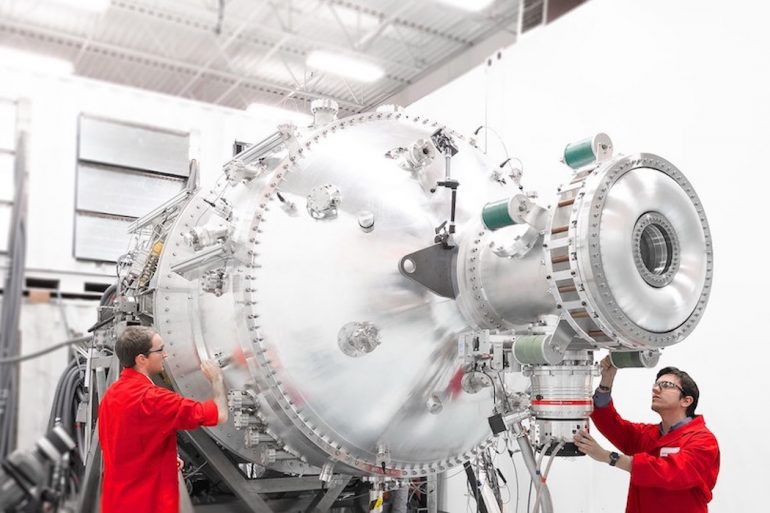
General Fusion founder and chief scientist Michel Laberge joked during the event that the company began in 2002 as his “middle-life crisis.” With LM26, General Fusion has been creating plasma and compressing it to fusion conditions in order to demonstrate commercial viability. It hopes to deploy its patented Magnetized Target Fusion (MTF) tech in a power plant by 2035.

Image courtesy General Fusion.
General Fusion CSO Megan Wilson described MTF as “the diesel engine of fusion,” noting that the company’s approach combines fuel injection and compression in a fusion context. The firm avoids superconducting magnets and high-powered lasers and leverages existing materials. Its liquid metal wall, which squeezes and encases the plasma with the help of an array of pistons, Wilson said, is its “secret sauce.”
“Fusion has been a pipe dream for a long time,” Laberge acknowledged. But lately, interest in it has been heating up in the wake of an important breakthrough at a US national lab, he said, and this has led several firms to join the fray and try commercializing fusion.
General Fusion is betting its approach will lead to a scalable power plant, and unlike some of its competitors, this is a target from which the firm has been working back, de-risking the necessary components in a step-by-step fashion, since its launch more than two decades ago.
“This is not a science experiment that we’re going to try and convert into a power plant,” Twinney said. “It’s exactly the opposite approach.”
Feature image courtesy General Fusion.