

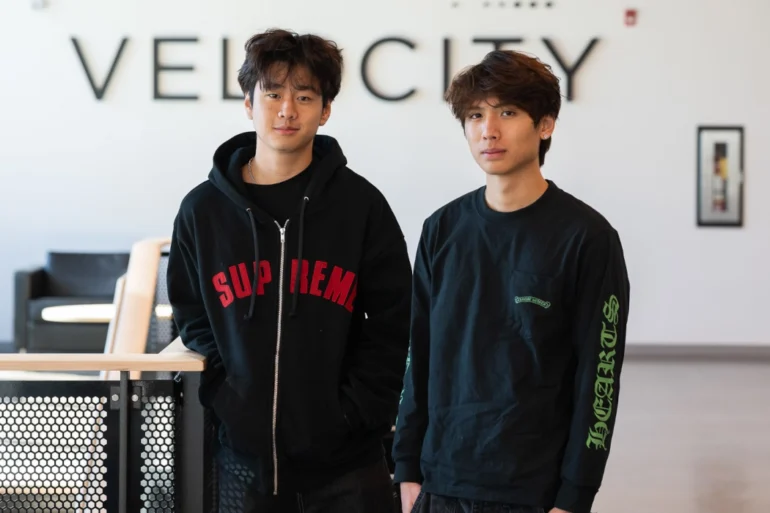
LarpGPT came to co-founder and CEO Feiyang Luo earlier this year in a dream. The 19-year-old entrepreneur bought the domain when he woke up.
At first, LarpGPT was just a name—specifically, an amalgamation of LARP, an acronym for live-action role-playing that in some circles has come to mean pretending to be wealthy online, and GPT, a popular family of AI models OpenAI developed for generating text and images.
Luo was attracted to the notion of merging AI with the world of “internet money,” which he said consists of young people who are trying to make money online by doing things like dropshipping, investing in cryptocurrency, and building software, and who often like to aura farm by flaunting their wealth publicly.
“I think the greatest deficit to an ambitious person is being around unambitious people.”
Anthony Li, LarpGPT
The day Luo purchased LarpGPT.com, his 17-year-old friend Anthony Li (LarpGPT’s co-founder and CMO) supplied the initial business idea: an AI-powered image generator that would allow users to envision themselves next to expensive cars, jewellery, and other luxury goods. The pair launched this tool in March and began generating revenue through subscriptions.
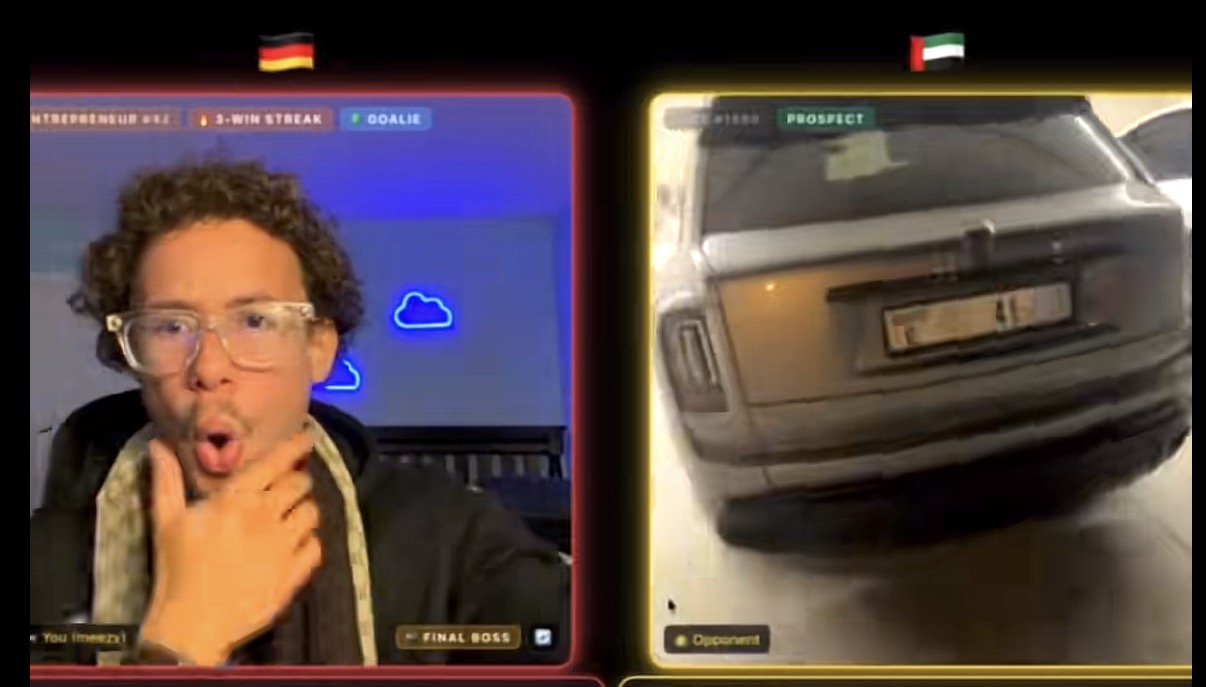
Since then, Toronto-based LarpGPT has evolved into a free, head-to-head game that they rolled out this June, where internet young hustlers and other players from around the globe “flex” on each other by showing off what they already own. Users battle to present more valuable possessions than their opponent based on specific prompts—say, who has the taller stack of luxury watches on their wrist—and LarpGPT leverages AI to appraise the items shown and determine a winner.
Its premise has quickly taken off. LarpGPT has amassed more than one million users, who are now competing in about 200,000 of these battles daily, and has grown to 10 employees.
From high school debate to flexing online
Gen Z and Gen Alpha are the world’s first internet-native generations. Their members also think a lot differently about money. Amid rising inflation and housing costs, a precarious job market, and unprecedented digital connectivity and exposure to social media, many have turned to the internet to make money outside of traditional work, achieve financial independence, and secure social validation; some have even gone broke in the process.
Luo and Li have been playing around with tech and hustling online for years. Luo is a former SoundCloud rapper who connected with Li, a champion debater, in high school debate club. Li was coding his own sports-betting algorithm, and had built a web scraper capable of pulling odds.
Last year, while finishing Grade 12, Luo claimed he repurposed that scraper to help successfully defend his realtor mother, Yan, against a Real Estate Council of Ontario ethics claim, leveraging the tech to predict arguments and outcomes based on past precedents and build a case around them.
Luo and Li initially teamed up to repurpose old books and build a network to distribute them to prisons across Ontario, securing support from the University of Waterloo for the project and ultimately providing reading material to more than 1,000 inmates. Luo went on to study philosophy at the University of Waterloo before dropping out to pursue LarpGPT with Li, who likewise abandoned high school to focus fully on the startup.
Early results indicate their bet is on a path to paying off. The startup recently secured $1 million USD ($1.4 million CAD) in pre-seed financing from the University of Waterloo’s Velocity incubator, and Silicon Valley’s Afore Capital and Parable VC, among others, to help sustain its rapid growth and support its plan to build LarpGPT into what its founders described as “LinkedIn for internet money.”
LarpGPT’s pre-seed financing, which was raised via simple agreements for future equity (SAFEs) at a $15-million USD ($21.6-million CAD) valuation cap, closed a month ago and marks the startup’s first external financing to date.
Connecting “young hustlers”
In a joint interview with BetaKit, Luo and Li said they hope to cultivate and inspire a community of like-minded “young hustlers” through LarpGPT.
“I think the greatest deficit to an ambitious person is being around unambitious people,” Li said. “When we put these ambitious people together, they really blossom.”
LarpGPT has some pretty grand ambitions. “In the next five years, there’s going to be an entire generation that was inspired and raised on LARP battles [who] look back [on] themselves and say, ‘Wow, I used to see these Lamborghinis on LARP battles; now I have them in person. LARP battles made me a better person and a better hustler.’ That’s the vision,” Li said.
While it’s a grand plan, the pair is also not taking themselves or the games they enable too seriously. Like much of what happens on the internet now, “At the end of the day, it’s all for fun,” Li said. “It’s all for jokes.”
While LarpGPT’s image generator is still available, its game has rapidly become its main attraction. Initial battles and rematches each last 30 seconds, and LarpGPT lets players stay in touch with their competitors outside of matches through its chat and connections features—a key draw for many users.
“In the next five years, there’s going to be an entire generation that was inspired and raised on LARP battles… That’s the vision.”
Anthony Li,
LarpGPT
LarpGPT claims its users range from billionaires to people living in huts with an internet connection. Luo and Li believe every player has something of value to provide, and view the chance to connect folks from vastly different socioeconomic backgrounds as a net positive—even if it’s through an arguably silly mechanism. They claimed one user from Kenya earned enough money from streaming his battles and jobs he obtained via viewers to attend university. Luo and Li did not share how LarpGPT itself plans to make money from its game at this time.
While they strive to limit toxicity on LarpGPT, Luo and Li also appreciate that the platform may not be for everyone. If you’re discouraged rather than motivated after playing LarpGPT, you may fall into this boat, Li said. “It’s just what you make of it,” he added.
Establishing your sense of self-worth by comparing yourself to other people online can be harmful to mental health, especially for younger people, and this is part of why Canada is proposing a youth social media ban. When asked how LarpGPT is considering its potential impact in this context, Luo noted that young people “are more capable of learning than at any other time in their lives.”
“I’d say that neuroplasticity, paired with connecting with and absorbing knowledge from others in the internet money space, is a superpower,” Luo said. “Either they wait to see that reality in adulthood, once their youthful drive has been shattered, or we accelerate the spirit of youth and show them that owning a supercar is certainly possible.”
Feature image courtesy LarpGPT.