

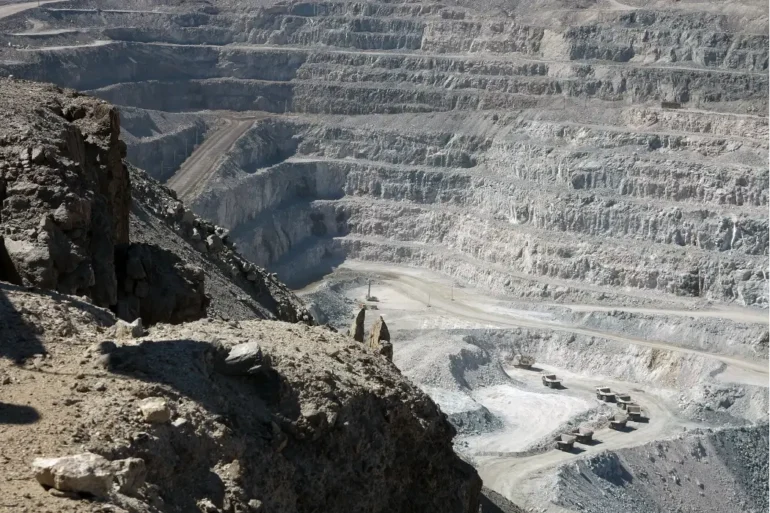
Saskatchewan is home to some of the world’s largest, richest uranium deposits. Developing those deposits has turned Canada into the world’s second-largest producer of the radioactive metal. The industry has been beset by gruelling boom-and-bust cycles, but those cycles may soon end as demand for nuclear power—and the uranium to fuel it—continues to ramp up.
“AI needs reliable, carbon-free power, and nuclear [power] needs uranium. It’s a hand-in-hand solution.”
Eduardo Buriticà
Located near the Northwest Territories, Saskatchewan’s Athabasca Basin contains so much uranium that just a small stretch of its more than 100,000-square-kilometre territory has the potential to power more than 40 million homes for around 25 years. Following a particularly lucrative market boom in 2024, the World Nuclear Association predicted that Canada would overtake Kazakhstan as the world’s leading uranium supplier.
That hasn’t happened yet. Commodities market prices have actually fallen somewhat since 2024, but Canada’s uranium sector is still very much experiencing a boom. Between 2019 and 2024, the price of uranium climbed 233 percent, according to reporting by Bloomberg. Gold, another valuable commodity, grew in comparison by just 75 percent.
“The World Nuclear Association projects that reactor requirements will grow 28 percent by 2030 and will more than double by 2040,” said Eduardo Buriticà, the director of external affairs for Canadian Uranium Corporation. Canadian Uranium owns a nearly 16,000-hectare uranium mining project known as Rook II in the Athabasca Basin.
Growth in the industry has experienced peaks and valleys over the past half-decade, but overall trendlines show an increase. That growth is driven, at least in part, by a global renaissance in nuclear development. According to nuclear data platform Yellowcake Analytics, there are more than 400 nuclear reactors operating worldwide; another 80 or so are under construction, and hundreds more are in the planning and development stages.
That resurgence has been spurred on by renewed interest in nuclear’s potential for clean energy after years of declining investment following Japan’s Fukushima disaster. It accelerated again after Russia’s invasion of Ukraine.
Increasingly, though, industry insiders see another source of demand emerging: AI.
“Demand is rising due to countries building and restarting nuclear reactors, but the data electricity demand from data centres and AI is only adding to it,” Buriticà said. “Demand for energy is not going to go down anytime soon, especially with the focus on data centres. We’re only seeing that trend go up.”
“AI needs reliable, carbon-free power, and nuclear [power] needs uranium. It’s a hand-in-hand solution,” he added.
Reza Mohammed is Canadian Uranium’s site exploration manager. Mohammed coordinates teams of geologists and contractors, handles site permitting, and helps come up with potential geographic targets for uranium exploration. A geologist with more than 30 years of experience in the Canadian uranium industry, Mohammed sees much the same opportunity as Buriticà does in AI’s scale of demand. Nuclear power, he argues, has distinct advantages for servicing that particular kind of need.
“[AI and data centres] need power, and they need modular power,” Mohammed said. “[Nuclear] is a scalable power source; you can have mobile reactors or massive reactors.”
“Demand for energy is not going to go down anytime soon, especially with the focus on data centres. We’re only seeing that trend go up.”
Eduardo Buriticà
Mohammed’s not speculating. Small, modular nuclear reactors, also called SMRs, have caught the attention of tech giants like Amazon, Meta, and Google, all of which have invested in the technology. SMRs are compact nuclear reactors that can be assembled where needed, allowing them to operate in remote or isolated areas, or in conjunction with other forms of power. They’re also grid-independent, meaning they can prevent transmission loss and reduce dependency on traditional or shared electric grids.
That influx of interest from governments and private businesses has not gone unnoticed by Saskatchewan or Canada. Both governments have moved to prioritize nuclear and uranium development, with the feds aiming to double production by 2035 and Regina looking to further cement nuclear energy as a key economic driver for the province.
Demand is slated to grow: the World Nuclear Association forecasts that by 2040, the world could face a shortfall in uranium supplies by as much as 40,000 tonnes, with that forecast coming prior to any accounting for the additional demands of AI. That presents an opportunity for Saskatchewan and Canada to fill a gap. With the basin’s vast resources, supply is no issue. But whether an industry accustomed to such volatile cycles can handle this kind of sustained demand is an open question.
Feature image courtesy IAEA. Photo by Conleth Brady. Shared under CC BY-SA 2.0.