

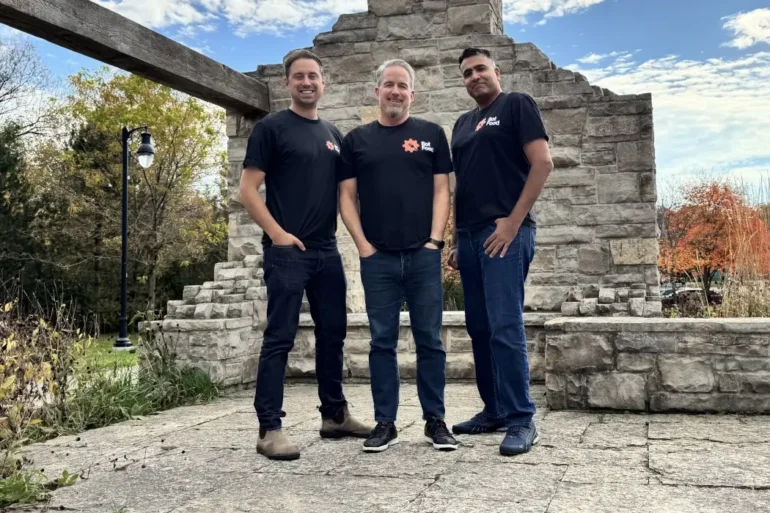
The team that built and sold Toronto’s Wysdom has launched a new software startup that aims to give individuals greater control and ownership over how much they share with powerful AI systems, and when they share it.
Bot Food Corporation announced on Thursday that it has secured $1.5 million CAD in pre-seed funding from fellow Toronto firm GreenSky Ventures to build “one personal context library that works across every AI product.” It also launched a beta version of its application.
“One day, people are going to realize, ‘I want to take back control of that [personal context].’”
Bot Food co-founder and CEO Ian Collins co-founded Wysdom as CEO in 2012 with former CTO Jeff Brunet, working alongside ex-COO Nitin Singhal. That startup, which was initially named CrowdCare, built an AI evaluation platform to help customer service chatbot operators improve their performance, before selling to Minneapolis-based Calabrio in 2024.
During his time at Wysdom, Collins said he and his colleagues grasped the importance of context in AI. “As we measured and evaluated all these bots and their performance, it was almost always a context problem,” he told BetaKit in an exclusive interview.
Collins said that while it has become clear that the more knowledge these systems possess about the individuals using them, the better they perform, many have yet to realize how valuable their personal context actually is. As AI companies race to capture as much personal context on their users as possible to improve their performance and keep them locked in, Collins envisions what he sees as a better path forward.
With Bot Food, Collins and Singhal have teamed up again to give individuals control and ownership over that context, and Brunet, now managing partner at GreenSky, has bought into their vision. Brunet has joined Bot Food’s board of directors as part of its all-equity, all-primary capital pre-seed round, which closed in October and brings the startup’s total funding to $3 million. Collins did not share its valuation.
RELATED: Bot management software startup Wysdom acquired by US-based Calabrio
Brunet told BetaKit over email that GreenSky likes to invest in startups building tech other products will depend upon. “We believe a universal personal context layer could become a critical piece of infrastructure for the entire AI ecosystem,” he added. “Backing proven founders I trust, with a bold vision for the future of AI, was an easy decision.”
Collins argued that sharing detailed personal context with AI will soon become a prerequisite for anyone who wants agentic systems “to do great things” for them. “A lot of people are resisting [AI],” he posited, “but we’re all going to give in eventually; the productivity is just going to be too great.”
For his part, Collins has been using Muse, US tech giant Meta’s fast-growing personal AI agent, since it became available in Canada last month. “It’s pretty amazing, and it’s getting to know me so much,” he said. “It’s just sucking up the data at this massive pace.”
As AI usage grows, these systems will amass deep libraries of information about the individuals using them over time. AI users may not possess access to or rights over their own usage data, Collins said, from rich details about their digital shopping history to the TV shows and movies they’ve watched, the music they listen to, and the places they’ve worked and travelled. At the moment, many major AI labs are using this personal context they have gathered for customer retention.
RELATED: GreenSky closes $23.5-million sixth fund with help from new managing partner Jeff Brunet
Bot Food is betting that some portion of the population will eventually recognize that all of this personal context is a tremendous asset. “One day, people are going to realize, ‘I want to take back control of that,’” Collins said. “‘I should own that thing. It’s rich, it’s valuable, [and] I could probably … get paid for it if I wanted to.’”
Bot Food aims to give its users that power, along with greater choice over how much they share about themselves, with which systems, and when. Those libraries will be collected and managed by Bot Food’s AI assistant RaLHF (pronounced like the common name Ralph), which Collins said will sign into the apps that customers use and catalogue what it finds into a private, encrypted digital library that they can view, edit, and selectively share from with the systems they are using.
The now seven-person startup, which has brought on former ThinkData Works CTO Brendan Stennett as CTO, plans to put its pre-seed funding largely towards go-to-market testing.
“A lot of people are resisting [AI], but we’re all going to give in eventually; the productivity is just going to be too great.”
When asked why individuals should trust a small startup like Bot Food to responsibly store their info instead of a large AI lab, Collins said Bot Food’s terms of service make clear that the company does not hold any rights to the data stored on its platform and cannot do anything with it. He also argued that Bot Food’s product architecture and Stennett’s experience in enterprise data security will help the company keep its clients’ context secure.
Bot Food’s beta features a simple on/off switch that users can click to allow or bar certain AI systems from accessing their data. Its next version will likely include permission for certain AI systems to draw relevant context from select apps.
Collins envisions a final product that can not only send personal context back into its library, but one that features more granular buckets as its own agent improves. He said the startup is also testing its capacity to allow individuals to grant AI access to their information for some tasks and then forget about it afterwards.
Cyberattacks are on the rise thanks to agentic AI, and Collins acknowledged that there could come a day where, if Bot Food achieves success building these sorts of libraries, it becomes a prime target for bad actors, human or machine.
“It’s key to us that we build trust like a 1Password, and have a level of security that we can offer like they do because [Bot Food] will become a target one day,” Collins said.
Feature image courtesy Bot Food Corporation.