

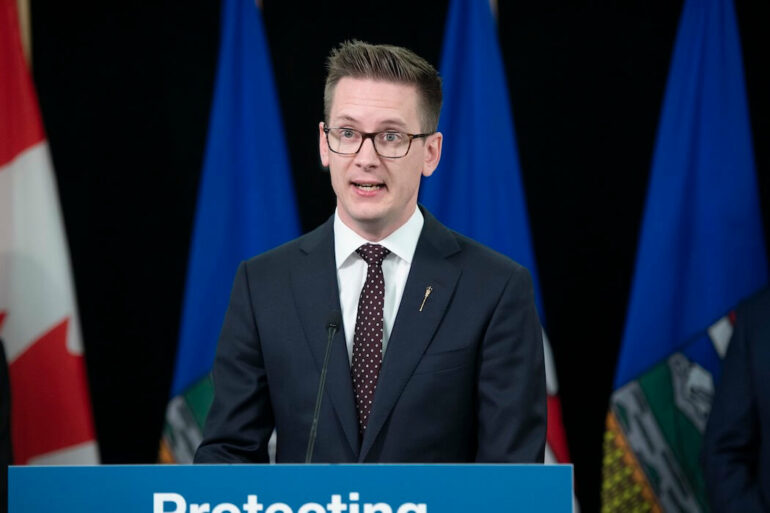
The provincial government announced today that Alberta is opening a new office to support the development and protection of intellectual property (IP).
Officially dubbed the Alberta Intellectual Property Office (AIPO), the entity is being funded with $8 million as part of the Province’s recent update to its Alberta Technology and Innovation Strategy.
“As a country, we have not necessarily thought as much about how to maintain our ideas in our country.”
Mike Mahon
Operating as a nonprofit, AIPO will be run out of Alberta Innovates and serve as a hub for developing IP capability and protection. It will also provide support such as legal expertise, market analysis, education, and resourcing to close the gap between research and development and commercialization, monetization, and economic development. The office will be governed by a board of directors, with guidance from IP professionals.
“Alberta and Canada have a great track record of developing, attracting, and equipping world-class researchers who develop world-class ideas. But often, the ideas they create end up owned by companies elsewhere, generating economic value there, not here,” Alberta’s minister for technology and innovation, Nate Glubish, wrote in a statement to BetaKit. “The Alberta IP Office will help ensure that when great innovations are born in Alberta, the opportunities, jobs, companies and economic returns will stay here and benefit Albertans.”
The rollout of the office’s capacity will take some time, according to Alberta Innovates CEO Mike Mahon, who said the office plans to hire staff and consult with stakeholders across the province, including in Alberta’s academic and startup ecosystems.
A statement from the provincial government also notes that the office will work to embed IP strategies into provincial public funding programs.
Fixing a flawed system
With AIPO, Alberta joins several other Canadian provinces, including Ontario and Quebec, that have established similar IP offices. It’s part of a broader focus in Canada on remediating the nation’s approach to intellectual property, which various studies, including from the Organization for Economic Cooperation and Development (OECD) and the Conference Board of Canada, say has significant flaws.
According to reporting from those organizations, Canadians excel at research and innovation, but lag behind peer nations when it comes to commercializing that research and innovation, and developing and protecting the IP that underpins it.
The reports also show that Canada is a laggard in patent ownership, with a more diffuse patent landscape where IP is “spread across many smaller players, each with limited holdings.” That can contribute to the country’s commercialization gap by making it more difficult for Canadian firms to navigate licensing requirements and potential infringements.
“As a country, we have not necessarily thought as much about how to maintain our ideas in our country. Many have bled off and headed to the US, or left for other jurisdictions. The net result of that is when you compare our IP volume to other countries, it’s pretty poor,” Mahon said.
The advent of trade disputes with the US, amid broader global diplomatic reordering, has underpinned a new awareness of the importance of domestic IP and renewed efforts by governments to support it, according to Mahon.
“What I think we’re seeing right now around the world is countries thinking about how to be as self-sustaining and independent as possible, and IP is one of the vehicles to ensure that we’re protecting our ideas that emerge from our innovators and our researchers and that those ideas that have opportunities are monetized within the borders of Alberta and also within Canada,” he said.“So the establishment of an IP office in Alberta—and the existence of one in Ontario and Quebec, with another emerging in BC—is really because there is a belief that creating greater intentionality is one of the ways to change this trend, and governments, I think, recognize they have a role to play … in helping to support the establishment of IP.”
BetaKit’s Prairies reporting is funded in part by YEGAF, a not-for-profit dedicated to amplifying business stories in Alberta.
Feature image courtesy Alberta Newsroom.