

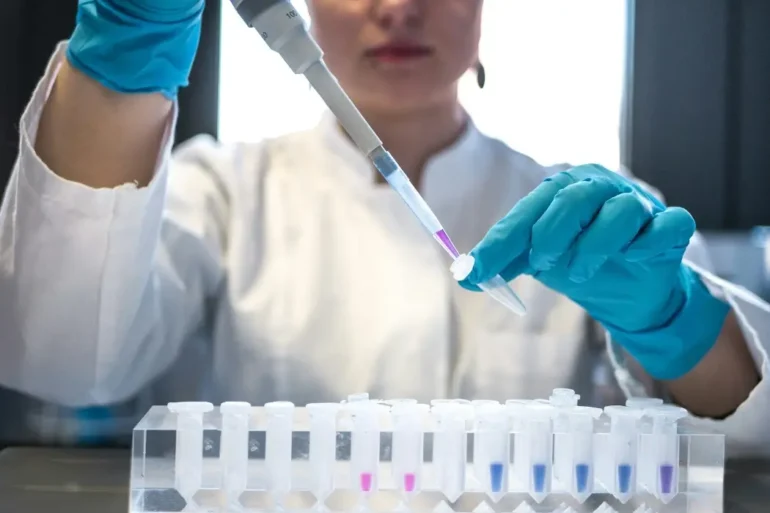
From a single drop of blood, you can find a whole world of biological information. One biotech startup is hoping that its miniaturized technology can make scientific research easier and more efficient, even when very little patient material is available.
DropGenie, based in Montréal and Boston, is betting its approach can help the pharmaceutical industry develop more therapies. The company announced on Monday morning that it has brought in BDC Capital’s Thrive Fund as a new investor for its seed-plus financing, bringing the total equity round to $5 million USD ($7 million CAD). Massachusetts-based Skeleton Key had led that financing, alongside Merck Global Health Innovation Fund and CQDM, with participation from Montréal’s Real Ventures and Anges Québec.
Alison Hirukawa,
DropGenie hopes to make personalized medicines possible “by doing the somewhat unsexy work of creating … automation systems.”
DropGenie
Founded in 2018, DropGenie began when CEO Alison Hirukawa met her co-founders, who were working on a digital microfluidics platform. The platform used electrical signals to manipulate very small amounts of liquid to accomplish typical lab tasks. Hirukawa, who was a postdoctoral fellow at McGill University’s Goodman Cancer Research Centre, met Hugo Sinha, Philippe Vo, and Mathieu Husser (who is no longer with the company) through a McGill-associated research project; the team decided to combine their technology with synthetic biology techniques to try to speed up the research process.
“A lot of work in the early stages of discovery is extremely artisanal,” Hirukawa said in an interview with BetaKit. “You’d have a PhD student doing a lot of manual work, and you’re extremely constrained by…material from a patient, which is very finite.”
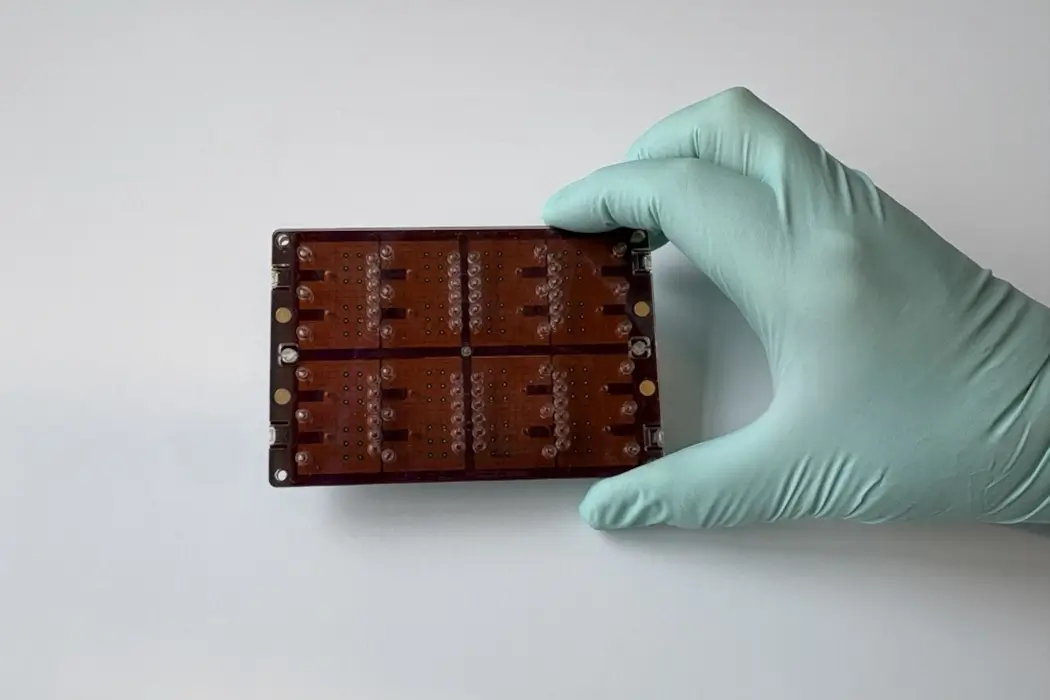
The startup plans to use the funding to drive commercialization of its first product, which puts gene editing on a tiny chip. The advantage is that it uses up to 100 times fewer cells, as well as less reagent—often expensive chemicals necessary for experiments—than traditional tests.
Since CRISPR gene-editing technology was first successfully applied in 2013, scientists have used it as a tool to test which genes are responsible for certain traits or diseases. When doing a genetic screening, sometimes researchers must use CRISPR to edit genes—according to the company, DropGenie’s method requires 100 times less volume than existing methods.
But how does DropGenie’s tech do this? Hirukawa said it’s all about scaling samples “down into a droplet.” Instead of transporting small sample liquids into different lab machines to do an experiment, it all happens on a small chip with a tiny amount of liquid.
“A lot of reagents and materials in that world are super bespoke or expensive,” she said. “Bringing down the volume and the amount of input required completely changes the cost profile.”
That’s an attractive proposition for its target customers, who are heavy hitters in the pharmaceutical industry. So far, DropGenie has formed partnerships with AbbVie, UCB Pharma, as well as life science instrument companies like Danaher and Sartorius.
There’s another way DropGenie’s tech could prove valuable in the age of AI. Many companies are using AI models to enhance and speed up drug discovery, and for that, they need a lot of high-quality data. With its faster screening methods, DropGenie “generates the high-quality, human-relevant data those models need,” BDC Thrive Fund managing director Mona Minhas said in a statement.
DropGenie hopes to sell its automated lab workflows as a service with a commercial launch in the second quarter of next year. It also wants to ink more data partnerships and grow its 10-person team, split between offices in Montréal and Cambridge, Mass.
“Where we want this to go is unlocking new therapies,” Hirukawa said. “Making personalized medicines possible by doing the somewhat unsexy work of creating these automation systems.”
Feature image courtesy Unsplash. Photo by Julia Koblitz.