

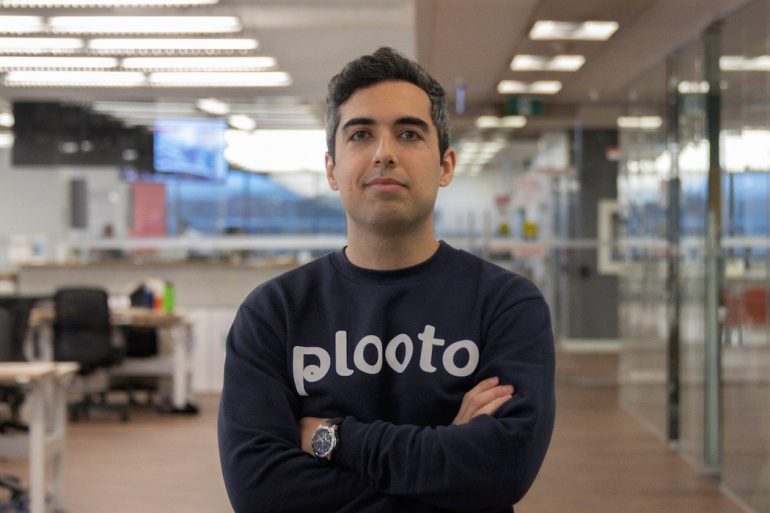
Toronto-based payments automation platform Plooto has secured $27 million CAD ($20 million USD) in Series B financing led by American investor Centana Growth Partners.
As a recession looms and it has become tougher to secure capital, preserving cash has become key to the survival of many companies—especially small-to-medium-sized businesses (SMBs).
“Plooto is the last application [companies] turn off, and we want to make sure that doesn’t happen to a lot of businesses.”
-Hamed Abbasi, Plooto
With the round, Plooto aims to tackle the “massive opportunity” co-founder and CEO Hamed Abbasi sees in helping SMBs manage their accounts receivable and payable during what could be a long economic downturn.
“What does every VC tell their portfolio company?” Abbasi told BetaKit in an interview. “A year ago, it was grow at all costs. Today, it’s preserve cash … It is the most important thing that small businesses need to manage, and Plooto is the platform that helps [them] do that.”
In addition to Centana (a first-time Plooto investor), Plooto’s equity Series B round saw participation from existing investors Fintop Capital and Luge Capital. According to Abbasi, the financing consisted mostly of primary capital and involved a “nominal,” undisclosed amount of secondary capital that went to unnamed early investors.
The round, which closed last month, brings Plooto’s total funding to $40 million CAD. Abbasi declined to disclose Plooto’s valuation but claimed that the company’s Series B financing was an up round on “fantastic terms” and a “very clean” term sheet.
Founded by Abbasi and CTO Serguei Kloubkov in 2015, Plooto’s platform helps SMBs automate their accounts payable and accounts receivable operations, integrating with accounting systems like QuickBooks and Xero to eliminate manual data entry, and automate the reconciliation of bills and invoices.
The business payments startup aims to address what Abbasi claims is the main reason most SMBs fail: poor cash flow management. It is a process Abbasi said many entrepreneurs leave to other people or ignore altogether until it is too late.
“The number one reason why companies stop using Plooto is because they go out of business,” said Abbasi. “Plooto is the last application they turn off, and we want to make sure that doesn’t happen to a lot of businesses.”
So far, Plooto has been able to lend a hand. According to the CEO, the company’s customer churn is less than one percent on a monthly basis.
RELATED: Plooto wants to solve the problem keeping entrepreneurs up at night
Plooto previously raised $8 million CAD in Series A financing in January 2021 led by Nashville’s Fintop Capital, with support from Toronto-based Luge Capital and Montréal’s Inovia Capital.
Since then, Plooto has more than quadrupled the size of its team to over 80 employees and grown its customer base to 8,500 firms, amassing a list of clients from across North America that includes Deloitte, Live.ca, and Borrowell. According to Abbasi, who did not share specific figures, Plooto has seen two-times year-over-year growth across “pretty much all business metrics.”
“We have been impressed by Plooto’s ability to execute and demonstrate results no matter the challenges of building a payments company and the macroeconomic environment,” said Fintop Capital partner John Philpott.
Abbasi noted that Plooto has been able to generate these results without a sales team, leveraging a product-led approach to growth that the company plans to stick with as it deploys its Series B capital. “The product really is designed to sell itself and and really show the value to the customer, and we want to double down on that strategy as well to really improve the product,” he said.
Plooto plans to use its Series B capital to introduce new product lines, build more integrations, and further customize its offering for more businesses, accounting, and bookkeeping firms.
RELATED: Cross-border payments startup Buckzy takes the smart money in downscaled $19.5 million CAD Series A
Amid an economic downturn during which many of Plooto’s fellow Canadian tech startup peers have shed staff, Abbasi said Plooto has managed to avoid layoffs, putting the company is a good position to expand its team as others reduce their headcounts and scale back their hiring plans. “There has never been a better time for Plooto to grow,” he said.
“As the economic situation worsens, [SMBs] need more control and more visibility of their cash and expenses,” Centana partner Ben Cukier told BetaKit. “Plooto provides that for their customers at an effective price point.”
For his part, Abbasi said Plooto met with 90 prospective investors as part of a fundraising process that began in Q2 before landing on Centana, joining a portfolio that also includes Athennian and Vena Solutions.
As the CEO said, Plooto was attracted to Centana’s experience the FinTech and payments space, belief in Plooto’s vision, the amount of resources it had to support it, and the fact that Centana had previously helped other companies scale to the level Plooto ultimately hopes to reach.
Cukier believes Plooto is “well positioned to grow dramatically in Canada.”
Right now, Cukier said Plooto’s primary competition comes from banks, noting that presently, Plooto’s solution is “complementary” to SMB’s current banking relationships.
From a geographic standpoint, Cukier said Canada has “been largely ignored” by United States-based FinTech competitors—which include Bill.com and Melio—despite the fact that Canada’s SMB market alone is sizeable. Small businesses across the country employ more than 10 million people and contribute to 40 percent of Canada’s gross domestic product, he noted.
Cukier believes Plooto is “well positioned to grow dramatically in Canada.” The Centana partner also sees plenty of room for Plooto to expand outside North America and move vertically into other areas of treasury.
“If they just achieve the first objective, this will be an incredible investment,” said Cukier. “But we believe that Plooto is well positioned to expand far beyond that.”
Feature image courtesy Plooto.