

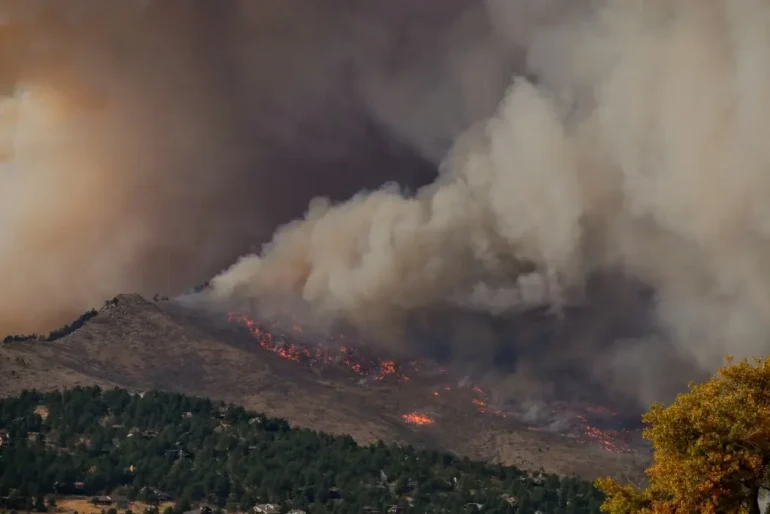
Mila and the Canadian government have co-created a new AI tool to predict the spread and intensity of wildfires across the country.
The news: Researchers from Montréal AI research institute Mila and the forestry division of Natural Resources Canada have partnered on an AI model that maps wildfire hazards—tracking how likely an area is to burn, how quickly it will spread, and how intense it might become.
NRCan’s existing simulator tool, BurnP3+, relies on physical fire behaviour data and must be updated constantly depending on factors like climate and vegetation. The new AI tool won’t replace this software, but is meant to act as a complement that NRCan analysts can use to quickly test parameters that would take months with BurnP3+.
From the source: The AI model runs between 800 and 3,400 times faster than BurnP3+, Mila said, depending on what kind of computing hardware is used.
“The emulator generates imperfect approximations, but with high fidelity and at speeds incomparably faster” than the existing tool, NRCan researcher and forest systems modelling specialist Tom Swystun said in a release. “The initial reaction to the model’s speed was simply ‘wow.’”
The context: Canada’s 2026 wildfire season is set to be the country’s fourth-worst on record. According to Public Safety Canada’s October update, more than 5,400 wildfires burned approximately 4.5 million hectares of land this year, forcing 33,750 people to evacuate their homes, including more than 8,800 people from First Nations communities.
NRCan’s fire division expects wildfires to only worsen in frequency and intensity, which is why it reached out to Mila’s applied research team to see if an AI model could improve the speed of its hazard mapping. The new AI tool was trained on data from physical fire simulation maps recorded this year, meaning it’s built on a similar database as the BurnP3+ tool but can map hazards within hours instead of months.
Final thought: This is another example of an open-source AI tool developed by Mila, which has been tapped by the federal government to deliver on the open-source section of its federal AI strategy—meaning it’s responsible for building AI models and software that are free to use and build upon. The hub is also negotiating new federal funding for these efforts.
CORRECTION (10/26/26): A previous version of this article incorrectly stated that Mila and NRCan’s new AI model is meant to replace BurnP3+. It has been updated to reflect that the new model complements BurnP3+ but is not intended to replace it.
Feature image courtesy Unsplash. Photo by Malachi Brooks.