


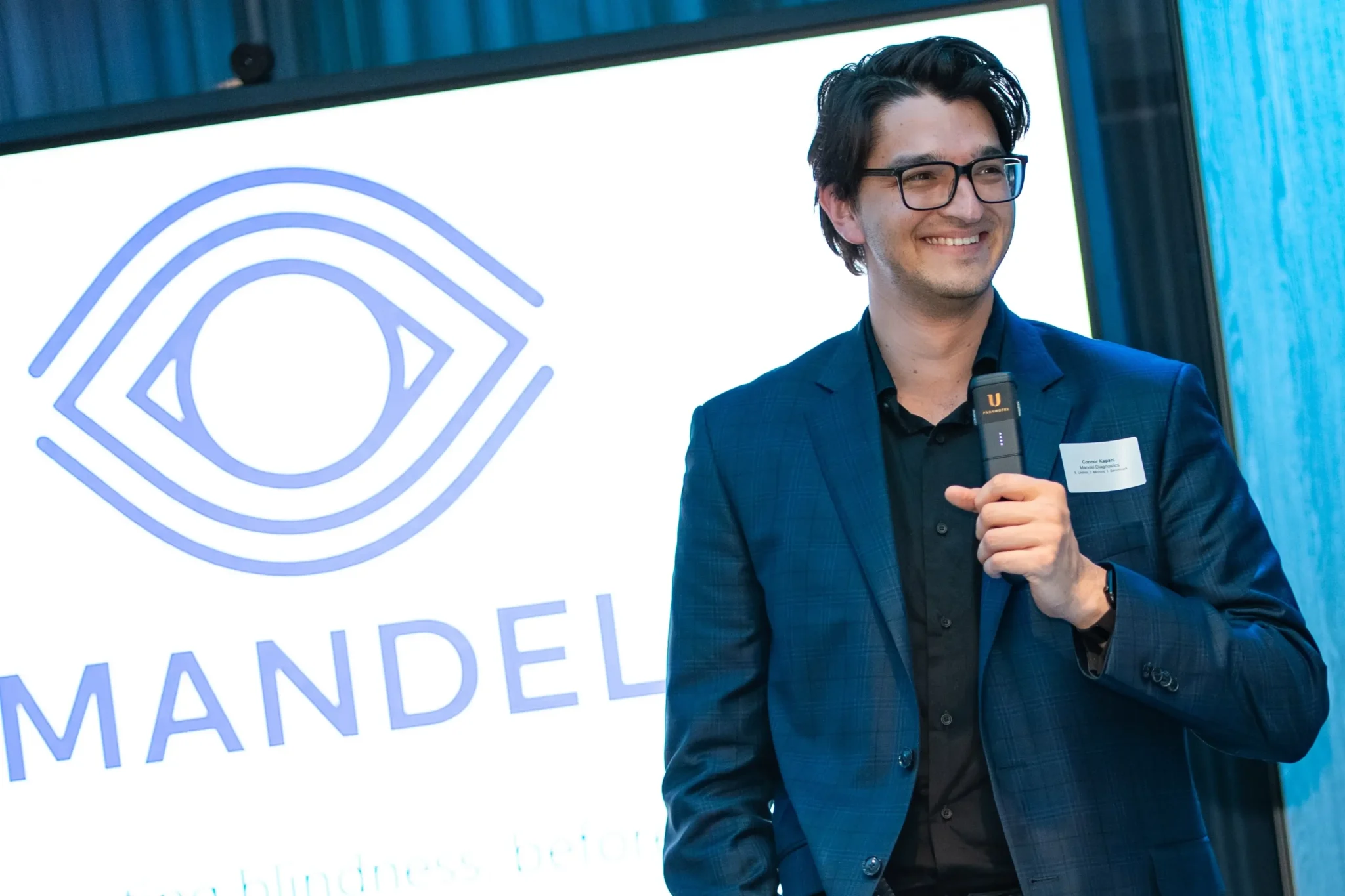
Connor Kapahi was still completing his PhD when he set out to commercialize a medical device that could detect one of the leading causes of irreversible vision loss.
His company, Mandel Diagnostics, was developing a tool that could screen patients for early signs of macular degeneration in just two minutes. Between his academic research and the demands of building a company, Kapahi had plenty on his plate.
“Ultimately, we need to help young people experience that failure isn’t the opposite of success, it is often part of the process of getting to success.”
Catherine Fowler,
Enactus Canada
“I found out early on that working on a startup while finishing school didn’t mean I was splitting my time 50/50,” said Kapahi, who is CEO and Founder of Mandel Diagnostics. “It was more like one-third of my time on my PhD research, one-third on the startup, and one-third worrying that I wasn’t balancing the other two goals correctly.”
Kapahi said much of his anxiety stemmed from not knowing whether customers would actually pay for the device. According to research from RBC, nearly 60 percent of young Canadians say a fear of failure would stop them from starting a business.
For the last three decades, Enactus Canada has worked to make entrepreneurship more accessible to postsecondary students, and through its Student Entrepreneur National Competition the organization is encouraging more young founders to take a chance on themselves.
Making room for failure
Catherine Fowler, President and CEO of Enactus Canada, understands why young people might hesitate to pursue entrepreneurship. Even those with promising ideas or skills can find themselves overwhelmed by everything it takes to run a business.
“Suddenly you are navigating accounting, technology, human resources, sales, and long-term strategic planning,” Fowler said. “Each new challenge can feel like another opportunity to fail.”
Still, she believes that students should have opportunities to experiment with entrepreneurship while they still have access to resources and a community of support.

courtesy Enactus.
“The postsecondary years are a pivotal time in a young person’s life,” Fowler said. “Students are exploring their interests, considering their futures, and discovering what they are capable of achieving.”
Enactus Canada is a registered charity that supports postsecondary students through entrepreneurial education and experiential learning. Its Student Entrepreneur National Competition, now celebrating its 30th anniversary, gives full-time postsecondary students running their own businesses a chance to get advice from established entrepreneurs, make connections, and compete for funding.
According to Fowler, the competition also gives students a chance to confront their fear of failure and learn from it, rather than avoid it altogether.
“Ultimately, we need to help young people experience that failure isn’t the opposite of success, it is often part of the process of getting to success,” she added.
The competition follows a multi-stage process. An initial group of 30 entrepreneurs receives feedback on their applications, with 12 advancing to a video pitch round and three ultimately selected to share a live presentation at the national final.
Judges assess participants’ business models, market knowledge, traction, and growth potential, and provide feedback at each stage. Those who do not advance can return in subsequent years if they remain eligible.
The value of a good introduction
Kapahi’s involvement with the competition began when an Enactus representative saw him pitch at another event and encouraged him to apply. By then, Kapahi had already participated in several startup competitions, but he saw this as an opportunity to share the story of how he turned his research into a business while completing his studies.
He ultimately won the 2026 national title and its $10,000 prize, which has helped the company commit two of its eye-screening tools to medical missions serving patients both abroad and in remote Canadian communities. The devices will be used by optometrists providing eye care in underserved communities, allowing Mandel Diagnostics to see how its technology performs in challenging clinical environments.
Kapahi valued the connections he made through the competition. “You never know who you’ll meet or what doors they can open for you,” he said.
Having started Mandel Diagnostics in the Waterloo Region, where there is an established startup community, Kapahi knew the value of advice from other founders. He found a similar network through Enactus Canada.
“Their experience, advice, and their ability to make key introductions is an extremely valuable resource that will continue to guide Mandel Diagnostics forward,” he added.
Thirty years of student entrepreneurship
When the Student Entrepreneur National Competition launched in 1997, entrepreneurship was rarely taught in postsecondary institutions, according to Fowler, and students had few avenues to secure funding or get exposure.
The first national champion operated a retail soccer business. Last year, Diana Virgovicova won with Xatoms, which is developing advanced water purification technology with AI and quantum chemistry. Kapahi followed in 2026 with Mandel Diagnostics.
According to Fowler, the range of businesses represented over the years shows how new technologies have expanded the possibilities for student entrepreneurs, although she still sees familiar qualities in the founders who participate.
“At their core, they are still the same ambitious, resourceful, self-starting individuals who see opportunities where others see obstacles and are willing to take meaningful risks to turn their ideas into reality,” Fowler said.
Enactus Canada is accepting nominations for its next Student Entrepreneur National Competition until December 4. Eligible entrepreneurs must be full-time postsecondary students who own at least 25 percent of their businesses. Students can either nominate themselves or be nominated by someone else in as little as ten minutes.
Eligible nominees will be invited to submit full applications by January 10, 2027, with the top 30 announced on January 13. Three national finalists will receive an all-expenses-paid trip to Toronto to present their ventures to a live audience on April 28.
Fowler believes the most important step is getting young entrepreneurs to put themselves forward in the first place.
“Don’t let the application be the barrier,” she said. “You don’t need a perfect business plan or to have everything figured out. The experience itself, regardless of how far you advance, can help you become a stronger entrepreneur.”
Kapahi, for his part, encouraged aspiring founders to start by speaking with potential customers, understanding their problems, and determining whether there is demand for their solution.
“If you can find customers desperate for what you’re building and willing to pay for it, then do it,” Kapahi said. “Whether you win Enactus Student Entrepreneur of the Year or not, you’ll have a far stronger foundation for your business.”
PRESENTED BY

Know a student entrepreneur who deserves recognition, or ready to put yourself forward? Nominate yourself or someone you know for Enactus Canada’s Student Entrepreneur National Competition. Nominate now.
Featured image courtesy Enactus Canada.