

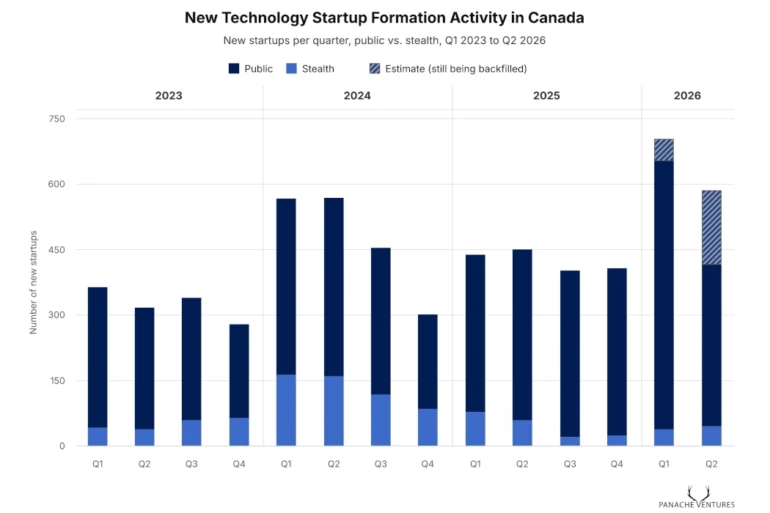
While Canada is on pace to produce more new technology startups in 2026 than in previous years, fewer of them have been raising capital at the earliest stages, according to a new report from Montréal-based venture capital (VC) firm Panache Ventures.
“Based on our data, there are more companies being created, but not as many getting funded, and that has always been the challenge for us as an ecosystem,” Panache managing partner and report co-author Prashant Matta told BetaKit in an interview.
Prashant Matta,
“What’s interesting to us is that Canada isn’t only producing more companies—it’s producing better-prepared ones.”
Panache Ventures
The report states that “lower pre-seed funding today means fewer growth-stage companies in the future.” As Matta points out, “This is pipeline development … If there are fewer companies graduating high school, there are going to be fewer companies graduating university.”
The VC firm’s latest annual Canadian tech startup formation report, which was penned by Matta and analyst Inshaal Qadir, gets its findings from a combination of proprietary and public data. Panache compiled the research as a measure of both the current health of the Canadian tech ecosystem and potential future demand for investment capital.
The report found that 1,703 new tech startups formed in 2025, more than 10 percent fewer companies than were launched in 2024. It also determined that the pace of business creation accelerated in early 2026 thanks to an especially strong first quarter that featured a 49 percent year-over-year spike, driven partly by rising activity across British Columbia, Alberta, and Québec.
Though the pace of tech companies being created decelerated a bit during the second quarter, 20 percent more net new firms (892 overall) were created in the first half of 2026 than during the same period in 2025, as more entrepreneurs opted to build startups in areas like AI infrastructure, deep tech, hardware, aerospace, and defence.
RELATED: Canada is gaining corporate VCs, but still has “a participation problem,” report finds
Matta expressed hope that this reflects founders seeing more opportunity in Canada today given macroeconomic shifts and the country’s renewed interest in defence and strategic tech.
While it is difficult to say for certain what has been driving this recent uptick in company creation, Matta’s hunch is that part of what’s so different this time around is that, thanks to AI, “it’s never been easier to build a new startup, especially at the app layer.”
Panache’s latest report also found that 44 percent of the founders who launched tech businesses in 2025 have prior experience at VC-backed startups (this was not a metric that Panache tracked in the report’s first edition).
“What’s interesting to us is that Canada isn’t only producing more companies, it’s producing better-prepared ones,” Matta said.
Back in 2023, when Panache began tracking Canadian tech startup formation in this way, approximately 13 percent (or one in eight) of the companies created secured pre-seed investment. That figure dropped to eight percent (or one in 12) in 2024 and held firm in 2025. Panache does not yet have enough confidence in its 2026 data to publish a ratio for the first six months of this year.
It’s unclear how much the rise in startup creation, and the coinciding drop in the share of these companies raising money, has been driven by AI that enables entrepreneurs to accomplish more with less capital.
RELATED: Canadian startup formation data from Panache Ventures points to future demand for capital
What is clear, Matta argued, is that “This is [an] opportunity for Panache and funds like Panache.” Panache, which has several new investments left to make out of the firm’s $100-million second fund, is currently raising its third, which is focused on pre-seed Canadian tech startups.
Panache did find that 60 percent of the startups launched in 2025 were building with AI in a meaningful way, which could itself be “a conservative minimum” given the report’s reliance on public signals. The “vast majority” of the startups Panache is meeting these days are also AI-native, Matta said.
The first six months of 2026 so far represent “a robust startup formation year,” Matta said. Time will tell whether the third and fourth quarters will bring more of the same. Once the full 2026 data is in, he said it will also be interesting to return to the question of what percentage of them have raised VC funding.
Feature image courtesy Panache Ventures.