

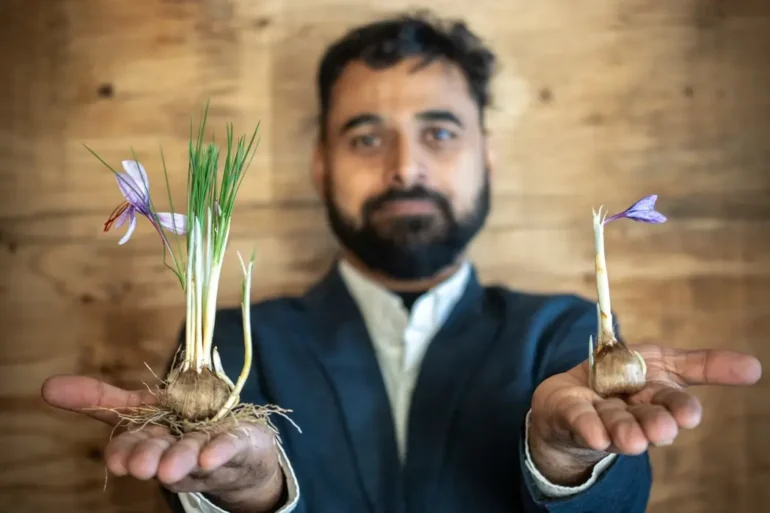
Vikash Sangwan spent too much time sitting behind a computer. Like so many young Indian expatriates, Sangwan came to Canada in the 2010s looking to advance his career. An engineer by trade, he entered through Canada’s Federal Express Entry program and later landed a nine-to-five at one of the Big Four consulting agencies. But after years of working a desk job, Sangwan was desperate for change.
Today, Sangwan’s working environment is split between the glassy towers of Calgary, where he continues to work as a consultant with KWA Analytics, and a rustic, retrofitted barn in the neighbouring foothills. It’s there that Sangwan tends to more than 40,000 saffron bulbs that make up the inventory for his startup, Saffron Box.
Vikash Sangwan,
“We want early investors and ecosystem partners to see that our [technology is] thoroughly proven before deploying at commercial scale.”
Saffron Box
Pound for pound, Saffron is the most expensive spice in the world. It routinely sells for as much as $18,000 USD ($25,000 CAD) per kilogram on the wholesale market. To contextualize that, cocaine retails wholesale in Canada for around $18,000 per kilogram.
While saffron’s not an illegal substance, its supply chain is similarly fraught. Global supply is heavily concentrated, with around 90 percent of saffron originating from Iran. Secondary markets—the largest among them India and Afghanistan—have in recent years declined amid climate-change-induced droughts, driving up prices even further.
Sangwan’s Saffron Box is hoping to capitalize on that market scarcity, while also changing it.
Canadian-grown saffron
Founded in February 2026, Saffron Box is using vertical farming techniques and climate controls to attempt to replicate the precision horticulture required to grow the infamously fickle plant. In doing so, Sangwan hopes to create a whole new market stream for saffron right here in Canada.
Saffron Box is still very much an early-stage company. A husband-and-wife team, the company has no commercial customers. Instead, Sangwan is focused on research and development.
“Three years ago I tried growing corms [the garlic-like bulbs from which the saffron flower grows] in a basement grow tent and completely failed. Last year, I upgraded to a custom walk-in cooler in my residential garage. Now, we’ve scaled up to the barn level specifically to prove out the commercial ROI and unit economics,” Sangwan told BetaKit.
Cultivated from the saffron crocus flower, saffron grows in an inverted lifecycle, blooming in the autumn, producing foliage throughout the winter, and going dormant in the summer. In order to harvest the stigmas—the waxy portion of a saffron flower’s female reproductive system—that constitute the spice, precise conditions need to be met. In nature, those conditions are only found along a narrow stretch of geography with Mediterranean-like weather.
“In nature, Saffron breaks its summer dormancy only when prompted by a specific sequence of autumnal climate shifts,” Sangwan told BetaKit in an email.
That actually makes growing the spice outside of its natural harvest season more difficult in hot places like Iran, where growers need to invest in expensive cooling systems to produce multiple harvests throughout the year.

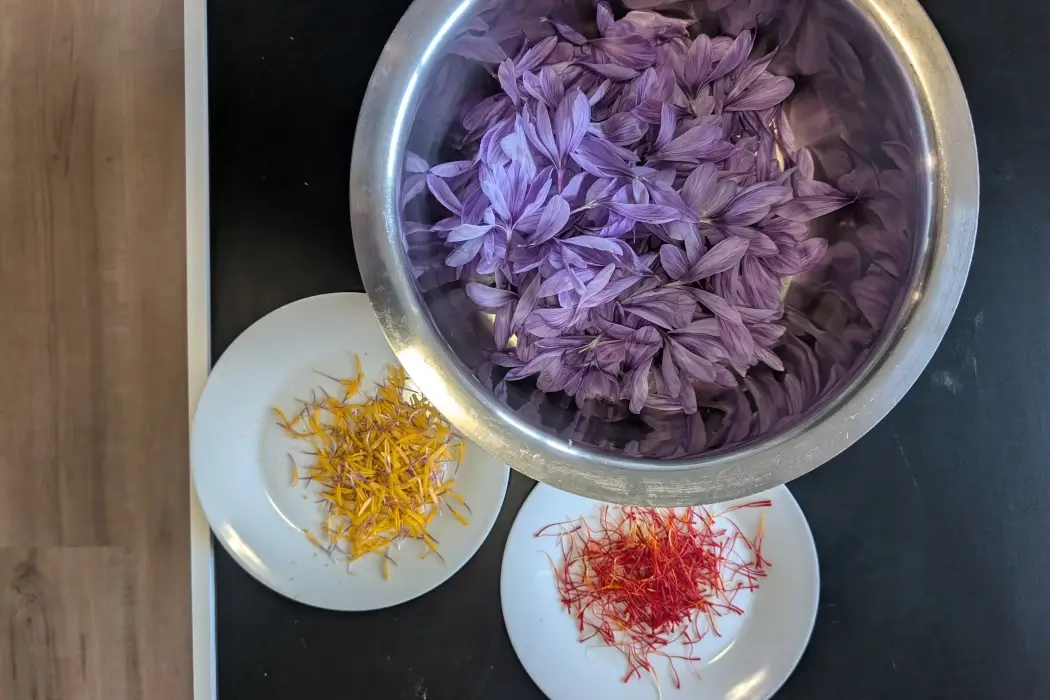
Images courtesy Saffron Box
Inside his barn, Sangwan is leveraging the brisk Alberta weather to avoid those costs.
“By mid-October, Canadian ambient outdoor temperature naturally matches the thermal profile required for floral induction,” Sangwan said.
Sangwan has set up an industrial air-handling unit to circulate that October air into the barn, keeping the temperature at the eight to 10 degrees Celsius needed to trigger saffron flowering. He pairs that with a hydronic boiler system (a heating device using heated, closed-loop water) that can supply targeted heat to counteract cooler winter temperatures that would otherwise destabilize the microclimate.
Sangwan cultivates his saffron corms without soil, meaning they can be stacked by the tens of thousands along vertical farming shelves, where they’re helped along the growth cycle with specialized light arrays and moisture monitoring.
“Throughout the transition, sensor arrays continuously monitor ambient temperature and moisture to maintain relative humidity,” Sangwan said. “When the flowers emerge, we deploy spectrum-tuned LED [lights] with targeted ratios of blue-to-red light.”
Big dreams start small
Ultimately, Sangwan hopes to commercialize his saffron farm. The founder envisions a future where Saffron Box’s product is grown in insulated, trailer-pod vertical farms capable of producing multiple yields per year regardless of the season.
“By controlling the climate … and staggering dormant batches, we [could] achieve up to four harvests per year rather than a single seasonal bloom,” he said.
Sangwan sees a future where these farm pods could be franchised out to independent growers nationwide, serving as a foundation for Canada to transition from saffron importer to exporter.
RELATED: After 15 years, GoodLeaf proves there’s profit in vertical farming
“Deploying this modular fleet would not only satisfy North American [saffron] consumption, but it would position Canada as a premier exporter,” he said.
That dream is, admittedly, quite a way off. While Sangwan claims to have secured at least one of the 53-foot trailers he hopes to convert to a vertical farming facility, he has not yet physically retrofitted it nor validated its ability to match the precision climatics present in his barn model, nor the economic viability of franchising said pods.
To do that, the 36-year-old entrepreneur would need some serious capital. He’s not there yet, but said the company is actively seeking pre-seed investment. “Physical fabrication is our immediate milestone, which our open pre-seed capital raise is structured to fund,” Sangwan said.
A/B testing
Just because Saffron Box isn’t ready to begin franchising out vertical farms doesn’t mean the company isn’t making efforts to expand beyond its current footprint. Sangwan has secured an outdoor plot of land in British Columbia’s Fraser Valley—which he says is about as close to the ideal climate for saffron as one can find outdoors in Canada—where he’s propagating another 20,000 saffron plants using traditional methods. The plan, he says, is to execute a comparative study between the indoor and outdoor yields.
“Running both parts simultaneously allows us to gather … the data and compare indoor, climate-controlled corm reproduction rates, sizing, and mortality, against traditional cultivation,” Sangwan said.
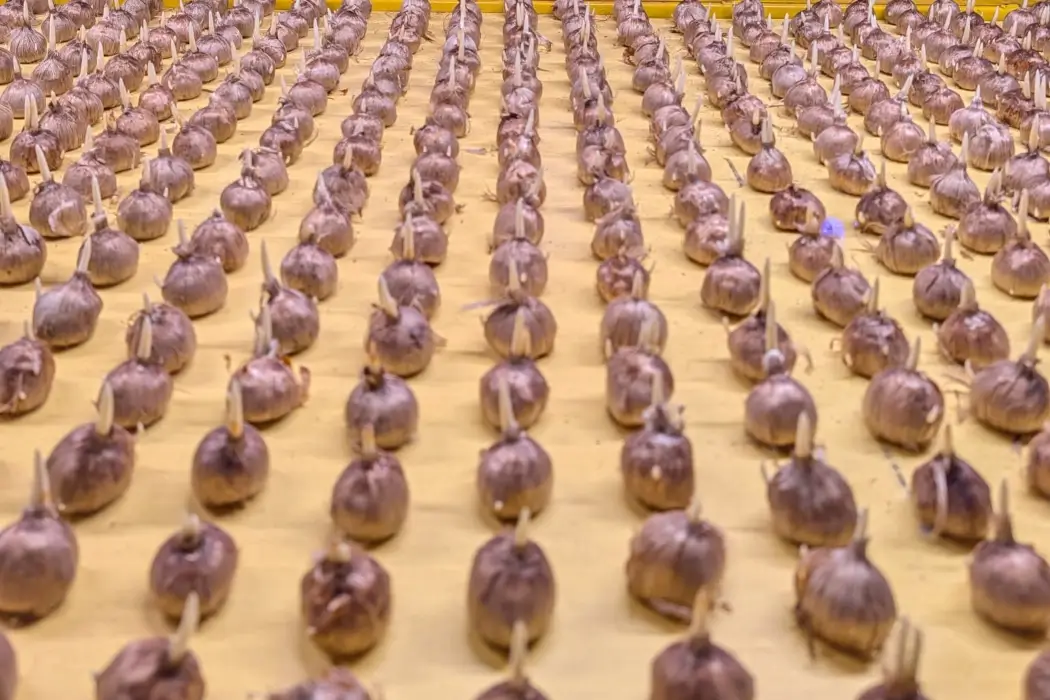
Sangwan is also in the midst of validating his multi-harvest thesis, staggering crop cycles through the year until June of 2027 in an effort to de-risk his business model. He hopes that by proving his methods, he might better attract the investors who could take his lofty dreams closer to reality.
“We want early investors and ecosystem partners to see that our biological triggers and CapEx models are thoroughly proven before deploying at commercial scale,” he said.
Some might say Saffron Box’s vision of Canada as a global saffron supplier is unrealistic. But so is the idea of growing saffron on the Canadian prairie in the first place. And so far, Sangwan’s been able to do just that.
BetaKit’s Prairies reporting is funded in part by YEGAF, a not-for-profit dedicated to amplifying business stories in Alberta.
Feature image courtesy of Saffron Box. Photo by Vikash Sangwan.