

Canada’s first national security strategy in more than two decades highlights the country’s technological strengths and vulnerabilities in an effort to sketch out a path to “true sovereignty.”
The 13-page strategy, titled The Plan for a Stronger Canada, released on Thursday, contained a broad summary of the government’s national security intentions rather than detailed guidance. A foreword from Prime Minister Mark Carney promises that leading Canadian technologies will be part of the “bedrock” of relationships that “promote a sovereign Canada and contribute to a more secure and prosperous world.”
The strategy lists frontier AI as a challenge that must be weathered, in the same way as “great power rivalries,” authoritarian aggression, climate change, and pandemics. To withstand those challenges, the strategy places emerging technologies as the first on a list of eight critical sectors Canada needs to build on. It states that those emerging technologies include cloud and AI compute, quantum computing, space-based communications and navigation, semiconductors, and telecommunications.
“Candidly, an investment like this today makes sure Canadians have control of our sovereign destiny, and sovereignty is a form of safety.”
AI Minister Evan Solomon
The strategy’s other strategic sectors are critical minerals, defence, energy, transportation, pharmaceuticals and biotech, food security, and financial systems.
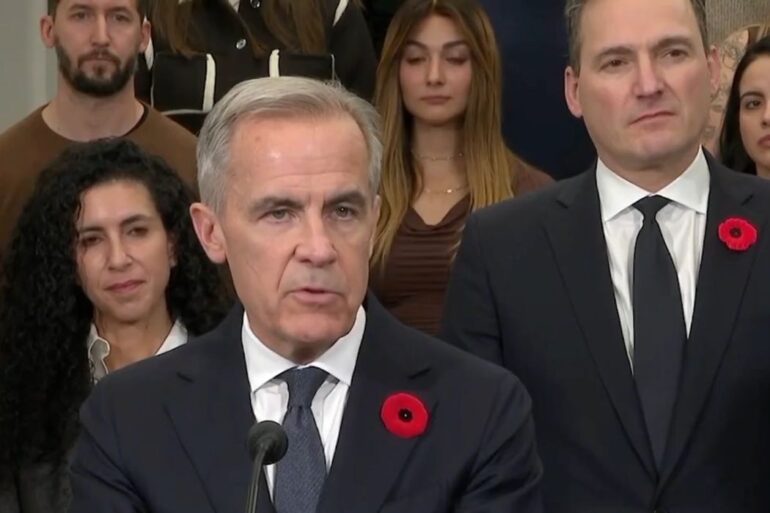
“Building these capabilities underpins our economic, foreign policy, and defence strategies,” Carney said in Montréal on Thursday. The national security strategy says that, where it can, Canada will build these strengths at home, and otherwise will partner with reliable, complementary allies to bring strength and scale.
To further this, the strategy pledges that the government will produce plans on nearly 40 policy points, many of which the government has already announced. Those include a buy Canadian policy, improving defence procurement, as well as a plan to “cement Canada as a major player in developing and commercializing advanced technologies,” including in AI, quantum computing, and space technology.
The strategy says Canada wants to strengthen its intelligence and security agencies like Communications Security Establishment Canada and the Canadian Security Intelligence Service (CSIS), and increase its contributions to the international Five Eyes intelligence partnership. It outlines plans to modernize Canada’s intelligence authorities to “reflect current threats and technologies,” improve its capability to detect foreign information manipulation, and invest in technologies like AI and secure cloud to improve intelligence processing.
Daniel Perry, the director of federal affairs at industry lobby group the Council of Canadian Innovators, said in a statement that the federal government has identified the right priorities, but raised concerns about the strategy’s lack of detail on intellectual property ownership or standards for the firms that would build the critical technologies outlined in the strategy.
RELATED: Feds to buy stake in Cohere via planned $7-billion Series E at $36-billion valuation
“Strategic autonomy depends on Canadian ownership,” Perry said. “If the technology and IP behind these capabilities are owned elsewhere, Canada’s dependence has simply moved onshore.”
The national security strategy continues the Carney government’s focus on improving Canada’s technological autonomy. Carney has remarked about pulling away from United States-controlled technologies like Starlink and, in 2026 alone, has rolled out a Defence Industrial Strategy and a refreshed AI strategy which both heavily emphasize sovereign technological capabilities.
Just as the national security strategy was revealed on Thursday, Carney also announced his government’s $1.6-billion investment in homegrown frontier AI developer Cohere, remarking that, “we are choosing to grow Canada’s technology future instead of someone else’s.”
“The new threat environment with cyber and AI is real,” AI minister Evan Solomon told BetaKit of the new national security strategy following the Cohere investment announcement. “Candidly, an investment like this today makes sure Canadians have control of our sovereign destiny, and sovereignty is a form of safety.”
As next steps, the prime minister plans to convene a First Ministers meeting on national security, and said that the federal government plans to bring forward a proposal to modernize national security legislation in the next year.
Feature image courtesy Mark Carney via X.
With files from Madison McLauchlan.